How to Add Fractions With Different Denominators
Add fractions with different denominators in four steps: common denominator, rewrite, add, simplify. Plus subtracting, dividing and repeating decimals.
By TheTextKit TeamPublished
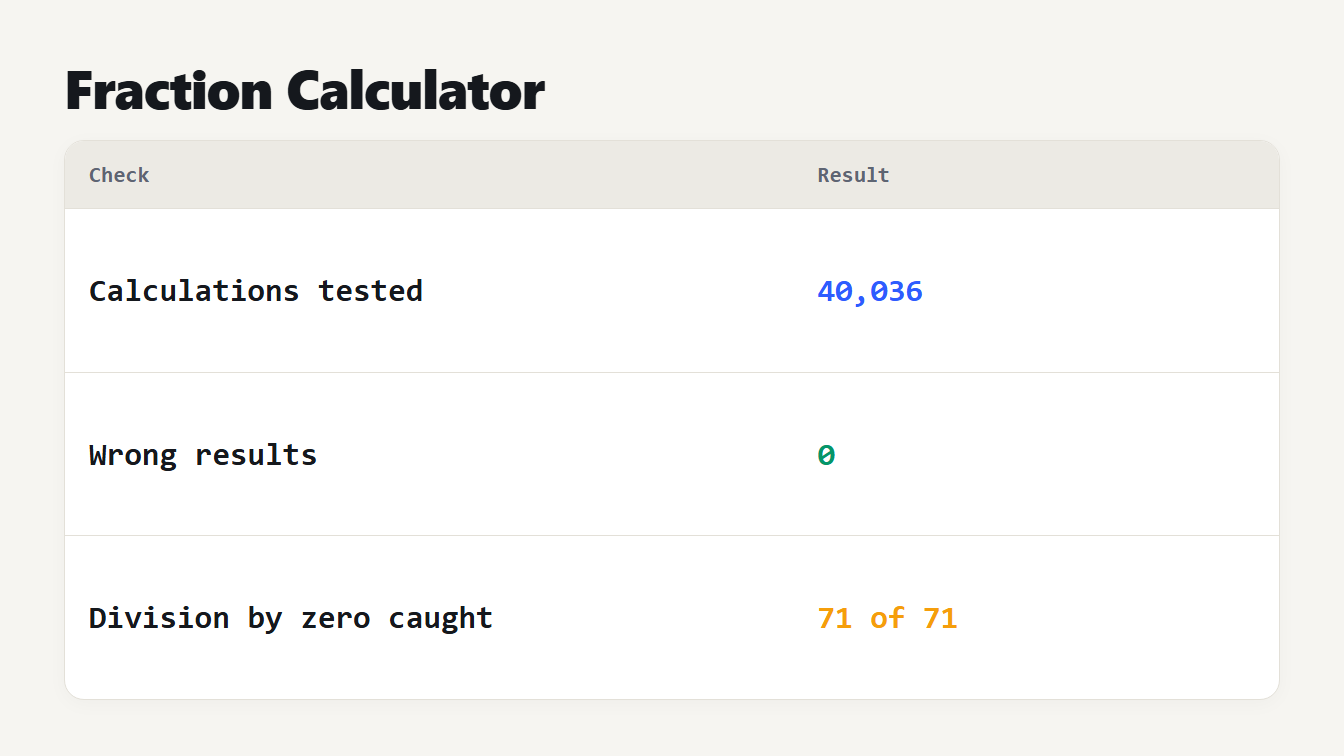
A table of three results for the fraction calculator. 40,036 calculations were compared with the Fraction type of Python. There were no wrong results. All 71 divisions by zero were caught.
To add fractions with different denominators, find a common denominator, usually the least common multiple of the two denominators. Rewrite each fraction over it, add the numerators, keep the denominator, and simplify. For 1/3 + 1/4 the common denominator is 12, so you add 4/12 + 3/12 and get 7/12. This guide shows the four steps, how to find the common denominator and the greatest common divisor by hand, how subtracting, multiplying and dividing differ, and when a fraction turns into a repeating decimal. We also compared our fraction calculator with Python on 40,036 calculations.
How to add fractions with different denominators
You cannot add the numerators of 1/3 and 1/4 directly, because thirds and quarters are pieces of different sizes. First cut both into the same size of piece.
- Find the least common multiple of the denominators. For 3 and 4 it is 12.
- Rewrite each fraction with that denominator. Multiply the top and the bottom by the same number: 1/3 becomes 4/12 and 1/4 becomes 3/12.
- Add the numerators and keep the denominator: 4/12 + 3/12 = 7/12.
- Simplify. The numbers 7 and 12 share no factor above 1, so 7/12 is done.
| Step | Example |
|---|---|
| Common denominator | 12 |
| Rewrite | 4/12 + 3/12 |
| Add the tops | 7/12 |
| Simplify | Already simple |
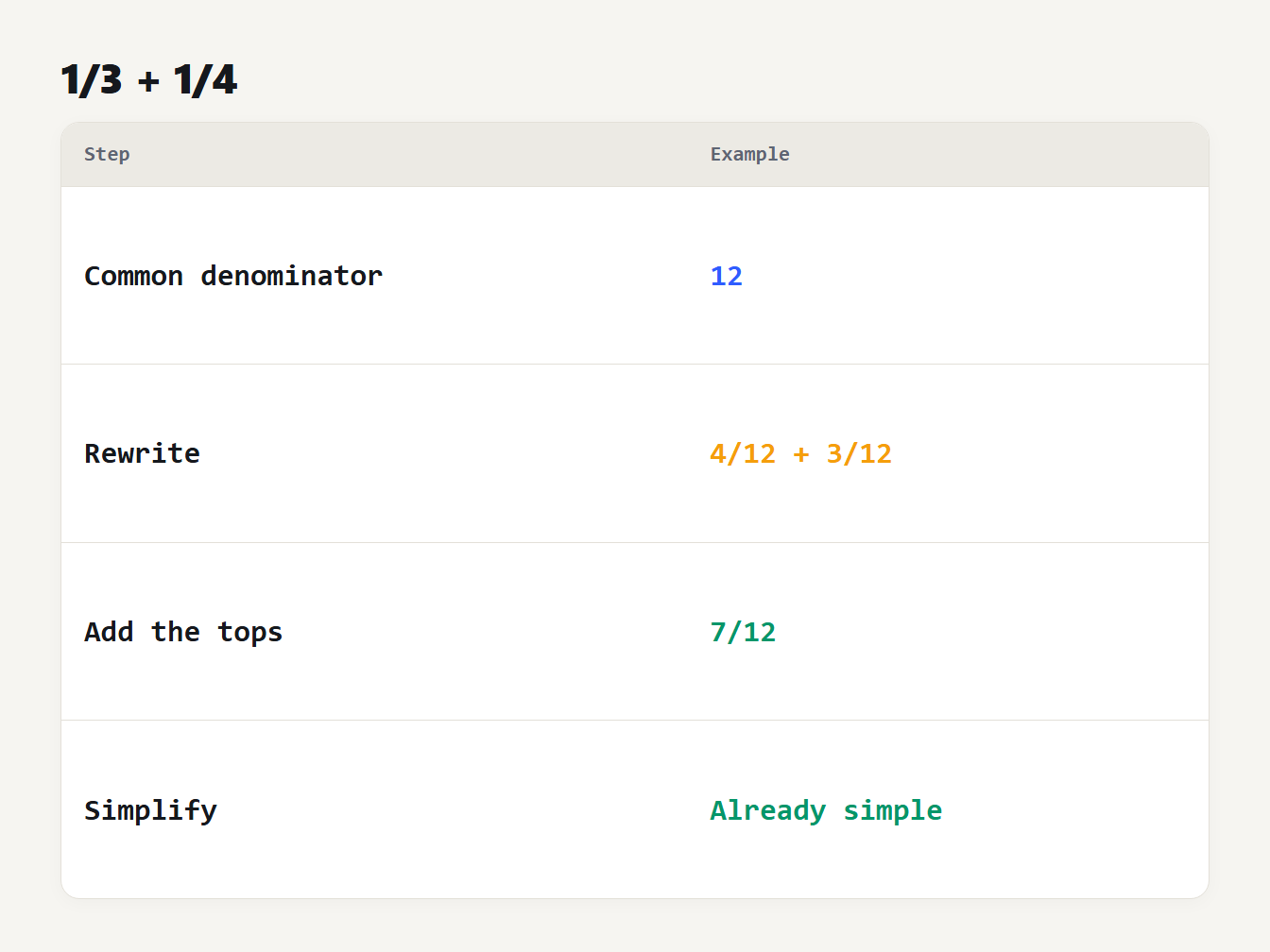
A table of the four steps for adding 1/3 and 1/4. The common denominator is 12. The fractions are rewritten as 4/12 and 3/12. Adding the tops gives 7/12. The result is already in lowest terms.
Here is one that needs a mixed number at the end: 5/6 + 3/8. The least common multiple of 6 and 8 is 24. Then 5/6 is 20/24 and 3/8 is 9/24, so the sum is 29/24. That is more than one whole, so write it as 1 5/24. You can check this and any other sum in the Fraction Calculator, which also shows the steps.
How to find the common denominator
The least common denominator is the least common multiple of the denominators. For small numbers, list the multiples of each until one repeats: 6, 12, 18, 24 and 8, 16, 24 meet at 24.
For bigger numbers, use the greatest common divisor, which is the largest number that divides both. The least common multiple of two numbers is their product divided by that divisor. For 12 and 18 the greatest common divisor is 6, so the least common multiple is 12 x 18 / 6 = 36. Then 5/12 + 7/18 becomes 15/36 + 14/36 = 29/36.
You are allowed to use any common multiple, such as 12 x 18 = 216. The sum comes out as 90/216 + 84/216 = 174/216, which simplifies to the same 29/36. The least common denominator just saves you the extra simplifying.
How to simplify a fraction
To simplify, divide the top and the bottom by their greatest common divisor. For 18/24 the divisor is 6, which gives 3/4. When the numbers are large, finding the divisor by eye is hard, so use the Euclidean algorithm. According to the Wikipedia article on the Euclidean algorithm, you repeatedly replace the larger number with its remainder after dividing by the smaller one, and the last nonzero remainder is the greatest common divisor. For 1071 and 462:
- 1071 = 2 x 462 + 147
- 462 = 3 x 147 + 21
- 147 = 7 x 21 + 0
The last nonzero remainder is 21, so 1071/462 simplifies to 51/22, because 1071 / 21 = 51 and 462 / 21 = 22.
Subtracting, multiplying and dividing fractions
Subtracting fractions with different denominators follows the same steps as addition. Find the common denominator, rewrite, and subtract the numerators. So 1/2 minus 3/4 is 2/4 minus 3/4, which is -1/4.
Multiplication needs no common denominator. Multiply the numerators, multiply the denominators, and simplify. A mixed number goes first: 2 1/2 is 5/2, so 2 1/2 x 3/4 is 15/8, which is 1 7/8 or 1.875.
Division is multiplication by the flipped fraction. 1/2 divided by 1/4 is 1/2 x 4/1 = 4/2 = 2. You cannot divide by a fraction whose numerator is zero.
| Operation | Example | Result |
|---|---|---|
| Add | 1/3 + 1/4 | 7/12 |
| Subtract | 1/2 minus 3/4 | -1/4 |
| Multiply | 2 1/2 x 3/4 | 15/8 or 1 7/8 |
| Divide | 1/2 divided by 1/4 | 2 |
Common mistakes
The most common error when you add fractions with different denominators is to add the tops and the bottoms: 1/2 + 1/3 is not 2/5. A half and a third are different sizes, so the pieces have to be rewritten first. The correct sum is 5/6.
The second is to stop too early. 1/4 + 1/4 is 2/4, but the answer you want is 1/2. The third is to multiply when you should flip: 1/2 divided by 1/4 is 2, and the 1/8 you get by multiplying straight across answers a different question.
| Sum | Common wrong answer | Right answer |
|---|---|---|
| 1/2 + 1/3 | 2/5 | 5/6 |
| 1/4 + 1/4 | 2/4 | 1/2 |
| 1/2 divided by 1/4 | 1/8 | 2 |
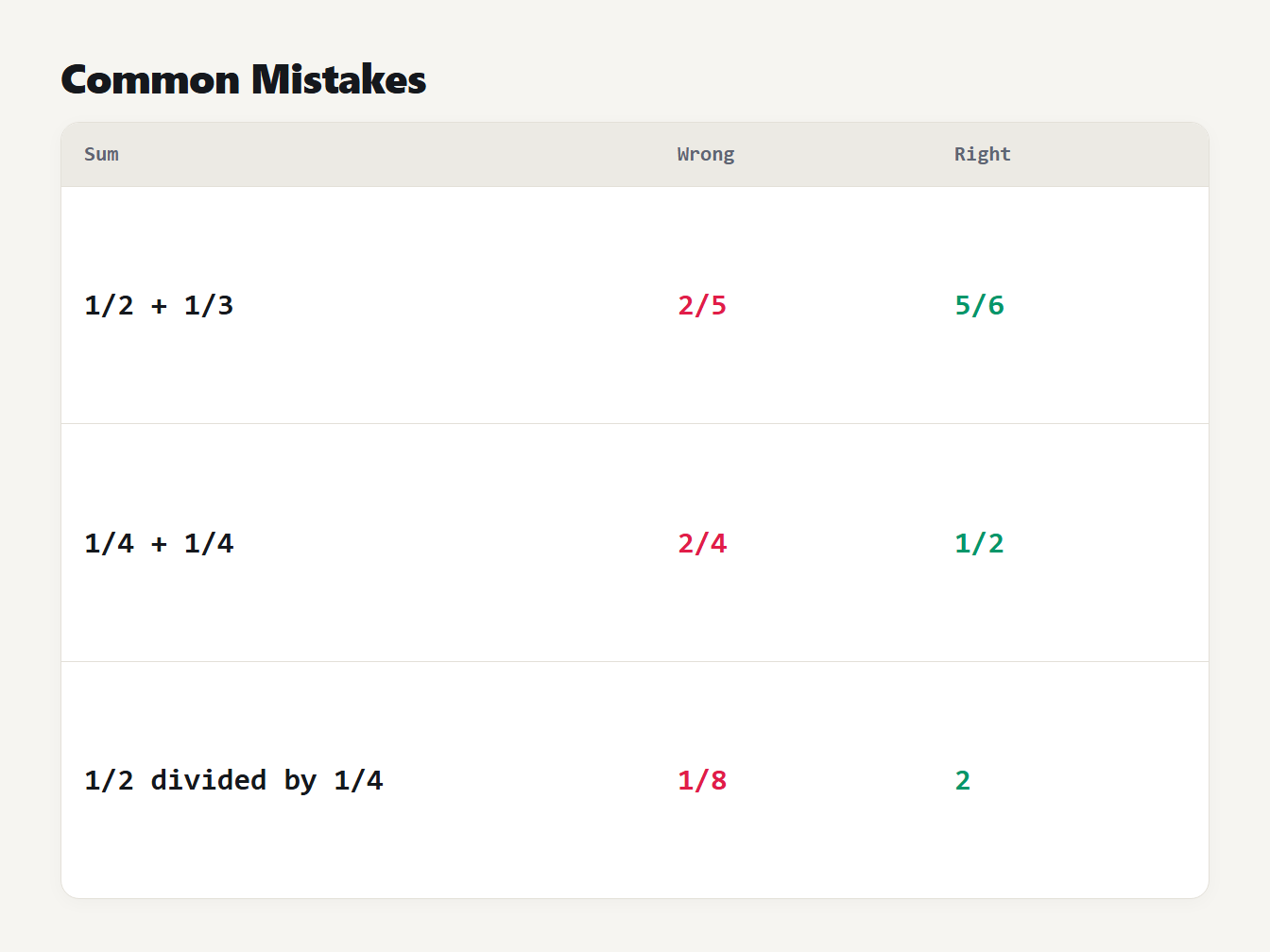
A table of three fraction sums with a common wrong answer and the right answer. 1/2 + 1/3 is 5/6, not 2/5. 1/4 + 1/4 is 1/2, not 2/4. 1/2 divided by 1/4 is 2, not 1/8.
Negative mixed numbers also trip people up. In the calculator, -2 1/2 means minus two and a half, the minus applies to the whole number, and the fraction part must be smaller than its denominator, so 1 5/2 is rejected.
When a fraction is a repeating decimal
Divide the top by the bottom to turn a fraction into a decimal. Some fractions end, and some repeat forever. According to the Wikipedia article on repeating decimals, a fraction in lowest terms has a repeating decimal if and only if its denominator has a prime factor other than 2 and 5. The same article says the repeating block of 1/k is never longer than k minus 1 digits.
We write the repeating digits in brackets. A calculator cannot print infinity, so 1/6 is 0.1(6), which means 0.1666 and so on.
| Fraction | Decimal | Fraction | Decimal |
|---|---|---|---|
| 1/2 | 0.5 | 1/9 | 0.(1) |
| 1/3 | 0.(3) | 1/10 | 0.1 |
| 1/4 | 0.25 | 1/11 | 0.(09) |
| 1/5 | 0.2 | 1/12 | 0.08(3) |
| 1/6 | 0.1(6) | 1/13 | 0.(076923) |
| 1/7 | 0.(142857) | 1/14 | 0.0(714285) |
| 1/8 | 0.125 | 1/16 | 0.0625 |
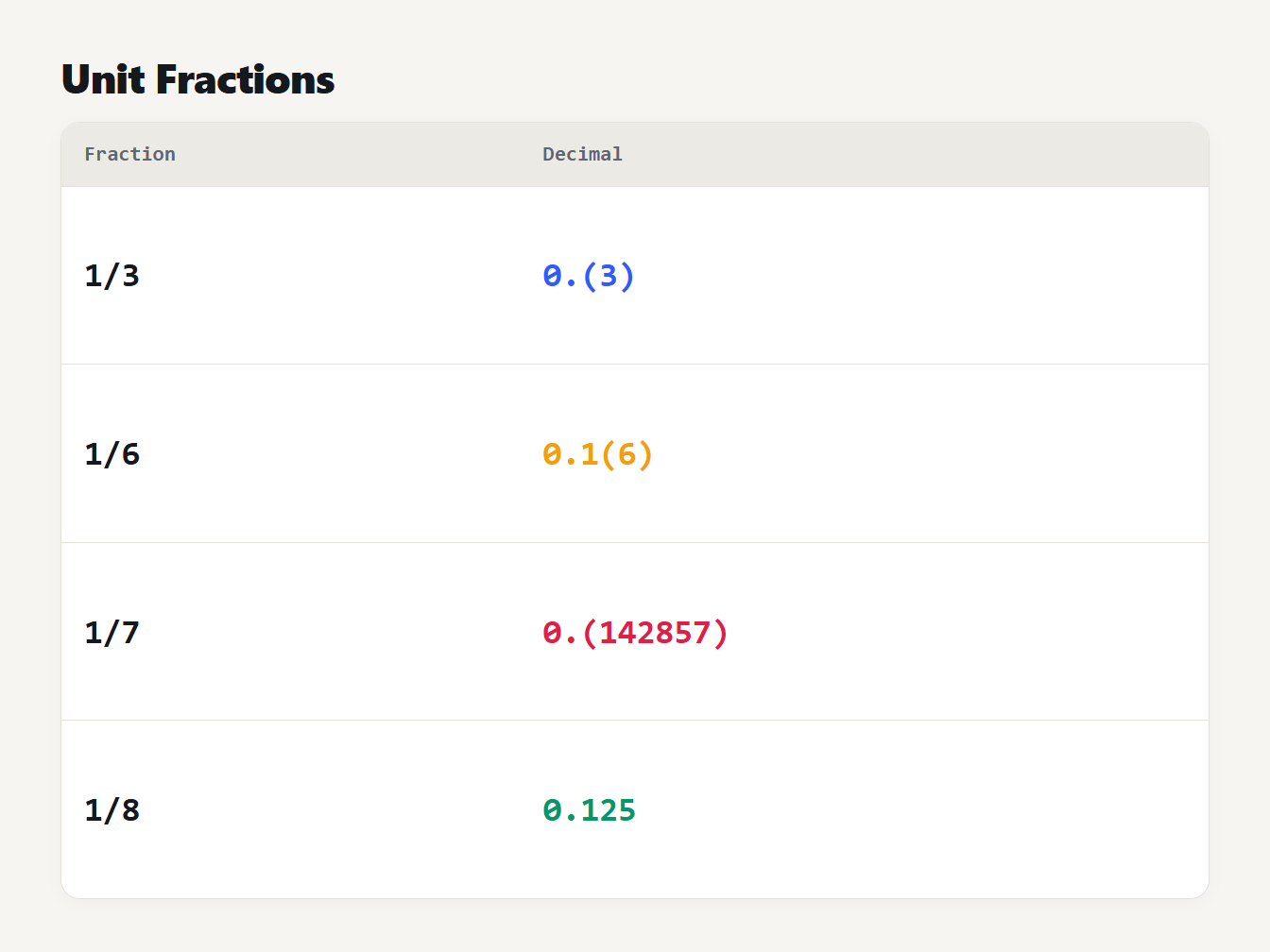
A table of four unit fractions and their decimals. 1/3 is 0.(3). 1/6 is 0.1(6). 1/7 is 0.(142857). 1/8 is 0.125, which ends. The digits in brackets repeat forever.
The pattern is visible: 2, 4, 5, 8, 10 and 16 end, while 3, 6, 7, 9, 11, 12, 13 and 14 repeat. A 7 in the denominator gives six repeating digits, which is the longest block that 1/7 could have.
How we tested the fraction calculator
We compared the calculator with the Fraction type in Python, which does exact arithmetic with whole numbers. A script generated 40,036 calculations: fractions, mixed numbers, decimals and whole numbers, positive and negative, from tiny to 30 digits long, with each of the four operations and with simplify. For every one, Python gave the reduced fraction. We wrote the mixed number and the decimal with separate code in Python and compared those too.
The decimals did not come from Python's division. They were worked out by a different route, from the length of the repeating block of each denominator, so the tool's long division was checked against a separate method. The working shown in the steps was read too, and the unreduced result it states had the same value as the answer.
| Result | Count |
|---|---|
| Calculations tested | 40,036 |
| Exact results that matched | 39,965 |
| Terminating decimals | 10,561 |
| Repeating decimals with the block shown in brackets | 17,865 |
| Repeating decimals too long to show in full | 11,539 |
| Divisions by zero that were rejected | 71 |
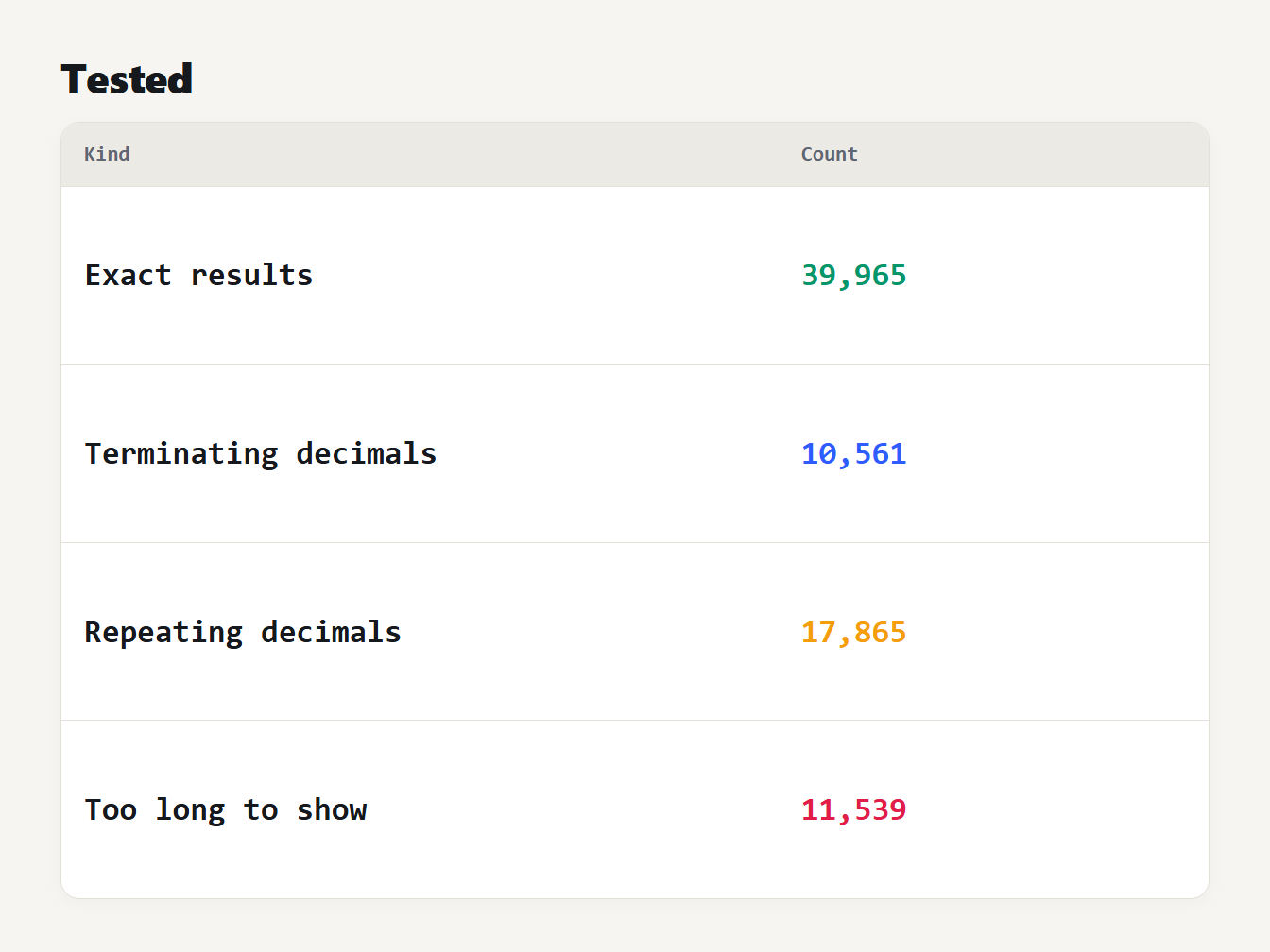
A table of how the 39,965 results of the fraction calculator divide. All 39,965 matched Python. 10,561 were terminating decimals, 17,865 were repeating decimals shown with a bracket, and 11,539 repeated too long to show in full.
There were no mismatches. The 11,539 cases that repeat too long are mostly fractions with huge denominators, where the repeating block can be thousands of digits long. The tool then prints the first 40 digits followed by three dots, and says so, instead of showing a block it did not find.
Limits
The calculator reads fractions, mixed numbers, decimals and whole numbers of up to 100 digits. It does not read repeating decimals like 0.(3) as input, and it does not accept commas, because 1,5 could mean a decimal comma or a typo. Results are exact, never rounded. If you need a rounded decimal, take it from the decimal line and round it yourself.
Frequently asked questions
How do you add fractions with different denominators?
Find a common denominator, usually the least common multiple of the two denominators. Rewrite each fraction over it, add the numerators, keep the denominator, and simplify. For 1/3 + 1/4 the common denominator is 12, so you add 4/12 + 3/12 and get 7/12.
Do I have to use the least common denominator?
No. Any common multiple works, such as the product of the two denominators. The answer is the same once you simplify, but the numbers are bigger. The least common denominator keeps them small and often needs no simplifying.
How do you simplify a fraction?
Divide the numerator and the denominator by their greatest common divisor. For 18/24 the greatest common divisor is 6, so the fraction is 3/4. If the greatest common divisor is 1, the fraction is already in lowest terms.
How do you subtract, multiply and divide fractions?
Subtract the same way you add: common denominator first, then subtract the numerators. To multiply, multiply the numerators and the denominators. To divide, multiply by the flipped second fraction, so 1/2 divided by 1/4 is 1/2 times 4/1, which is 2.
Which fractions have repeating decimals?
A fraction in lowest terms repeats if its denominator has a prime factor other than 2 or 5. So 1/8 is 0.125 and 1/5 is 0.2, while 1/3 is 0.333... and 1/7 is 0.142857142857... A decimal written with a bracket, such as 0.1(6), repeats the digits in the bracket.
Add your fractions now
Enter two fractions into the Fraction Calculator to add, subtract, multiply or divide them, simplify a single fraction, and see the steps. For averages and percentages, try the Mean, Median and Mode Calculator and the Percentage Calculator. Everything runs in your browser, so nothing you type is uploaded.