How to Convert Celsius to Fahrenheit (and Back)
Convert Celsius to Fahrenheit with one formula, and back again. Learn why 98.6 F is exactly 37 C, where the scales meet, and how absolute zero limits both.
By TheTextKit TeamPublished
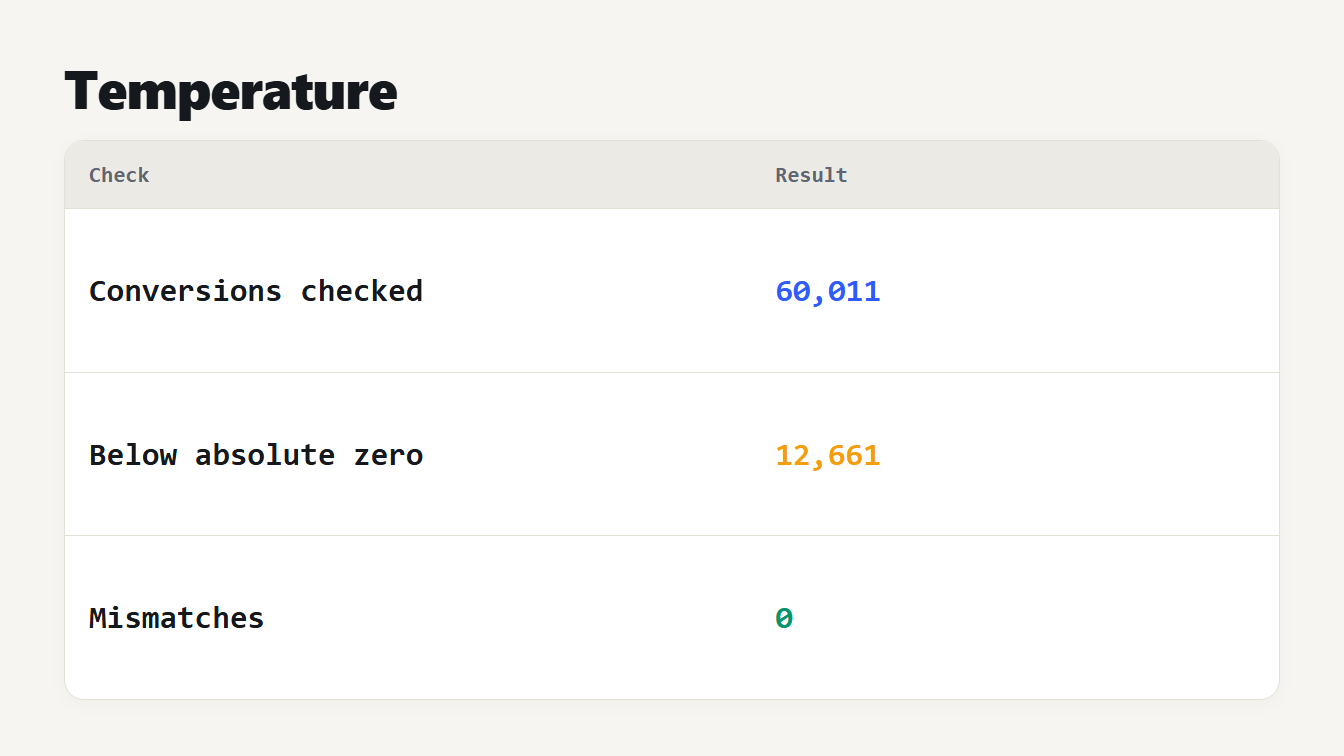
A table of three results for the temperature converter. 60,011 conversions were compared with Python's exact Fraction and Decimal types. 12,661 of them were below absolute zero and were rejected. There were 0 mismatches.
To convert Celsius to Fahrenheit, multiply by 9/5 (that is, 1.8) and add 32. So 20 degrees Celsius is 20 × 1.8 + 32 = 68 degrees Fahrenheit. To go back, subtract 32 and multiply by 5/9. This guide shows why the formula has that shape, where the two scales meet, how Kelvin fits in, and why a plain calculator can give you 36.99999999999999 when the answer is 37. We also checked our own converter on 60,011 conversions.
The Celsius to Fahrenheit formula
Both scales measure heat, but they start in different places and use different step sizes. Celsius puts 0 at the freezing point of water and 100 at its boiling point, a gap of 100 degrees. Fahrenheit puts those same two points at 32 and 212, a gap of 180 degrees. So one Celsius degree is 180/100 = 9/5 of a Fahrenheit degree, and the zero points are 32 degrees apart.
That is the whole formula. Scale the size of the step by 9/5, then shift by 32:
| To convert | Formula |
|---|---|
| Celsius to Fahrenheit | F = C × 9/5 + 32 |
| Fahrenheit to Celsius | C = (F − 32) × 5/9 |
| Celsius to Kelvin | K = C + 273.15 |
| Fahrenheit to Rankine | R = F + 459.67 |
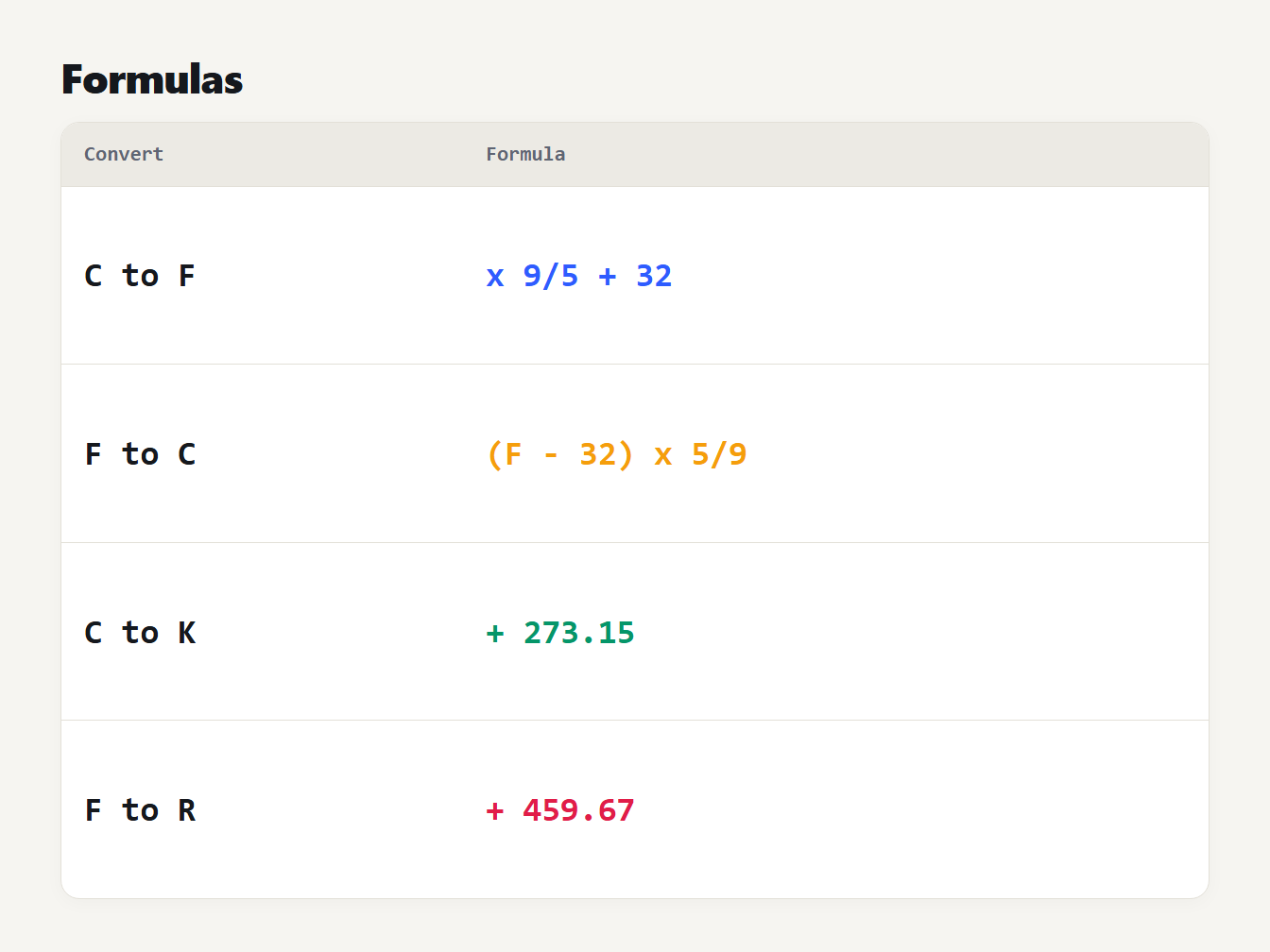
A table of four temperature conversions. Celsius to Fahrenheit multiplies by 9/5 and adds 32. Fahrenheit to Celsius subtracts 32 and multiplies by 5/9. Celsius to Kelvin adds 273.15. Fahrenheit to Rankine adds 459.67.
Notice the order of operations. Going up, you multiply first and then add. Going down, you subtract first and then multiply. Swapping them is the most common mistake: (100 × 9/5) + 32 is 212, but 100 + 32 × 9/5 is 157.6, which is nonsense for boiling water.
Worked examples
Take 25 degrees Celsius, a warm day. Multiply by 1.8 to get 45, then add 32 to get 77 degrees Fahrenheit.
Now go the other way with 50 degrees Fahrenheit. Subtract 32 to get 18, multiply by 5 to get 90, and divide by 9 to get 10 degrees Celsius. Doing the multiplication by 5 and the division by 9 as separate steps avoids a long decimal such as 0.5555 along the way. If you want to keep fractions exact, the Fraction Calculator handles 5/9 without rounding.
Where the two scales meet
Because the step sizes differ, there is one temperature where the two scales agree. Set C = F in the formula and solve: C = 1.8C + 32, so −0.8C = 32, and C = −40. At −40 degrees both thermometers read the same number. It is the only such point, and it makes a handy check: converting −40 either way must give −40 back.
The more famous pair is normal body temperature. The value 98.6 degrees Fahrenheit is commonly quoted, and it converts to exactly 37 degrees Celsius: 98.6 − 32 = 66.6, and 66.6 × 5/9 = 37. Nothing is rounded, which makes it a good test case for any converter, including ours.
Celsius, Kelvin and absolute zero
Kelvin is the SI unit of temperature, and it is the same size as the Celsius degree. NIST says one Celsius degree equals an interval of one kelvin, and that zero degrees Celsius is 273.15 K. So to go from Celsius to Kelvin you add 273.15, and the other way you subtract it. No multiplying is needed, because the two scales have the same step size.
Zero kelvin is absolute zero, which NIST describes as the coldest possible temperature. On the other scales it sits at −273.15 degrees Celsius and −459.67 degrees Fahrenheit. The Rankine scale has Fahrenheit-sized degrees that also start at absolute zero, so R = F + 459.67.
Since nothing can be colder than absolute zero, a temperature below it is not a real temperature at all. Our converter rejects it with an explanation instead of printing a number.
| Point | Celsius | Fahrenheit | Kelvin |
|---|---|---|---|
| Absolute zero | −273.15 | −459.67 | 0 |
| Same on both scales | −40 | −40 | 233.15 |
| Water freezes | 0 | 32 | 273.15 |
| Normal body temperature | 37 | 98.6 | 310.15 |
| Water boils | 100 | 212 | 373.15 |
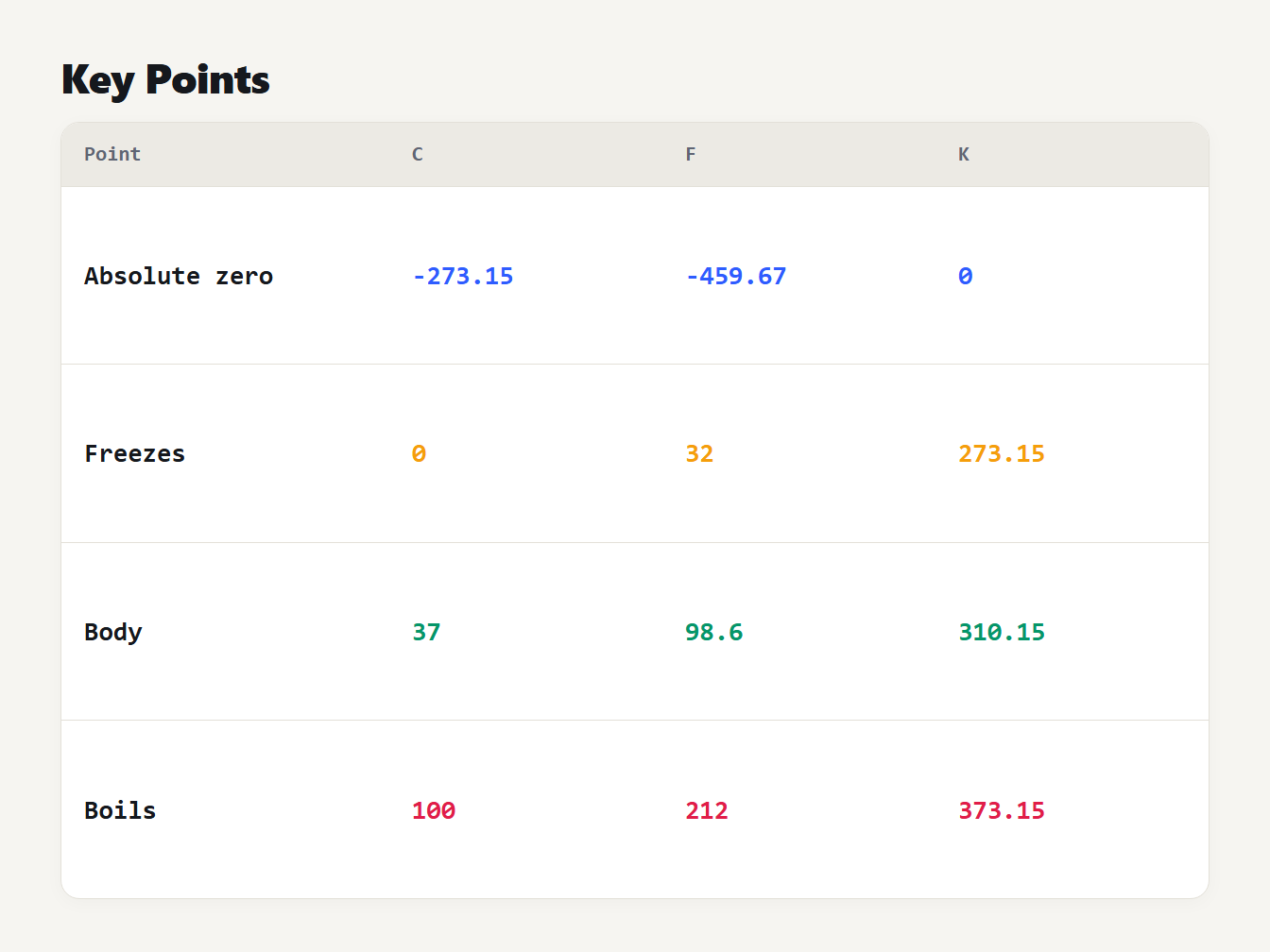
A table of four key temperatures in Celsius, Fahrenheit and Kelvin. Absolute zero is minus 273.15 C, minus 459.67 F and 0 K. Water freezes at 0 C, 32 F and 273.15 K. Normal body temperature is 37 C, 98.6 F and 310.15 K. Water boils at 100 C, 212 F and 373.15 K.
The double and add 30 shortcut
Many people estimate Celsius to Fahrenheit by doubling the number and adding 30. It works because 2 is close to 1.8 and 30 is close to 32. How close depends on the temperature, because the error grows with every degree away from 10:
| Celsius | Double and add 30 | Exact | Off by |
|---|---|---|---|
| 0 | 30 | 32 | 2 too low |
| 10 | 50 | 50 | exact |
| 20 | 70 | 68 | 2 too high |
| 30 | 90 | 86 | 4 too high |
| 37 | 104 | 98.6 | 5.4 too high |
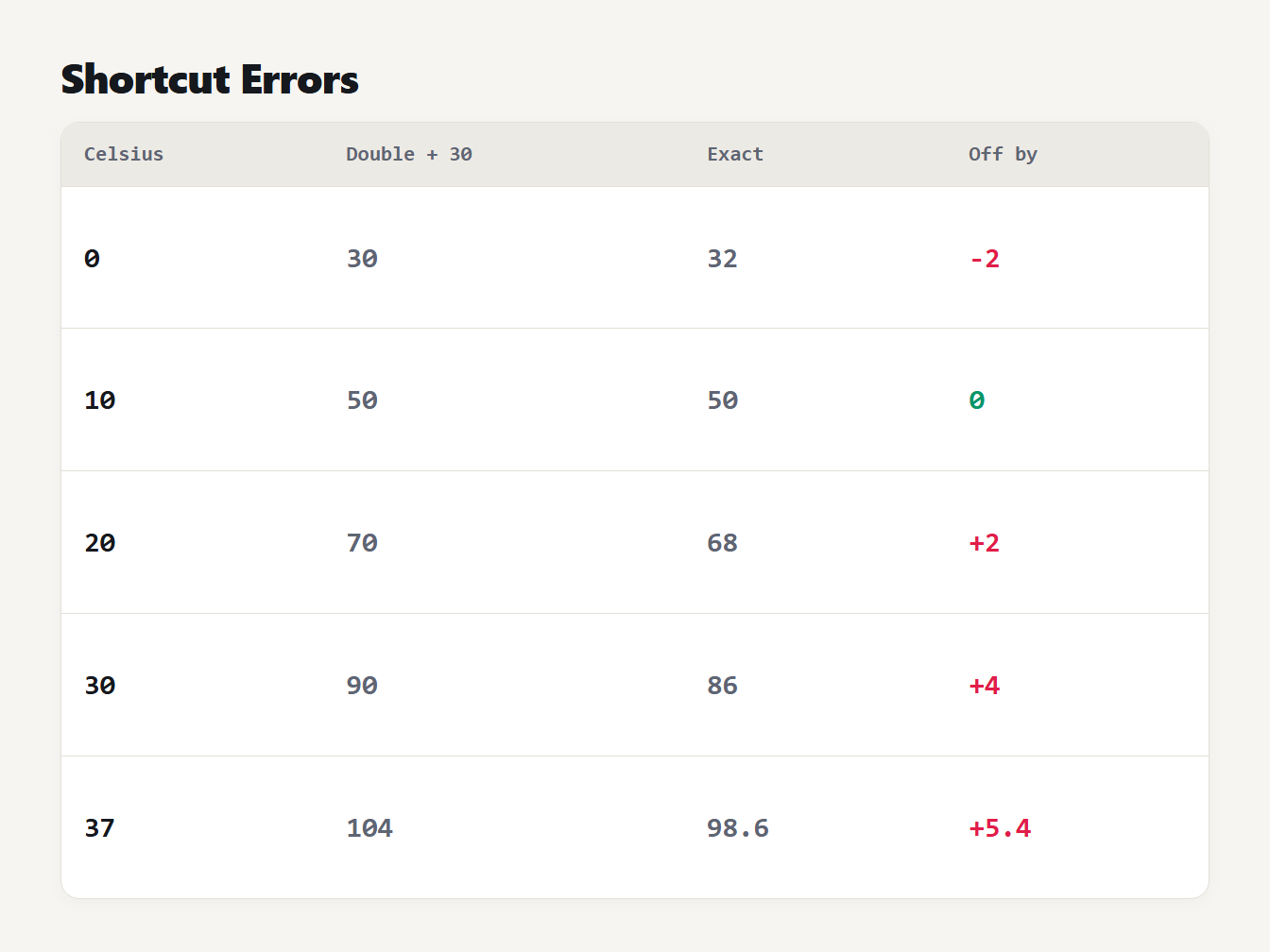
A table comparing the double and add 30 shortcut with the exact conversion. At 0 C it is 2 degrees too low. At 10 C it is exact. At 20 C it is 2 too high, at 30 C it is 4 too high and at 37 C it is 5.4 too high.
The error is exactly 0.2 × C − 2, so it is zero at 10 and grows by 0.2 for each degree. That is fine for deciding on a jacket. It is a poor tool for a fever, an oven or a lab, where a 5 degree miss changes the meaning. For those, use the real formula or the Temperature Converter.
Why calculators sometimes give 36.99999999999999
Computers store most decimal numbers as binary fractions, and 1.8 and 0.1 have no exact binary form. A conversion written with them picks up tiny errors. In JavaScript, (98.6 − 32) × 5/9 gives 36.99999999999999 instead of 37, and 37 × 1.8 + 32 gives 98.60000000000001 instead of 98.6. The value 30.3 degrees Celsius comes out as 86.53999999999999 instead of 86.54.
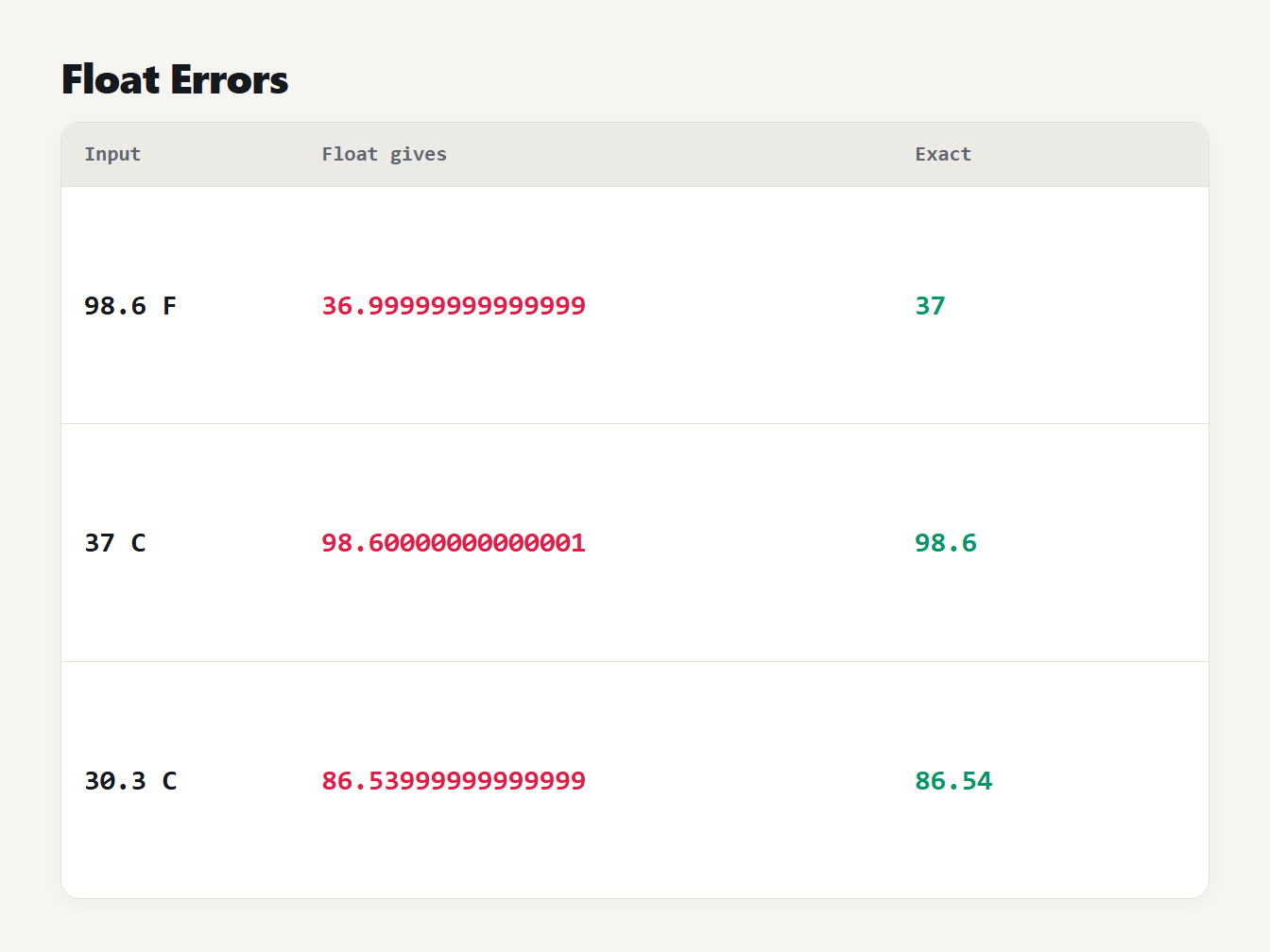
A table of three conversions where plain floating point arithmetic in JavaScript gives a result with a tiny error. 98.6 F gives 36.99999999999999 C instead of 37. 37 C gives 98.60000000000001 F instead of 98.6. 30.3 C gives 86.53999999999999 F instead of 86.54.
The errors are harmless to a weather app, but they look wrong and they break equality checks. Our converter avoids them by using exact fractions: 9/5 and 5/9 are whole-number ratios, and 273.15 and 459.67 are stored as 27,315/100 and 45,967/100. It rounds only once, at the end, to the number of decimals you choose, and it says when a result was rounded. This follows the same idea as Python's Fraction type, which keeps every number as a ratio of two whole numbers.
How we checked the converter
We wrote an independent version in Python using its Fraction and Decimal types, and compared it with the converter on 60,011 random temperatures. Each one started in a random unit, was shown in all four, and was rounded to 0, 1, 2, 3, 4 or 8 decimals. Some had up to nine digits after the point. Of those temperatures, 12,661 were below absolute zero, and both programs agreed to reject them. Every other result matched, so there were 0 mismatches.
The rounding rule matters at the edge: halves round away from zero, so 2.5 becomes 3 and −2.5 becomes −3, and a tiny negative number such as −0.004 shows as 0.00, never −0.00.
What to remember
For everyday conversions you need two formulas and two numbers. Celsius to Fahrenheit is multiply by 1.8 and add 32. Fahrenheit to Celsius is subtract 32 and multiply by 5/9. The scales meet at −40, and 98.6 degrees Fahrenheit is exactly 37 degrees Celsius. For Kelvin, just add 273.15 to Celsius, and nothing can go below 0 K.
Limits
The converter handles the four scales above and nothing else: it doesn't do Réaumur or Delta, for example. The inputs are plain numbers with up to 15 digits before the point and nine after it, and no unit suffix, so type 36.6 and choose the unit from the list. Results are rounded to at most eight decimals.
Frequently asked questions
How do I convert Celsius to Fahrenheit?
Multiply the Celsius value by 9/5, which is 1.8, and add 32. So 100 degrees Celsius is 100 times 1.8 plus 32, which is 212 degrees Fahrenheit. To go back, subtract 32 and multiply by 5/9.
At what temperature are Celsius and Fahrenheit the same?
At minus 40. Put minus 40 into either formula and you get minus 40 back. It is the only temperature where the two scales show the same number.
How do I convert Celsius to Kelvin?
Add 273.15. So 0 degrees Celsius is 273.15 K, and 100 degrees Celsius is 373.15 K. A change of one kelvin is the same size as a change of one degree Celsius, only the zero point is different.
What is absolute zero?
It is 0 K, which is minus 273.15 degrees Celsius or minus 459.67 degrees Fahrenheit, the lowest temperature there can be. The converter reports an error for anything below it.
Is the double and add 30 trick accurate?
Only near 10 degrees Celsius, where it is exact. At 20 degrees it gives 70 instead of 68, and at 37 degrees it gives 104 instead of 98.6, so it is fine for weather but not for a fever or a recipe.
Convert a temperature now
Open the Temperature Converter to see a value in Celsius, Fahrenheit, Kelvin and Rankine at once, with the decimals you choose. To keep 9/5 and 5/9 exact in your own working, use the Fraction Calculator, and for percentage changes between readings, the Percentage Calculator. Everything runs in your browser, so nothing you type is uploaded.