How to Calculate GPA: The Formula, Real Scales and a Target Plan
How to calculate GPA with one formula: quality points divided by credits. See real school scales, weighted GPA rules and how to reach a target GPA.
By TheTextKit TeamPublished
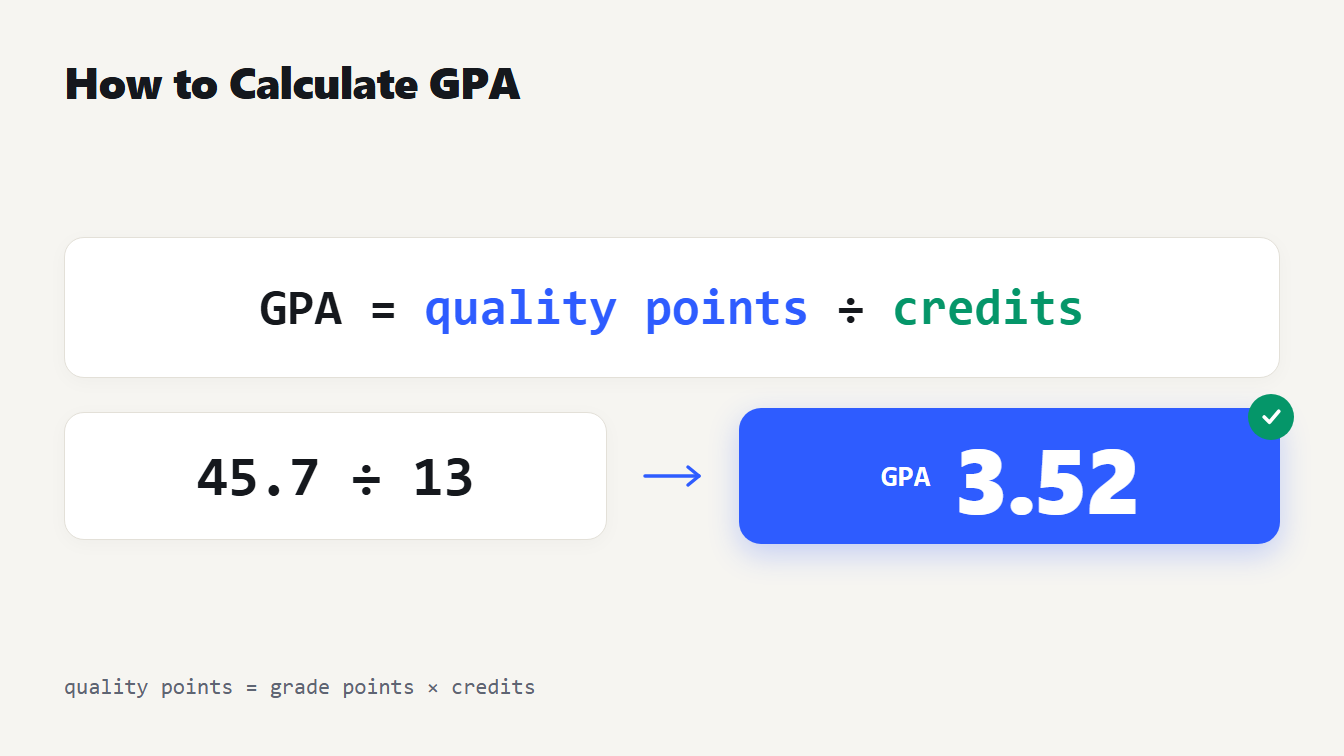
A formula card showing GPA equals total quality points divided by total credits, with an example of 45.7 quality points over 13 credits giving a 3.52 GPA.
How to calculate GPA: multiply each course's grade points by its credits to get quality points, add the quality points up, and divide by the total credits. Four courses worth 3, 3, 4 and 3 credits with grades A, B+, A- and B give 45.7 quality points over 13 credits, a GPA of 3.52. The catch is that schools use different grade point scales, so the same transcript can produce different GPAs. Here is the formula step by step, three real scales compared, how weighted and cumulative GPA work and how to find the semester GPA you need to reach a target.
How to calculate GPA step by step
The method is the same everywhere. Arizona State's registrar puts it plainly: multiply the grade point value by the semester hours to get honor points, add them, add the hours, and divide (ASU's GPA calculation rules). Rutgers School of Engineering describes the same three moves (Rutgers SoE's GPA guide).
- Convert each letter grade to grade points using your school's scale.
- Multiply by the credits to get quality points for each course.
- Add the quality points and add the credits.
- Divide quality points by credits. Round to two decimals if your school does: ASU rounds to the nearest hundredth.
Here is the worked example, on the common scale where A is 4.0, A- is 3.7, B+ is 3.3 and B is 3.0:
| Course | Grade | Grade points | Credits | Quality points |
|---|---|---|---|---|
| Course 1 | A | 4.0 | 3 | 12.0 |
| Course 2 | B+ | 3.3 | 3 | 9.9 |
| Course 3 | A- | 3.7 | 4 | 14.8 |
| Course 4 | B | 3.0 | 3 | 9.0 |
| Total | 13 | 45.7 |
The GPA is 45.7 ÷ 13 = 3.515, which rounds to 3.52. Notice that the 4 credit course counts more than the 3 credit ones. A course's weight in your GPA is its credits, not a vote of one per class.
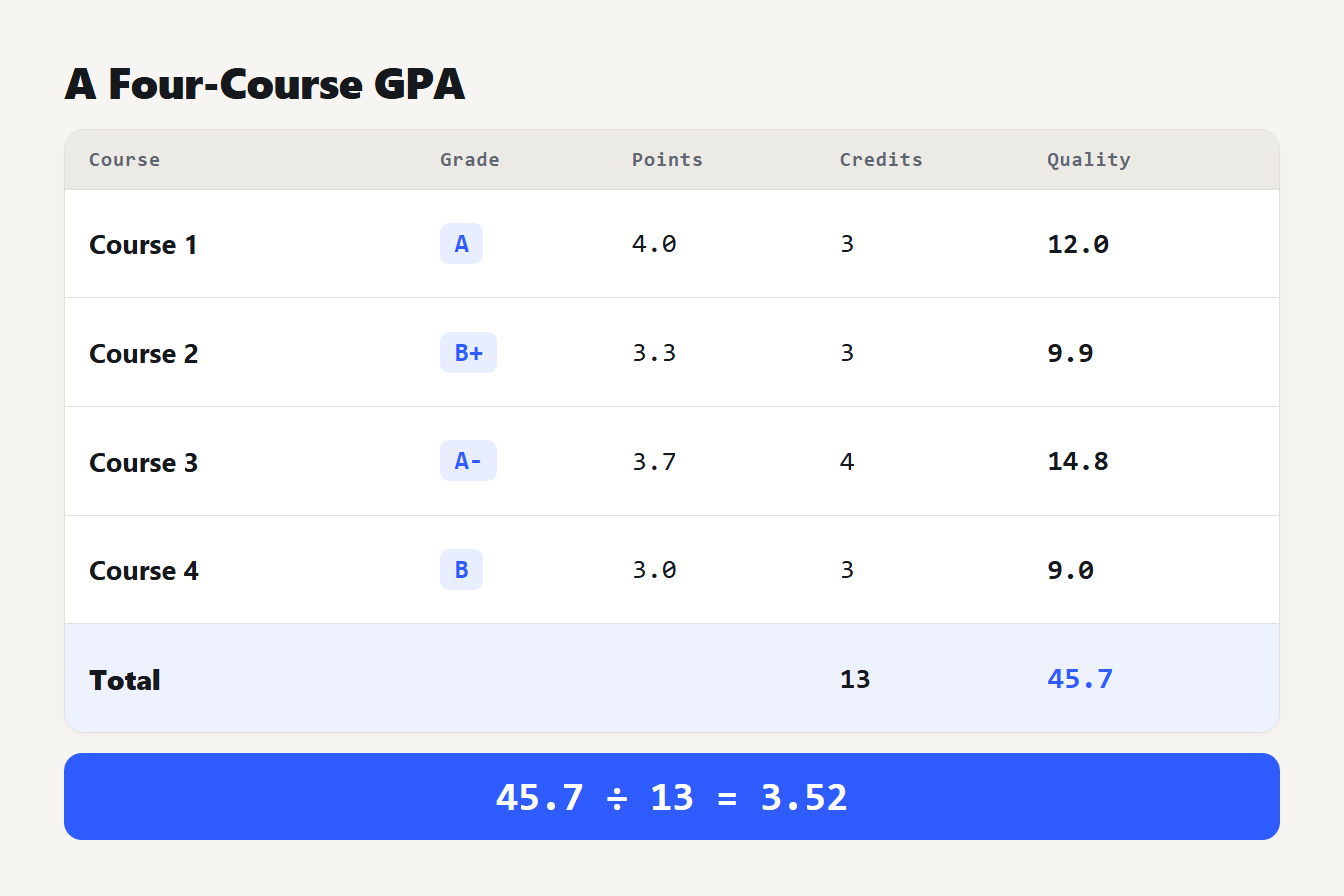
Four courses: A for 3 credits gives 12.0 quality points, B+ for 3 credits gives 9.9, A- for 4 credits gives 14.8 and B for 3 credits gives 9.0. The total is 45.7 points over 13 credits, a 3.52 GPA.
Which grade point scale does your school use?
This is where most calculators quietly differ. Three official scales, from three real schools:
| Grade | UC Santa Cruz | Arizona State | Rutgers Engineering |
|---|---|---|---|
| A+ | 4.0 | 4.33 | not listed |
| A | 4.0 | 4.00 | 4.0 |
| A- | 3.7 | 3.67 | not listed |
| B+ | 3.3 | 3.33 | 3.5 |
| B | 3.0 | 3.00 | 3.0 |
| C+ | 2.3 | 2.33 | 2.5 |
| C | 2.0 | 2.00 | 2.0 |
| D | 1.0 | 1.00 | 1.0 |
| F or E | 0.0 | 0.00 | 0.0 |
UC Santa Cruz publishes its grade point table with 3.7 and 3.3 steps. ASU uses 3.67 and 3.33, gives A+ a 4.33 and then caps the cumulative GPA at 4.00. Rutgers Engineering lists a simple scale where a B+ is worth 3.5, not 3.3, and shows no minus grades.
Does the difference matter? Take one set of grades: A in 3 credits, B+ in 3, B in 4 and C+ in 3. Under UC Santa Cruz's scale that is a 3.14 GPA. Under ASU's it is 3.15. Under Rutgers Engineering's it is 3.23. The grades did not change, and the GPA moved by 0.09.
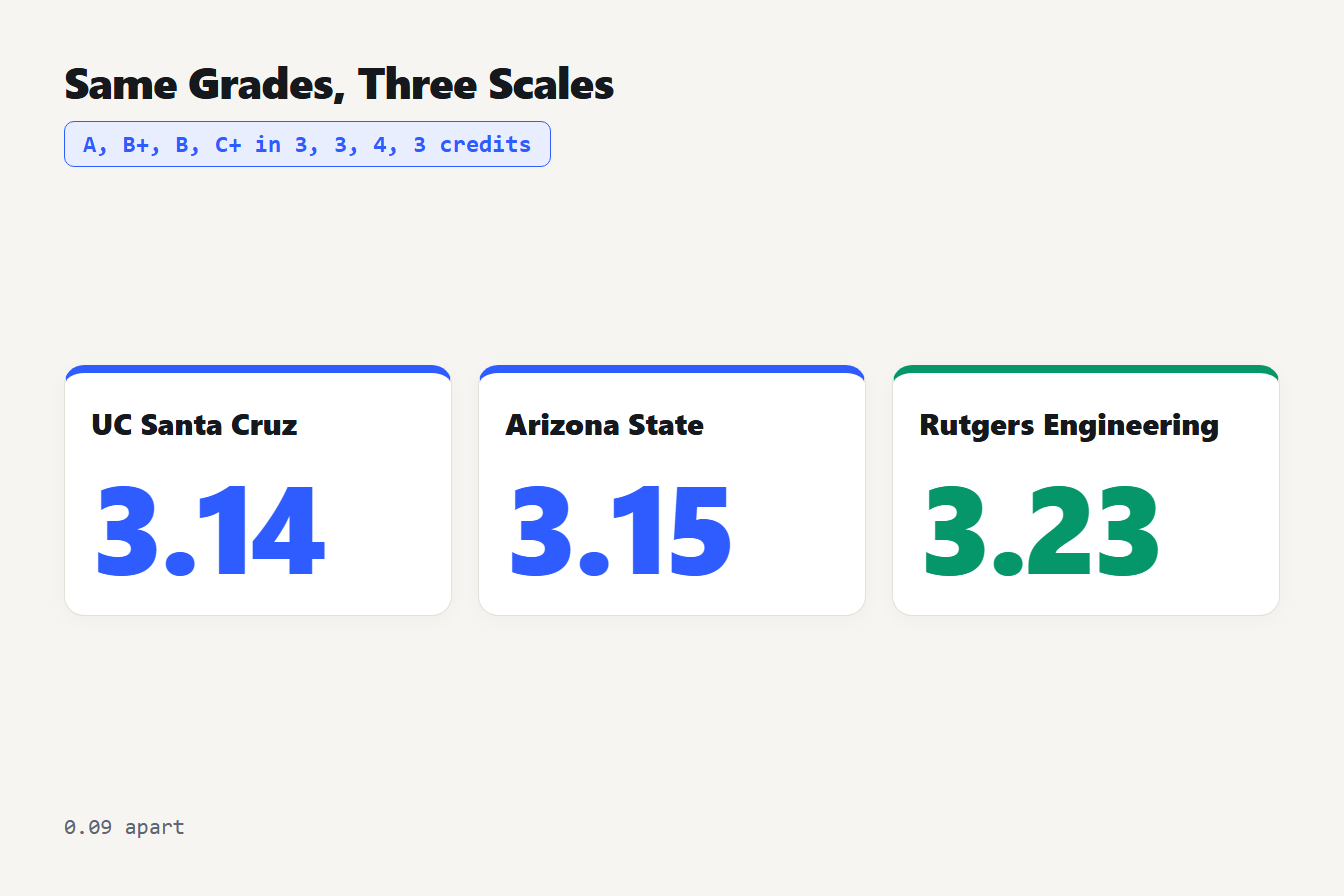
Grades of A, B+, B and C+ in courses of 3, 3, 4 and 3 credits give a GPA of 3.14 on the UC Santa Cruz scale, 3.15 on the Arizona State scale and 3.23 on the Rutgers Engineering scale.
Check your own registrar's table before you trust any calculator, including ours. The GPA Calculator uses the UC Santa Cruz style scale: A+ and A are both 4.0, A- is 3.7, B+ is 3.3, and so on down to F at 0.
How to calculate cumulative GPA
Your cumulative GPA covers every semester, and the rule is the same: total quality points over total credits. The mistake to avoid is averaging semester GPAs.
Say you have a 3.20 GPA over 60 credits, which is 192 quality points. This semester adds the 45.7 points over 13 credits from above. Your cumulative GPA is (192 + 45.7) ÷ (60 + 13) = 237.7 ÷ 73 = 3.26. Averaging 3.20 and 3.52 would give 3.36, which is wrong by 0.10, because it treats a 13-credit semester as if it weighed the same as your 60 earlier credits.
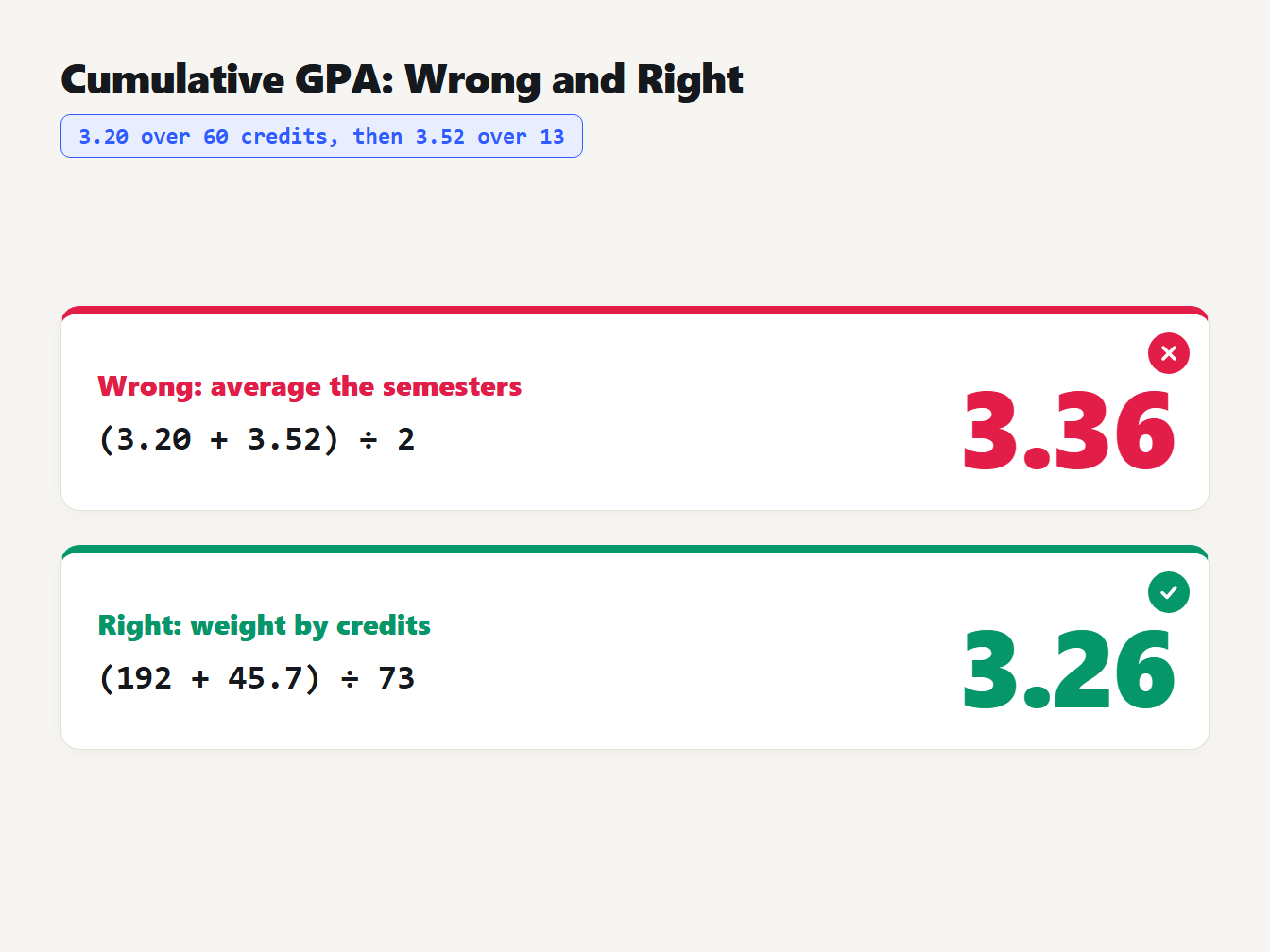
With a 3.20 GPA over 60 credits and a new 3.52 over 13 credits, averaging the two gives a wrong 3.36. Adding 192 and 45.7 quality points and dividing by 73 credits gives the correct 3.26.
Weighted vs unweighted GPA
An unweighted GPA uses the plain scale, so an A is 4.0 in any course. A weighted GPA gives extra points for harder courses. A simple and common scheme is +0.5 for honors and +1.0 for AP. One New Jersey school, for example, describes its weighted honors GPA as .5 higher and its weighted AP GPA as 1.0 higher than the unweighted one (McGinnis Middle School's policy).
Details differ from school to school. Patterson High School in California gives an extra grade point for honors and AP grades of C and above. An A is then worth 5, a B 4 and a C 3 (Patterson High School's grading policy). Ask your counselor which rule applies to you.
Here is five one-credit courses under the +0.5 and +1.0 scheme: AP with an A, honors with a B+, and regular courses with A-, B and A. Unweighted that is 4.0 + 3.3 + 3.7 + 3.0 + 4.0 = 18.0 over 5 credits, a 3.60. Weighted it becomes 5.0 + 3.8 + 3.7 + 3.0 + 4.0 = 19.5, a 3.90.
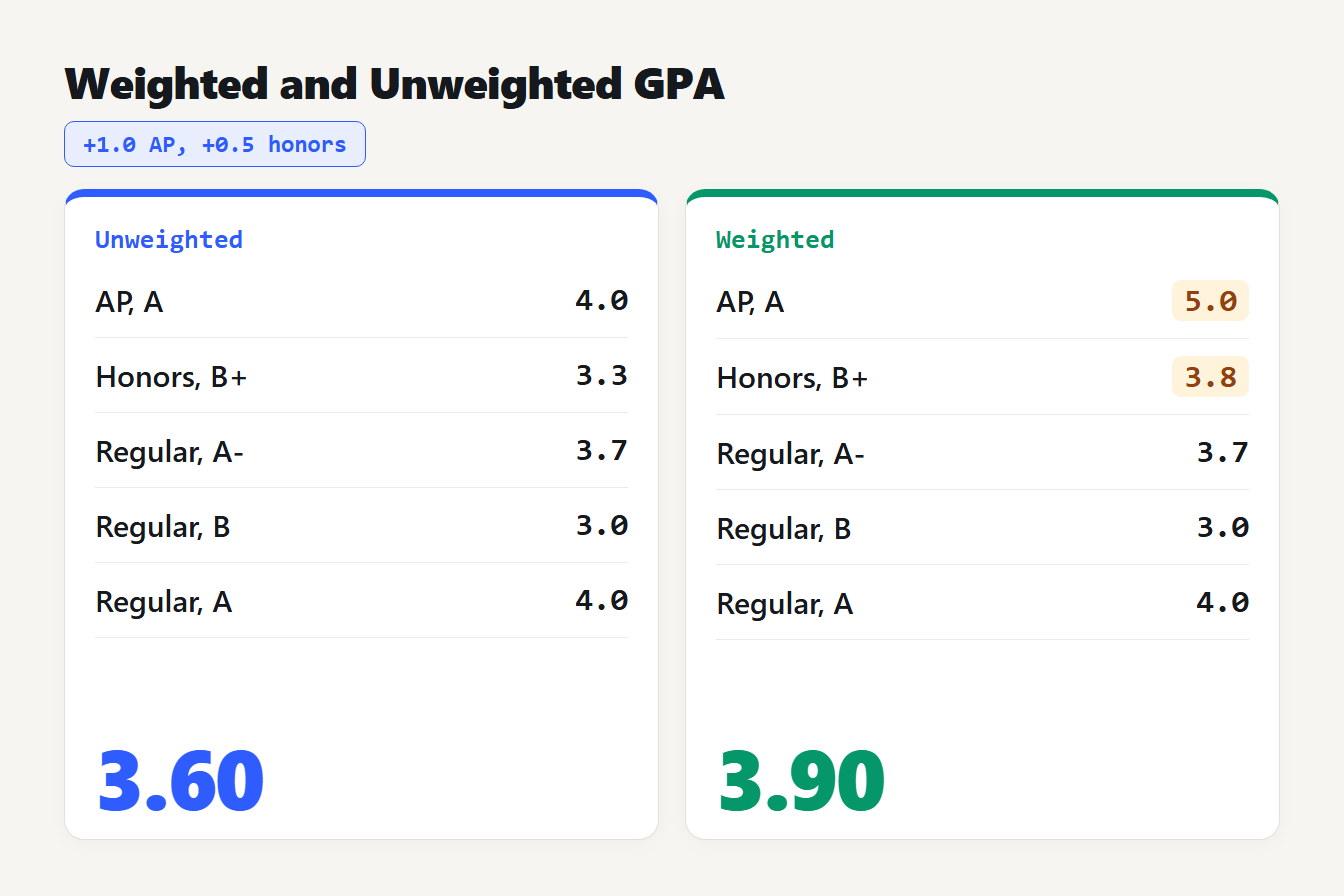
Five one-credit courses: AP with an A, honors with a B+, and regular courses with A-, B and A. The unweighted GPA is 3.60 and the weighted GPA is 3.90, using 1.0 extra for AP and 0.5 extra for honors.
The Calculator's weighted mode uses exactly this +0.5 and +1.0 scheme. It adds the bonus to whatever grade you enter, so if your school gives no bonus for failing grades, enter a failed course as a regular course.
How to raise your GPA: the semester GPA you need
Once your GPA is a number, the next question is what it takes to move it. The needed semester GPA comes from rearranging the cumulative formula:
needed = (target × (prior credits + new credits) - prior GPA × prior credits) ÷ new credits
Use a 3.20 GPA over 60 credits and a 15-credit semester. For a 3.30 target, the semester has to average (3.30 × 75 - 192) ÷ 15 = 3.70. For a 3.40 target the answer is 4.20, which no semester can deliver on a 4.0 scale. If you want to know how many credits of straight A's it takes, use credits = prior credits × (target - prior GPA) ÷ (4.0 - target).
| Target GPA | Semester GPA needed (15 credits) | Credits of straight A's needed |
|---|---|---|
| 3.25 | 3.45 | 4 |
| 3.30 | 3.70 | 9 (8.57 rounded up) |
| 3.40 | 4.20, not possible | 20 |
| 3.50 | 4.70, not possible | 36 |
The pattern is that a bigger prior credit count makes your GPA harder to move. Going from 3.20 to 3.50 takes 36 credits of perfect grades, which is more than two full semesters. You can test scenarios in the GPA Calculator: switch on the previous GPA and credits fields, then add your planned courses.
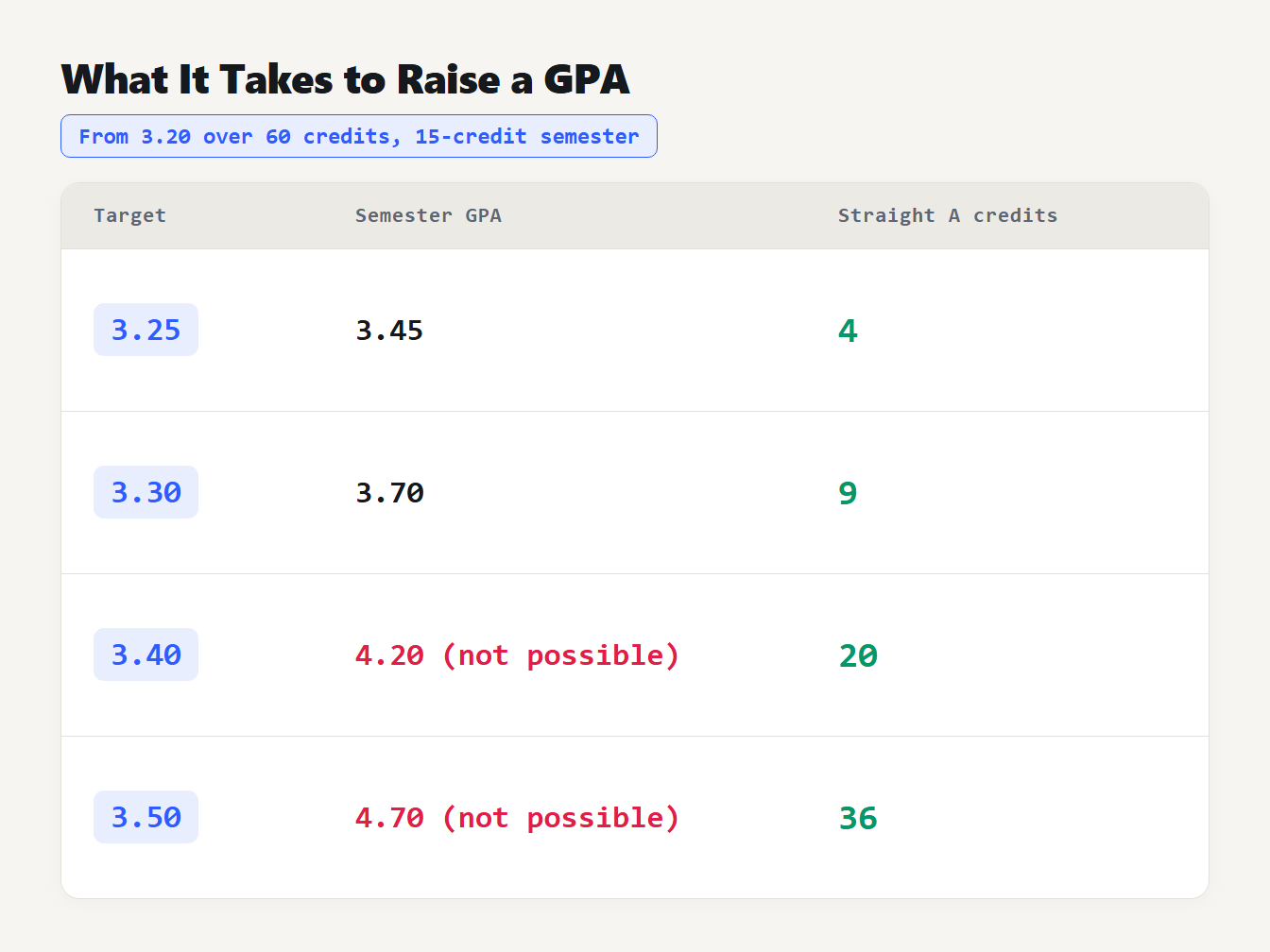
Starting from a 3.20 GPA over 60 credits: a 3.25 target needs a 3.45 semester over 15 credits or 4 credits of straight A's, 3.30 needs 3.70 or 9 credits, 3.40 needs 4.20 (not possible) or 20 credits, and 3.50 needs 4.70 (not possible) or 36 credits.
Need a course grade first? Use the Grade Calculator, or see what grade you need on your final.
Rounding, caps and credits: details that change the answer
Three small rules decide whether your number matches the one on your transcript.
Rounding. Our example GPA is 3.5154. ASU rounds to the nearest hundredth, so it becomes 3.52. A school that simply drops the extra digits would show 3.51. The difference is tiny, but it can decide an honors cutoff.
Caps. ASU's scale gives A+ a 4.33, yet its cumulative GPA is capped at 4.00. A student with nothing but A+ grades would compute 4.33 by hand and still see 4.00 on the transcript.
Credits. A course counts in proportion to its credits. A B in a 4 credit course adds 12 quality points, and an A in a 1 credit course adds only 4. If a grade moves your GPA less than you expected, look at the credits first.
Mistakes that skew a GPA
- Averaging semesters. Weight them by credits.
- Ignoring credits. A 4 credit B counts more than a 1 credit A.
- Using the wrong scale. A+ is 4.0 at one school and 4.33 at another.
- Counting pass/fail courses. UC Santa Cruz excludes P and NP from the GPA.
- Forgetting the rounding rule. Rounding to the nearest hundredth and truncating can differ by 0.01.
Frequently asked questions
How do you calculate GPA?
Multiply each course's grade points by its credits to get quality points, add them up, and divide by the total credits. Four courses worth 3, 3, 4 and 3 credits with grades A, B+, A- and B give 45.7 quality points over 13 credits, a GPA of 3.52.
How do you calculate cumulative GPA?
Add your new quality points to your previous quality points (previous GPA times previous credits), then divide by the combined credits. Do not average semester GPAs, because that ignores how many credits each semester had.
Is an A+ worth 4.0 or 4.33?
It depends on the school. UC Santa Cruz counts A+ and A as 4.0, while Arizona State gives A+ a 4.33 on its plus/minus scale and then caps the cumulative GPA at 4.00. Check your school's registrar page before you calculate.
What is the difference between weighted and unweighted GPA?
Unweighted GPA uses the plain scale, so an A is 4.0 in any course. Weighted GPA adds a bonus for honors or AP courses, often 0.5 and 1.0 points. Rules vary: one California high school gives the bonus only for grades of C and above.
Do pass/fail courses count in GPA?
Usually not. UC Santa Cruz, for example, says its P and NP grades are not included in calculating GPA and are not assigned grade points. Your own school's policy decides, so check it before you assume.
Calculate yours, then plan
Now you know how to calculate GPA: find your school's grade point table, list your courses with credits, and run the formula or enter them into the GPA Calculator. Then use the target formula to see what next semester has to look like, before you decide how hard to push.