How to Read Roman Numerals: Rules, Chart 1 to 100 and Examples
How to read Roman numerals in three steps, with the seven symbols, the subtraction rules, a chart from 1 to 100, years like MMXXVI and the IIII vs IV question.
By TheTextKit TeamPublished
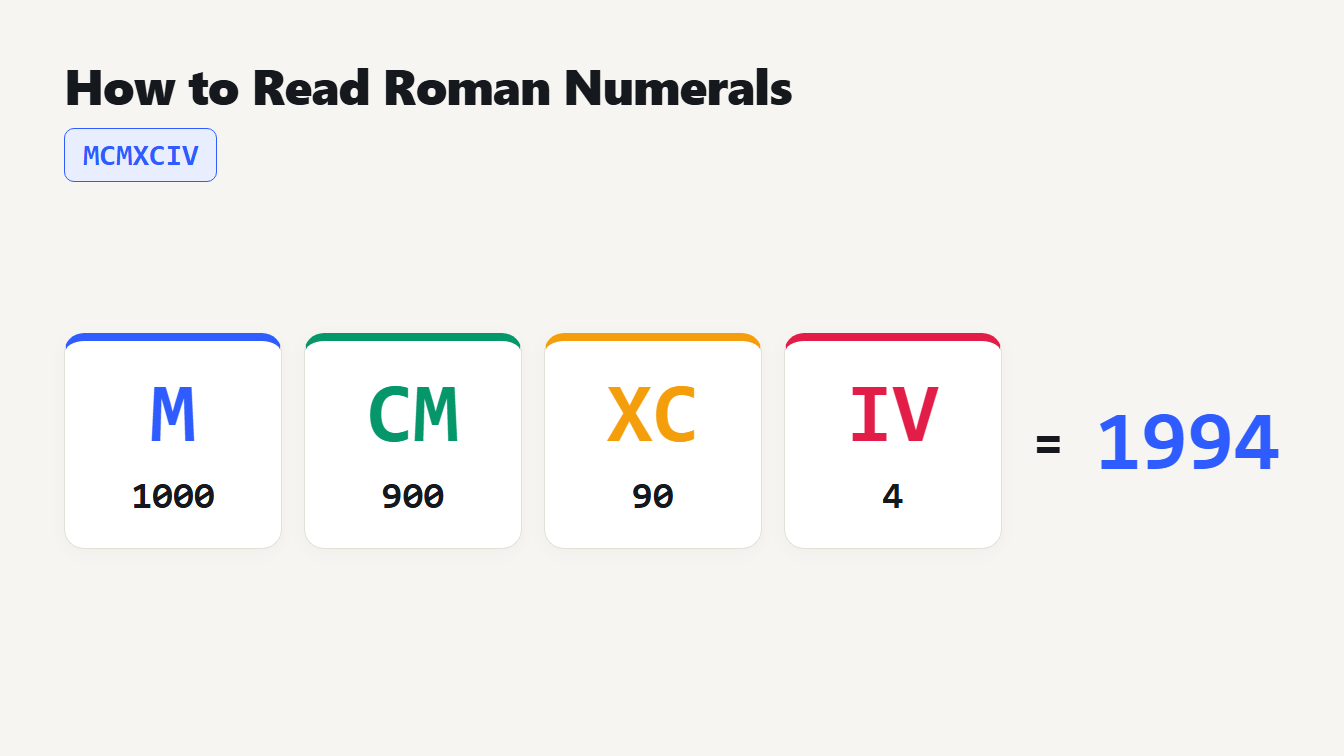
The numeral MCMXCIV split into four parts, M for 1000, CM for 900, XC for 90 and IV for 4, which add up to 1994.
How to read Roman numerals comes down to one habit: go left to right and add the values of the letters. When a smaller letter comes before a larger one, subtract it instead. So VI is 5 plus 1, which is 6, but IV is 5 minus 1, which is 4, and MCMXCIV is 1,000 + 900 + 90 + 4 = 1994. Seven letters, six subtraction pairs and one rule about repeats cover every standard numeral from 1 to 3999. Below you get those rules, a chart from 1 to 100, years such as MMXXVI, and the IIII versus IV puzzle.
The seven Roman numeral symbols
Every Roman numeral is built from these letters:
| Symbol | I | V | X | L | C | D | M |
|---|---|---|---|---|---|---|---|
| Value | 1 | 5 | 10 | 50 | 100 | 500 | 1,000 |
How to read Roman numerals in three steps
- Split the numeral into chunks. Keep each subtraction pair together (a smaller letter right before a larger one) and treat every other letter alone.
- Value each chunk. A pair is the larger value minus the smaller one, so CM is 1,000 minus 100, which is 900.
- Add the chunks. Work from left to right.
Here are three numerals worked out:
| Numeral | Chunks | Sum |
|---|---|---|
| XLIX | XL + IX | 40 + 9 = 49 |
| CDXLIV | CD + XL + IV | 400 + 40 + 4 = 444 |
| MCMXCIV | M + CM + XC + IV | 1,000 + 900 + 90 + 4 = 1994 |
Try it yourself
Cover the right column and read these numerals, then check:
| Numeral | Chunks | Value |
|---|---|---|
| XXIV | X + X + IV | 24 |
| XCVII | XC + V + I + I | 97 |
| DCCLXIX | D + C + C + L + X + IX | 769 |
| MMCDXLIV | M + M + CD + XL + IV | 2444 |
| MCMLXXXIV | M + CM + L + X + X + X + IV | 1984 |
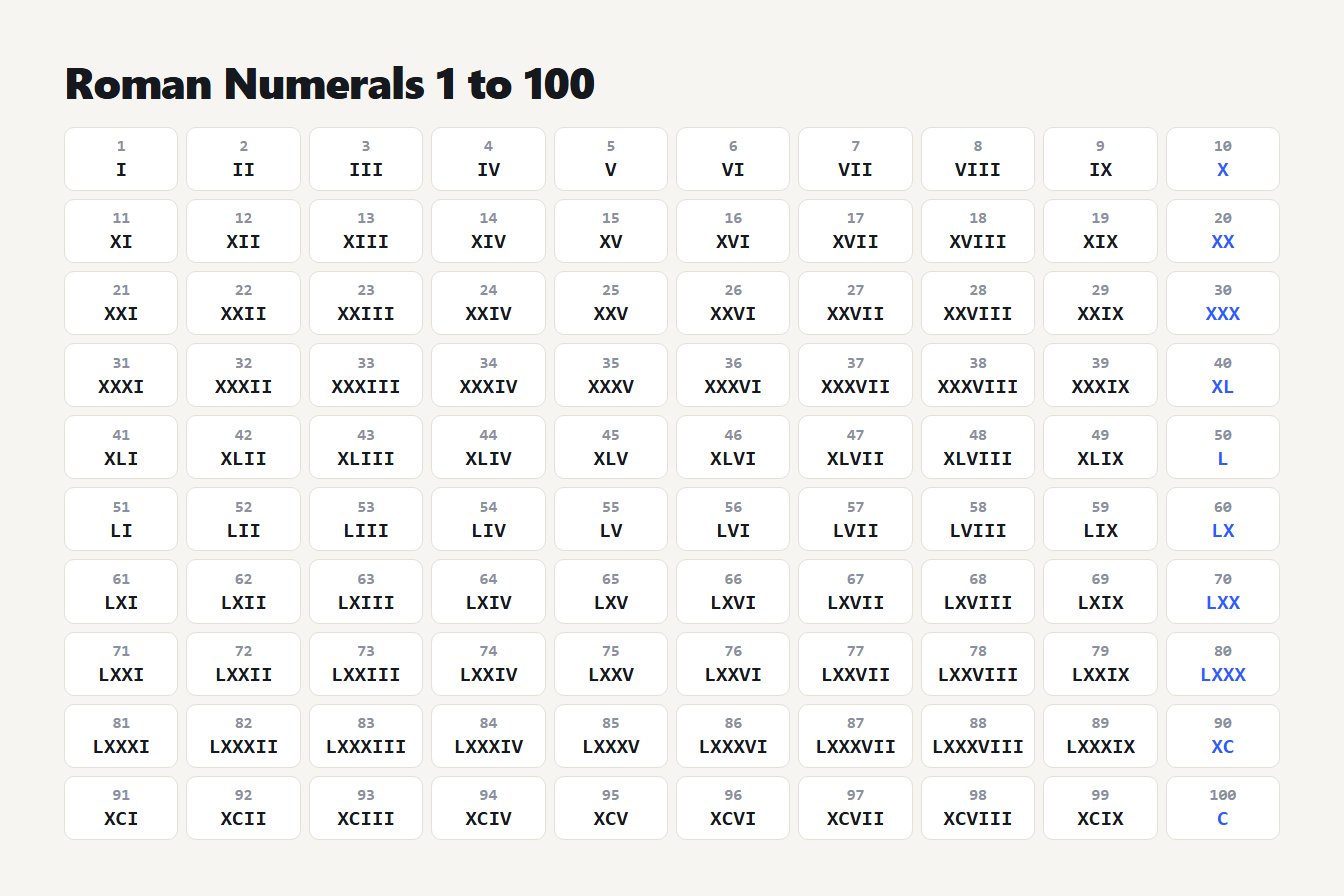
A ten by ten grid showing the standard Roman numeral for every number from 1 to 100, from I to C.
The rules for writing Roman numerals
Reading is easy once you know what a valid numeral looks like. The standard form has four rules:
- Repeat I, X, C and M up to three times. III is 3 and XXX is 30, but 4 is not IIII.
- Never repeat V, L or D. Ten is X, not VV.
- Subtract only in six pairs. IV (4), IX (9), XL (40), XC (90), CD (400) and CM (900).
- Subtract only I, X and C, and only from the next two larger symbols. I goes before V or X, X before L or C, and C before D or M.
The last rule explains why 99 is XCIX and not IC, and why 49 is XLIX and not IL. A common shortcut is to build a number place by place, thousands first. For 64, write 60 as LX and 4 as IV: LXIV.
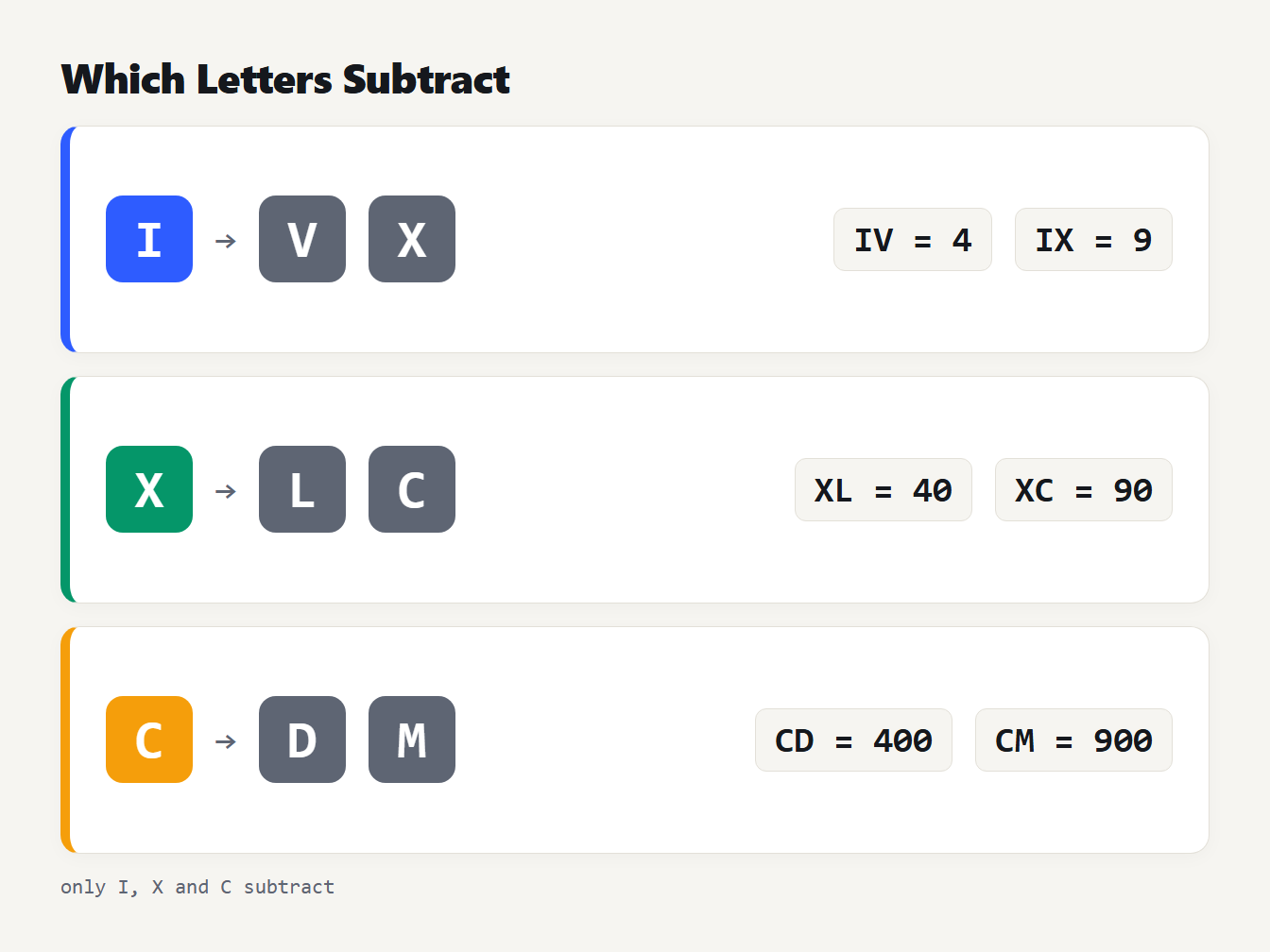
Three rows. I may come before V or X to make 4 and 9. X may come before L or C to make 40 and 90. C may come before D or M to make 400 and 900.
Common mistakes when you read or write numerals
- Writing 99 as IC. I can only come before V or X, so 99 is XC + IX = XCIX.
- Subtracting across too wide a gap. XM is not 990. Write 990 as CMXC.
- Adding a subtraction pair. Reading IX as 1 + 10 gives 11. It is 10 minus 1, which is 9.
- Building a year with the wrong order. 1994 is MCMXCIV, never MXMIV. A naive left-to-right reader would give MXMIV the value 1994, but the standard form does not allow it, and our converter rejects it.
- Repeating V, L or D. VV is not a way to write 10.
A Roman numerals chart from 1 to 100
Because the system works place by place, you only need two short lists. The tens column gives you the rest:
| Ones | I | II | III | IV | V | VI | VII | VIII | IX |
|---|---|---|---|---|---|---|---|---|---|
| Value | 1 | 2 | 3 | 4 | 5 | 6 | 7 | 8 | 9 |
| Tens | X | XX | XXX | XL | L | LX | LXX | LXXX | XC | C |
|---|---|---|---|---|---|---|---|---|---|---|
| Value | 10 | 20 | 30 | 40 | 50 | 60 | 70 | 80 | 90 | 100 |
Join the tens part and the ones part to read any number up to 100. So 87 is LXXX + VII = LXXXVII, and 94 is XC + IV = XCIV. The ten by ten grid above shows all 100 in one place.
Roman numerals for years
Knowing how to read Roman numerals for years means doing the same thing, thousands first. We converted these with a script and checked each one against an independent calculation:
| Year | Roman numeral | Chunks |
|---|---|---|
| 1994 | MCMXCIV | M + CM + XC + IV |
| 2000 | MM | M + M |
| 2024 | MMXXIV | MM + XX + IV |
| 2025 | MMXXV | MM + XX + V |
| 2026 | MMXXVI | MM + XX + VI |
| 2027 | MMXXVII | MM + XX + VII |
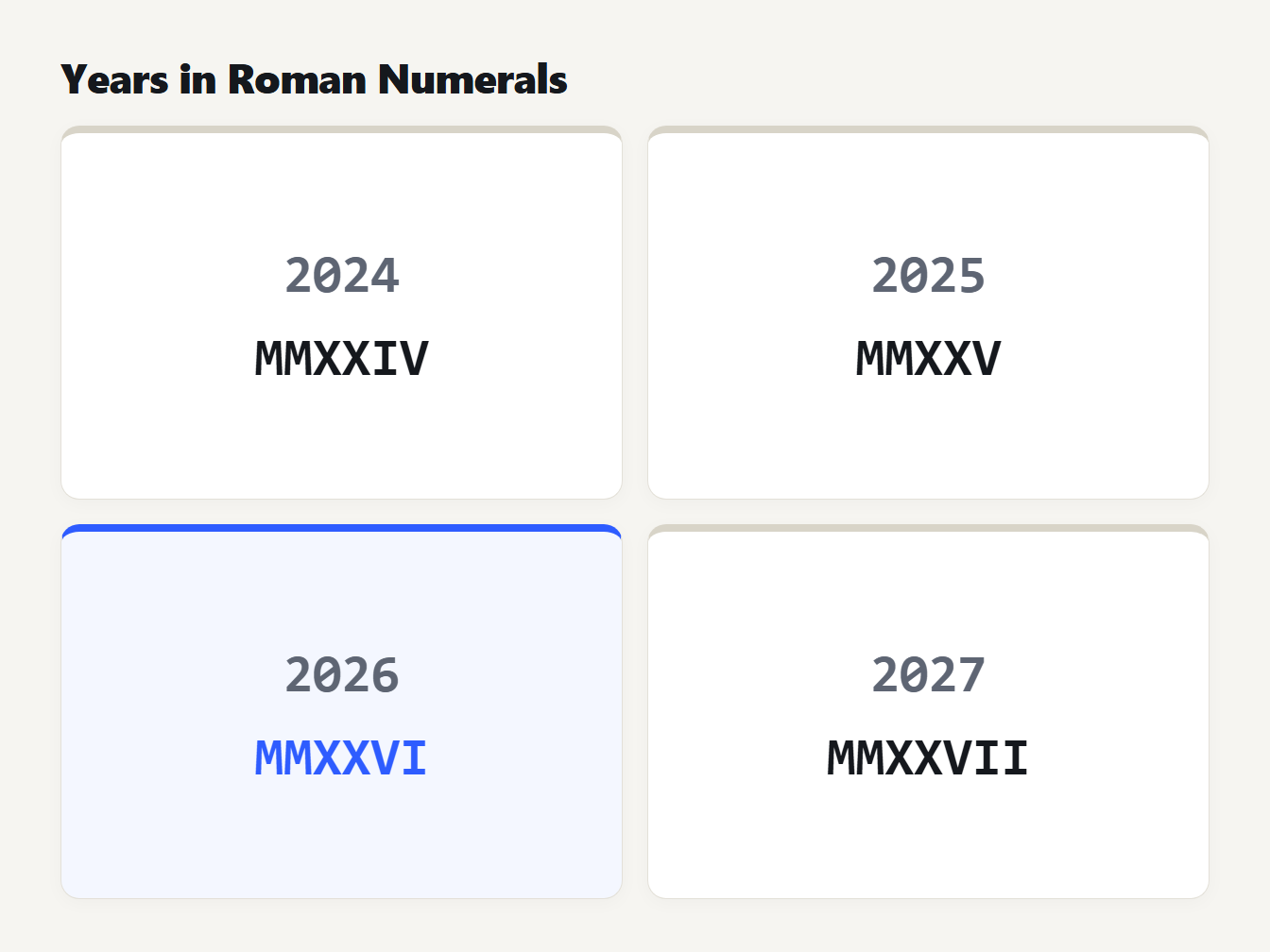
Four cards. 2024 is MMXXIV, 2025 is MMXXV, 2026 is MMXXVI and 2027 is MMXXVII.
Wikipedia's article on Roman numerals lists where they survive today: movie copyright years, Super Bowl numbering, monarchs' regnal numbers and chapter headings. If you sort a list of chapter numbers as text, you get a surprise. We sorted I to XV alphabetically and got I, II, III, IV, IX, V, VI, and so on, with IX landing before V. The Sort Lines tool in A to Z mode does the same, so number the chapters first, then sort.
Why there is no zero, and what comes after 3999
The system has no symbol for zero. According to Wikipedia, medieval writers used the Latin word nulla, meaning none, and Bede used the letter N around 725 AD.
The standard form also stops at 3999. The largest numeral, MMMCMXCIX, uses the biggest letter, M, three times, and 4,000 would need a fourth M. Two older systems stretched the range. The vinculum, a bar over a numeral, multiplied it by 1,000, so a barred IV meant 4,000, and the apostrophus used shapes built from C and a backwards C. Math Is Fun notes that the bar notation is not commonly used today.
Wikipedia notes that Unicode has dedicated Roman numeral characters from U+2160 to U+2188, but describes them as being for compatibility only. Type ordinary letters instead.
IIII or IV: which is right?
For the standard form, IV is correct. Yet many clocks show IIII at four o'clock and IX at nine. Wikipedia says this practice goes back to very early clocks, such as the Wells Cathedral clock of the late 14th century, and that some famous clocks, including the Elizabeth Tower in London, use IV.
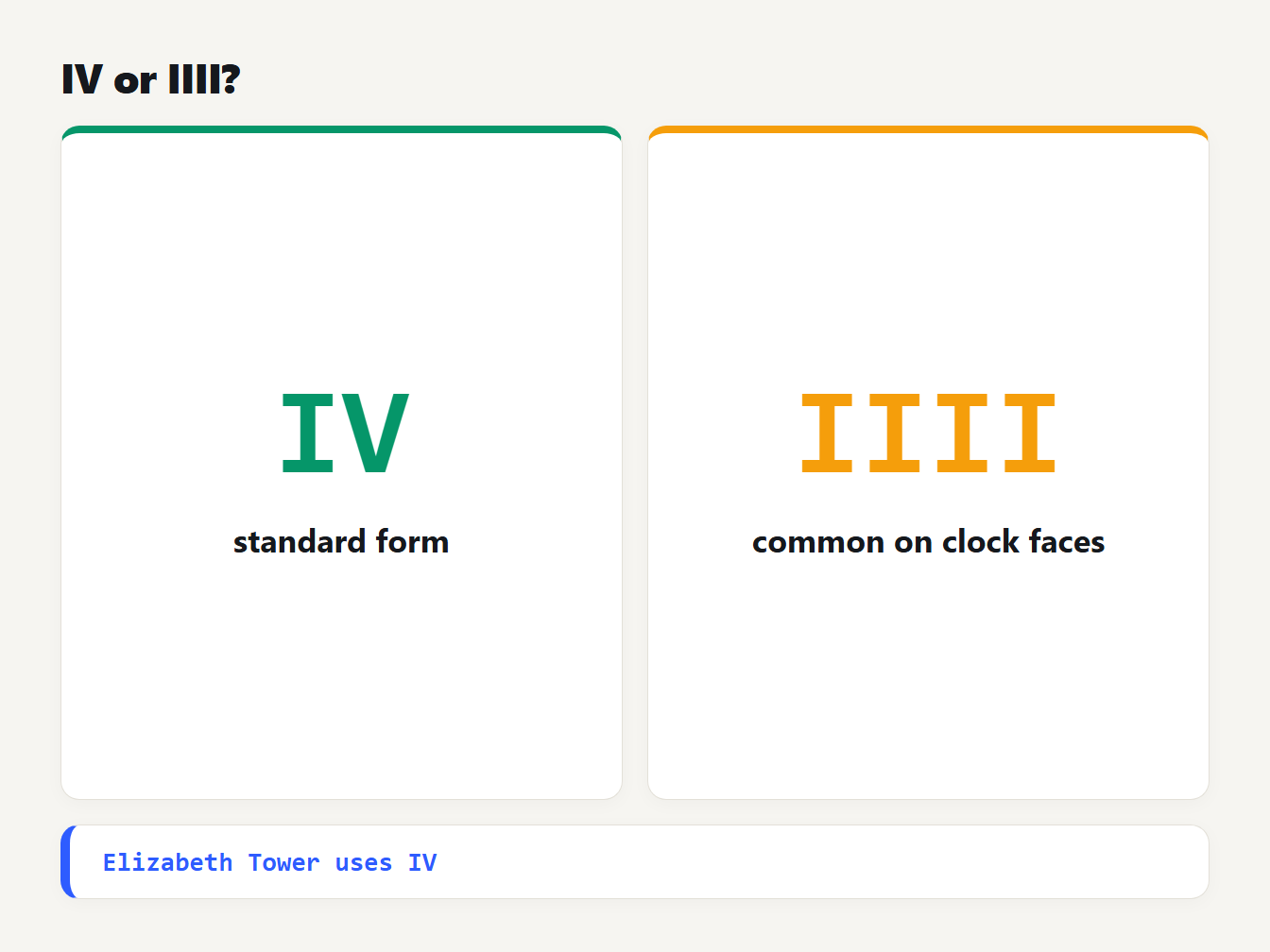
One card shows IV as the standard form. The other shows IIII as a variant common on clock faces. A note says the Elizabeth Tower uses IV.
So IIII is not an error on a clock, but it is not the form to use in a document, a school exam or a tool that follows the standard rules.
Check a numeral with the converter
The Roman Numeral Converter turns a number into a numeral and back, and works out the direction from what you type. It covers 1 to 3999 and rejects malformed input instead of guessing.
We tested it hard. All 3,999 numbers converted to the same numeral as an independent calculation and came back to the same number. We then tried every string of up to five letters from I, V, X, L, C, D and M, 19,607 in all, and it accepted 735, every one a standard numeral. It rejected IIII, VX, VV, IC, IL, XM, IIX and MMMM, and it shows an error for 0 and 4000. It also accepts lowercase and ignores spaces around the input, so mcmxciv reads as 1994.
Roman numerals are one of several ways to write the same number. Binary is another: see our guide to converting text to binary and the Text to Binary Translator.
Frequently asked questions
What is 2026 in Roman numerals?
MMXXVI. MM is 2,000, XX is 20 and VI is 6, and 2,000 + 20 + 6 gives 2026. The year before is MMXXV and the year after is MMXXVII.
Why is 4 written IV and not IIII?
The standard form never repeats a letter four times, so 4 is IV, one before five. IIII is a traditional variant that is still common on clock faces, but it is not the standard spelling, and our converter rejects it.
What is the largest Roman numeral?
In the standard system it is MMMCMXCIX, which is 3999, because there is no symbol above M. Historically a bar over a numeral multiplied it by 1,000, but that notation is rarely used today.
Is there a Roman numeral for zero?
No. The system has no zero symbol. Medieval writers used the Latin word nulla, meaning none, and Bede used the letter N around 725 AD.
How do you write 99 in Roman numerals?
XCIX, which is 90 (XC) plus 9 (IX). IC looks shorter but is not standard, because only I, X and C can be subtracted and each only from the next two larger symbols. I may come only before V or X.
Read your next numeral place by place
The next time you need to know how to read Roman numerals on a clock, a film credit or a chapter heading, split the numeral into chunks, value each chunk and add. Start from the left, keep pairs together, and check the result against the rules above. To confirm your answer, paste it into the Roman Numeral Converter.