How to Convert CM to Inches: Formula, Fractions and Heights
How to convert cm to inches by dividing by 2.54, how to write the result as a fraction for a tape measure, and how to turn centimeters into feet and inches.
By TheTextKit TeamPublished
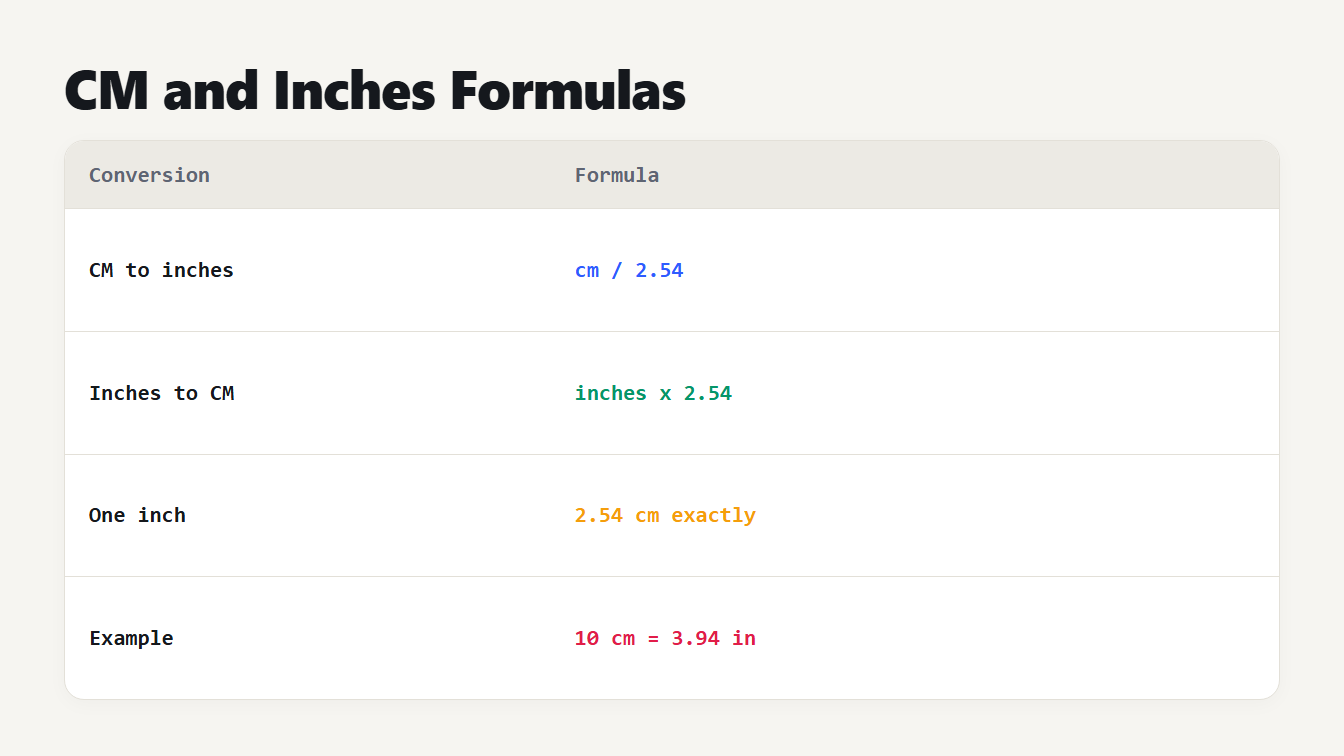
A table of the formulas for centimeters and inches. To get inches from centimeters, divide by 2.54. To get centimeters from inches, multiply by 2.54. One inch is exactly 2.54 centimeters. For example, 10 centimeters is 3.94 inches.
To convert cm to inches, divide the number of centimeters by 2.54. So 10 cm is 3.94 inches, 25 cm is 9.84 inches and 175 cm is 68.9 inches. To go the other way, multiply inches by 2.54. The number is exact, because the inch is defined as 2.54 centimeters. This guide shows the formula and why it is exact, then works through centimeters to inches and back. It also shows how to write the answer as a fraction for a tape measure and how to turn a height in centimeters into feet and inches.
The formula for cm to inches
Wikipedia's article on the inch defines it as exactly 2.54 centimeters, which is exactly 25.4 millimeters. That is a definition, not a measurement, so there are no hidden digits behind the 4. The same article says the inch is one twelfth of a foot.
The factor agrees with the international yard. The agreement of 1 July 1959, signed by six countries, defined the yard as exactly 0.9144 meters. A yard is 36 inches, so one inch is 0.9144 divided by 36, which is 0.0254 meters, or 2.54 centimeters.
inches = centimeters / 2.54
centimeters = inches x 2.54
Dividing by 2.54 and multiplying by 0.3937 give almost the same answer, but only the first is exact. The decimal 0.3937 is the rounded form of 1 divided by 2.54, which never ends.
| Conversion | Formula |
|---|---|
| CM to inches | cm / 2.54 |
| Inches to CM | inches x 2.54 |
| One inch | 2.54 cm exactly |
| Example | 10 cm = 3.94 in |
Convert cm to inches
Take the length in centimeters and divide by 2.54. For 25 cm, 25 divided by 2.54 is 9.8425, which you can round to 9.84 inches. For a long length such as 100 cm, the answer is 39.37 inches.
Use as many digits as you need and no more. Two decimals are enough for most jobs, and rounding at the end keeps errors small. If you round the factor to 2.5 first, you add an error of about 1.6 percent.
| Centimeters | Inches |
|---|---|
| 1 cm | 0.39 in |
| 10 cm | 3.94 in |
| 25 cm | 9.84 in |
| 50 cm | 19.69 in |
| 100 cm | 39.37 in |
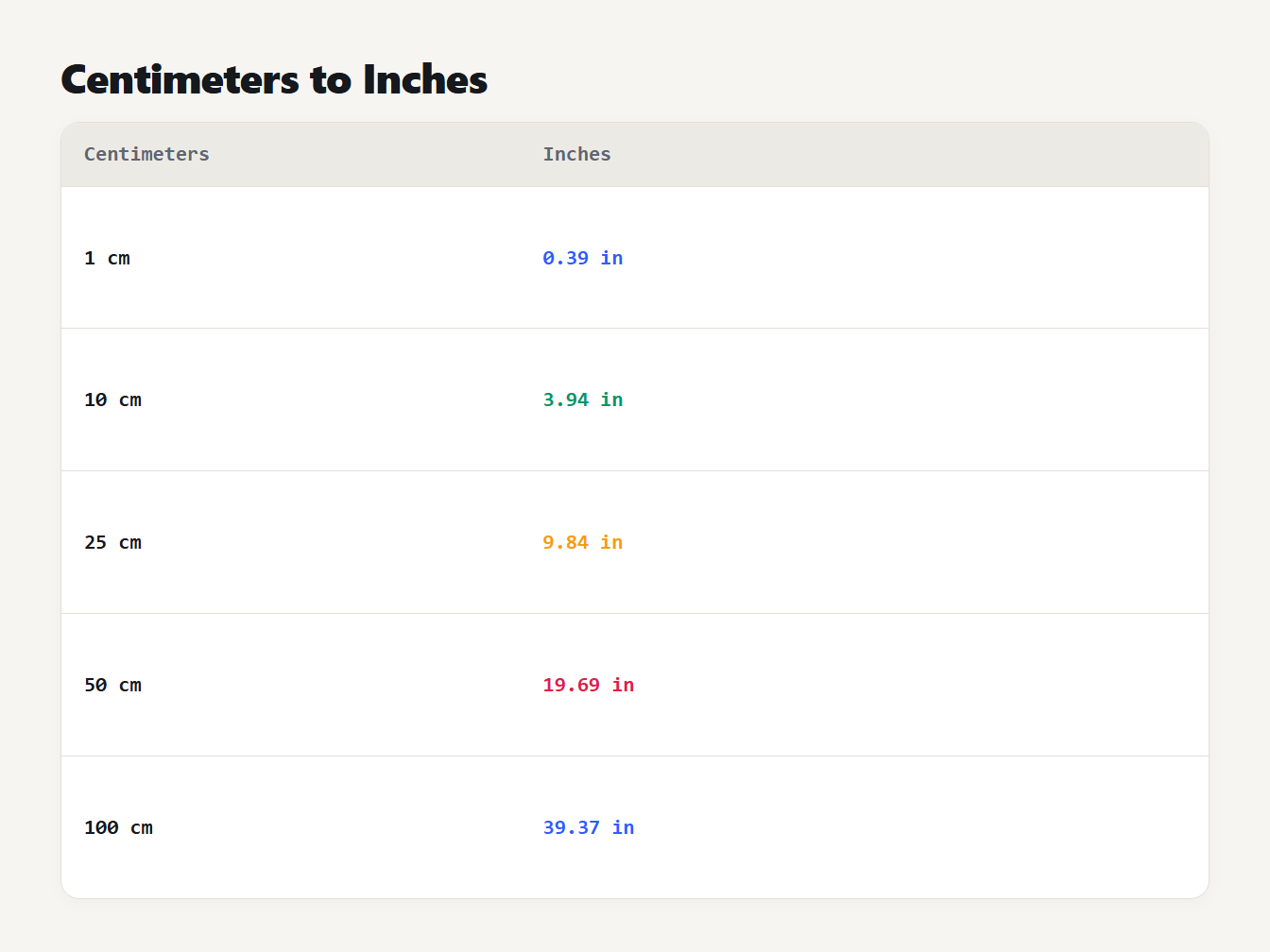
A table of five lengths in centimeters and the same lengths in inches. 1 cm is 0.39 inches. 10 cm is 3.94 inches. 25 cm is 9.84 inches. 50 cm is 19.69 inches. 100 cm is 39.37 inches.
For a quick estimate in your head, multiply the centimeters by 0.4. Then 25 cm gives 10 inches, against the true 9.84. The guess runs about 1.6 percent high, which is fine for a rough check but not for cutting material.
Convert inches to cm
The reverse is a multiplication. An inch is 2.54 cm, so 6 inches is 6 times 2.54, which is 15.24 cm. A foot is 12 inches, so it is 30.48 cm, and a yard is 36 inches, which is 91.44 cm. That last figure matches the yard defined in 1959.
| Inches | Centimeters |
|---|---|
| 1 in | 2.54 cm |
| 6 in | 15.24 cm |
| 12 in (1 foot) | 30.48 cm |
| 36 in (1 yard) | 91.44 cm |
| 100 in | 254 cm |
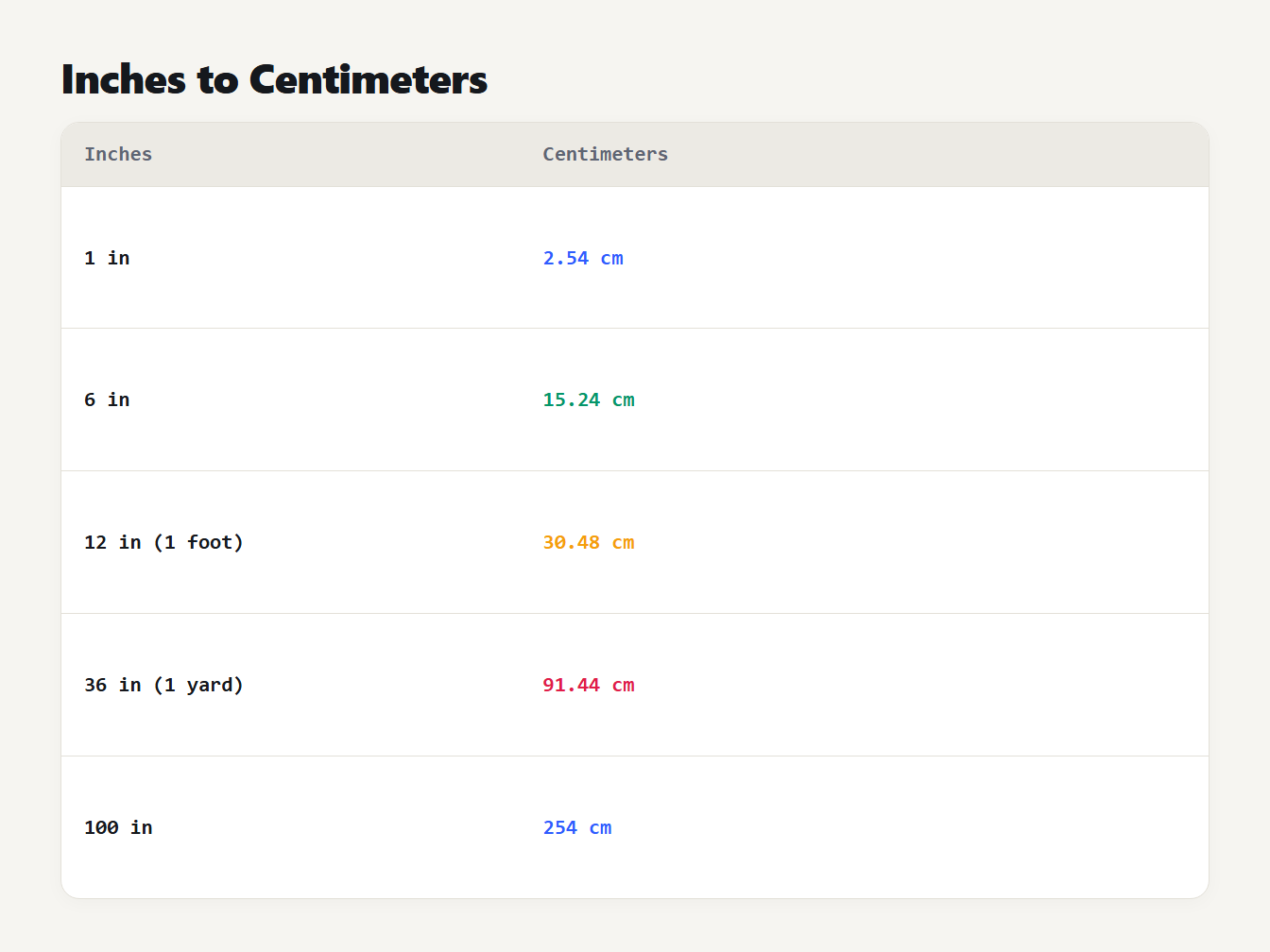
A table of five lengths in inches and the same lengths in centimeters. 1 inch is 2.54 cm. 6 inches is 15.24 cm. 12 inches, one foot, is 30.48 cm. 36 inches, one yard, is 91.44 cm. 100 inches is 254 cm.
Inches written with a fraction need one extra step. For 5 3/4 inches, first turn the fraction into a decimal, so that 3/4 becomes 0.75 and the length is 5.75 inches. Then multiply by 2.54 to get 14.605 cm.
Many measurements in everyday life are given in millimeters, and the same factor applies. One inch is 25.4 mm, so 10 mm is 0.39 inches. The Paper Size Converter, linked at the end of this guide, lists page sizes in millimeters, inches, points and pixels side by side.
Inches as a fraction
A decimal such as 9.8425 inches is hard to find on a tape measure. Tapes mark halves, quarters, eighths, sixteenths and sometimes finer steps. So you round the decimal to the nearest mark and write it as a fraction.
Wikipedia notes that parts of an inch are typically written as fractions with an odd numerator, giving the example of 2 and 3/8 rather than 2.375 or 2 and 6/16. That means you reduce the fraction to its lowest terms.
The method has three steps. Multiply the decimal part by the denominator you want. Round to a whole number. Reduce the fraction. For 9.8425 inches at sixteenths, 0.8425 times 16 is 13.48, which rounds to 13. So the answer is 9 13/16 inches.
| Nearest | 25 cm is |
|---|---|
| 1/2 inch | 10 in |
| 1/4 inch | 9 3/4 in |
| 1/8 inch | 9 7/8 in |
| 1/16 inch | 9 13/16 in |
| 1/32 inch | 9 27/32 in |
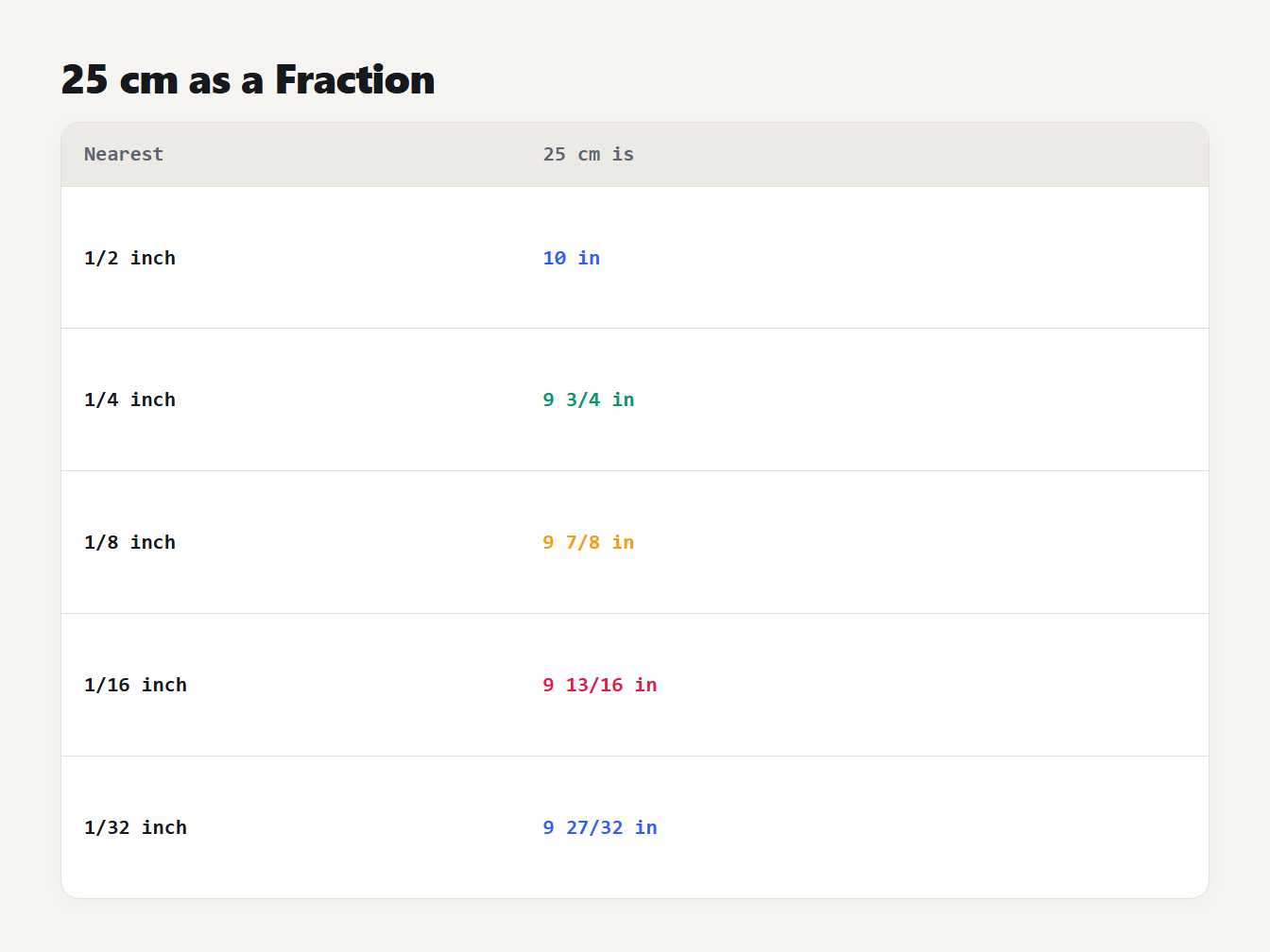
A table of 25 centimeters, which is 9.8425 inches, rounded to five fractions of an inch. To the nearest half it is 10 inches. To the nearest quarter it is 9 3/4. To the nearest eighth it is 9 7/8. To the nearest sixteenth it is 9 13/16. To the nearest thirty-second it is 9 27/32.
Finer steps are closer to the true value but harder to read. Use the step your tape or your job needs. A woodworker may want sixteenths, while someone buying a picture frame may be happy with the nearest half.
If the rounding reaches the next whole inch, carry it. A length of 3.99 inches at quarters is not 3 4/4 but 4 inches.
Centimeters to feet and inches
People in the United States, and some other places, give height in feet and inches. To convert, change the centimeters to inches first. Then divide by 12 and keep the whole part as feet. The remainder is the inches.
For 175 cm, the first step gives 68.9 inches. Dividing by 12 gives 5 with a remainder of 8.9, so the height is 5 feet 8.9 inches. Rounded to the nearest inch, that is 5 feet 9 inches, written 5'9". The reverse check works too. Five feet nine inches is 69 inches, and 69 times 2.54 is 175.26 cm.
| Height | Feet and inches |
|---|---|
| 150 cm | 4'11" |
| 160 cm | 5'3" |
| 170 cm | 5'7" |
| 180 cm | 5'11" |
| 190 cm | 6'3" |
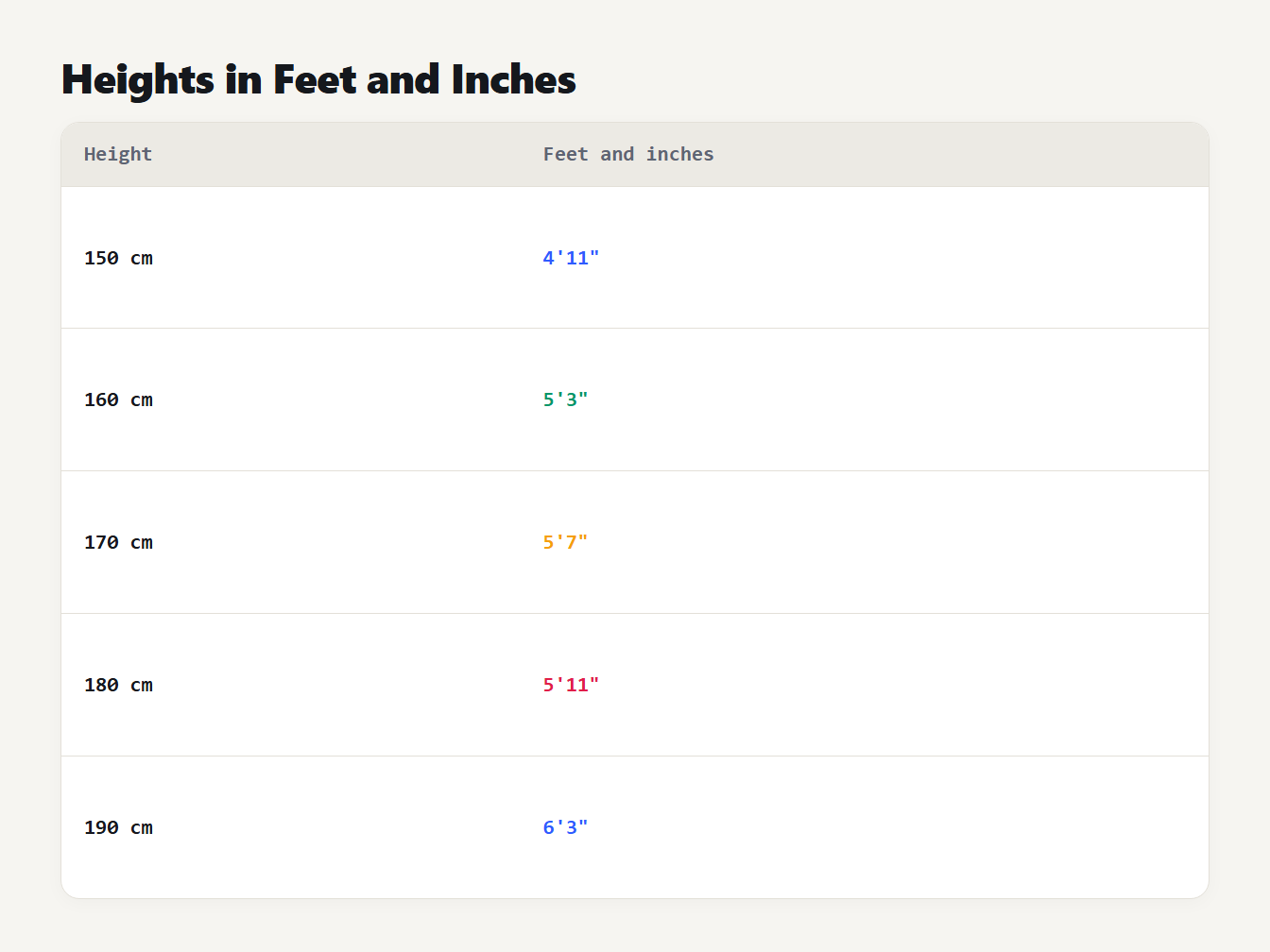
A table of five heights in centimeters and the same heights in feet and inches, rounded to the nearest inch. 150 cm is 4 feet 11 inches. 160 cm is 5 feet 3 inches. 170 cm is 5 feet 7 inches. 180 cm is 5 feet 11 inches. 190 cm is 6 feet 3 inches.
The single quote stands for feet and the double quote for inches. Some people write them with a prime sign, but the plain marks are the ones you can type on any keyboard. Health calculators such as BMI take a height, and they accept either centimeters or inches.
Where you will meet both units
Screens, paper and photos mix the two systems all the time. A laptop is sold by its diagonal in inches, while its width might be quoted in centimeters. Pixel density is counted per inch too, and a web designer who moves between pixels and CSS units may like the guide to PX to REM.
The same goes for clothing, furniture and pipes, where a catalogue may list the size in one unit and your tape shows the other. Convert once, write both numbers down, and you will not need to repeat the sum.
Common mistakes
Dividing when you should multiply is the most common slip. A quick check removes it. An inch is longer than a centimeter, so the number of inches must be smaller than the number of centimeters.
Rounding the factor to 2.5 is the second. Mixing up the feet mark and the inches mark is the third, since 5' is five feet and 5" is five inches. Rounding in the middle of a long calculation is the fourth, because the small errors add up. Keep the full number until the last step.
Frequently asked questions
How do you convert cm to inches?
Divide the centimeters by 2.54. So 10 cm is 10 divided by 2.54, which is 3.94 inches, and 175 cm is 68.9 inches. To go the other way, multiply the inches by 2.54. The factor is exact, because one inch is defined as exactly 2.54 centimeters.
How many cm are in an inch?
There are exactly 2.54 centimeters in one inch, which is 25.4 millimeters. This is a definition and not a measurement, so it has no extra digits. It matches the international yard of exactly 0.9144 meters, because 36 inches make a yard and 91.44 divided by 36 is 2.54.
How do you convert cm to feet and inches?
Divide by 2.54 to get inches, then divide by 12 for the feet and keep the remainder as inches. A height of 175 cm is 68.9 inches, which is 5 feet 8.9 inches, or about 5 feet 9 inches. The converter does this in one step and can round to a fraction.
How do you write inches as a fraction?
Multiply the decimal part by the denominator you want, such as 16, round to a whole number and reduce the fraction. For 9.8425 inches, 0.8425 times 16 is 13.48, which rounds to 13, so the answer is 9 13/16 inches. Tape measures mark halves, quarters, eighths and so on.
Is 2.54 exact or rounded?
It is exact. Wikipedia describes the inch as exactly 2.54 centimeters, which is exactly 25.4 millimeters. The 0.3937 that people use for going the other way is rounded, because 1 divided by 2.54 never ends. Use 2.54 directly, by dividing or multiplying, to avoid rounding errors.
Convert cm to inches with the tool
To convert a length, type it into the CM to Inches Converter. Choose centimeters to inches or inches to centimeters, and it shows the exact result, the nearest fraction of an inch, the feet and inches, and the length in millimeters and meters. You can type inches as 5.75, 5 3/4, 5 ft 9 in or 5'9 1/2" and it reads them all.
For other units, the Unit Converter covers more kinds of measurement. The Paper Size Converter lists page sizes in both systems, the Screen Size Calculator and the PPI Calculator deal with displays, and the BMI Calculator takes a height. Everything runs in your browser.