How to Convert Time Zones (and Handle Daylight Saving)
How to convert time zones the safe way: go through UTC, watch daylight saving, and know what to do with times that never happen or happen twice.
By TheTextKit TeamPublished
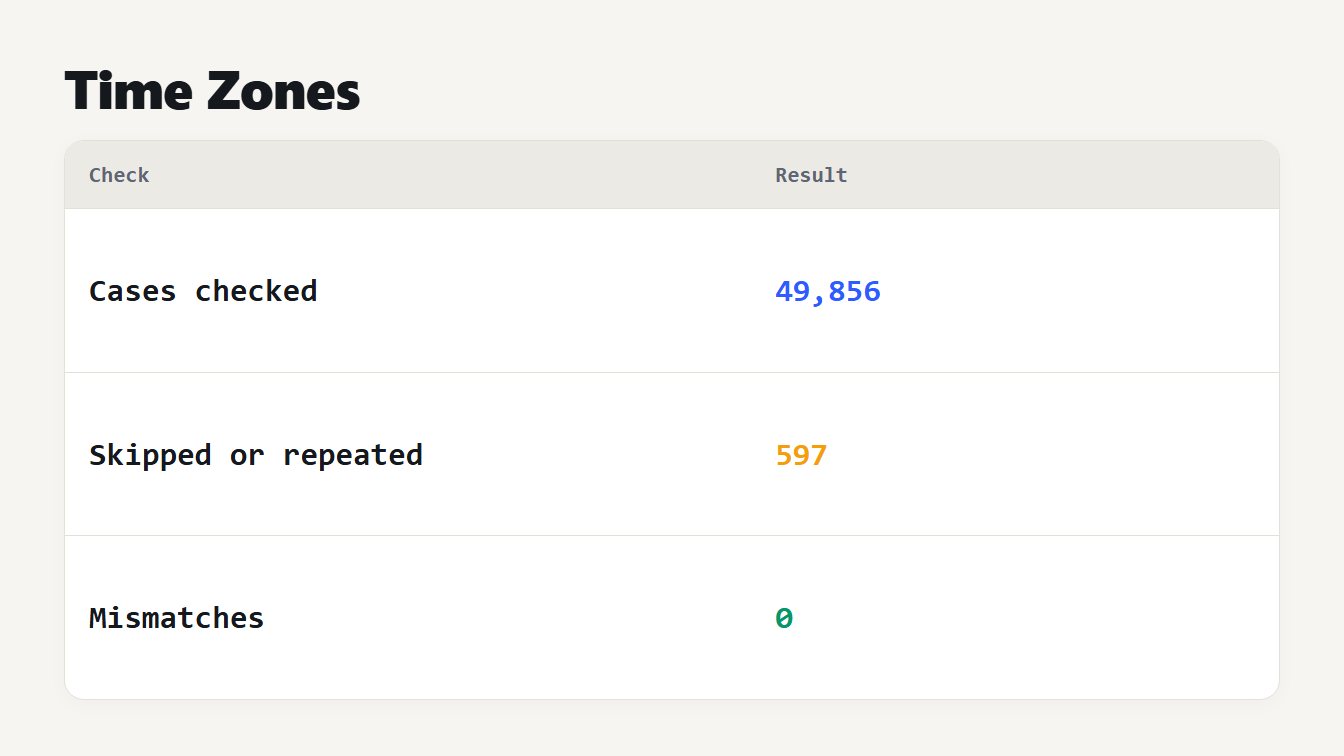
A table of three results for the time zone converter. 49,856 dates and times in 56 zones were compared with Python's zoneinfo. 597 of them were skipped or repeated by a clock change. There were 0 mismatches.
To convert time zones safely, turn the local time into UTC first, then turn UTC into the other zone. The step in the middle is the offset from UTC on that exact date, and it is the part people get wrong, because the offset changes with daylight saving. For example, 09:00 in New York on 1 July is UTC−04:00, so it is 13:00 UTC, and in Tokyo at UTC+09:00 it is 22:00 the same day. This guide shows the method, the weeks when the usual gap between two cities is wrong, and what to do with times that don't exist.
We also checked our converter on 49,856 cases.
The method to convert time zones
Don't convert between two local times directly. Every zone is defined by its offset from UTC, so the safe route is always local time to UTC to local time:
- Find the offset of the first zone on that date. New York is UTC−05:00 in winter and UTC−04:00 in summer.
- Subtract the offset to get UTC. Subtracting −04:00 means adding 4 hours, so 09:00 becomes 13:00 UTC.
- Add the offset of the second zone on that date. Tokyo is UTC+09:00 all year, so 13:00 UTC becomes 22:00.
Date matters at every step when you convert time zones, because the offset depends on the date. It also moves the calendar day sometimes: noon UTC on 1 July is already 00:45 the next day on the Chatham Islands, in New Zealand's far east.
Why the offset changes
Many places move their clocks twice a year. In the United States, according to NIST, daylight saving time starts on the second Sunday in March at 2:00 a.m., when clocks skip to 3:00 a.m. It ends on the first Sunday in November at 2:00 a.m., when they fall back to 1:00 a.m. The Energy Policy Act of 2005 set those dates, and they took effect in 2007.
The United Kingdom follows a different rule. GOV.UK says the clocks change on the last Sunday of March and the last Sunday of October. In 2026 that is 29 March and 25 October, while the US changes on 8 March and 1 November.
The result is that two cities don't keep a fixed gap. Take a 09:00 meeting in New York in 2026:
| Date | New York | London |
|---|---|---|
| 15 January | 09:00 | 14:00 |
| 15 March | 09:00 | 13:00 |
| 15 July | 09:00 | 14:00 |
| 28 October | 09:00 | 13:00 |
| 2 November | 09:00 | 14:00 |
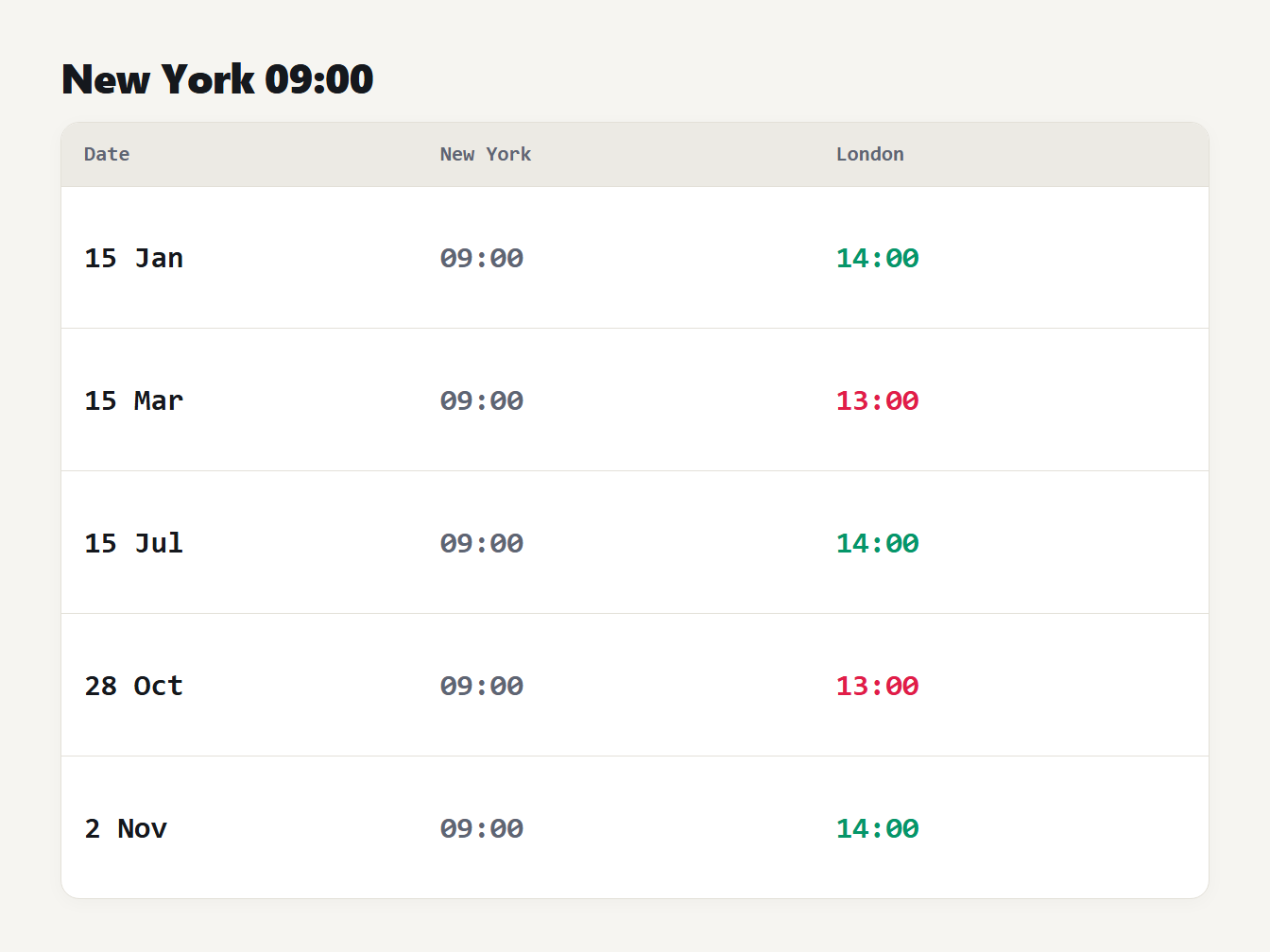
A table of what a 9:00 meeting in New York is in London time on five dates in 2026. On 15 January it is 14:00. On 15 March it is 13:00. On 15 July it is 14:00. On 28 October it is 13:00. On 2 November it is 14:00.
Between 8 and 28 March, and again between 25 October and 1 November, the gap is four hours, not five. If a recurring meeting is set up in the wrong week, one side is an hour off.
Not everyone changes. Tokyo and Kolkata keep the same offset all year. The same noon UTC in January and July shows how different places react:
| Place | 12:00 UTC in January | 12:00 UTC in July |
|---|---|---|
| London | 12:00 | 13:00 |
| New York | 07:00 | 08:00 |
| Sydney | 23:00 | 22:00 |
| Kolkata | 17:30 | 17:30 |
| Tokyo | 21:00 | 21:00 |
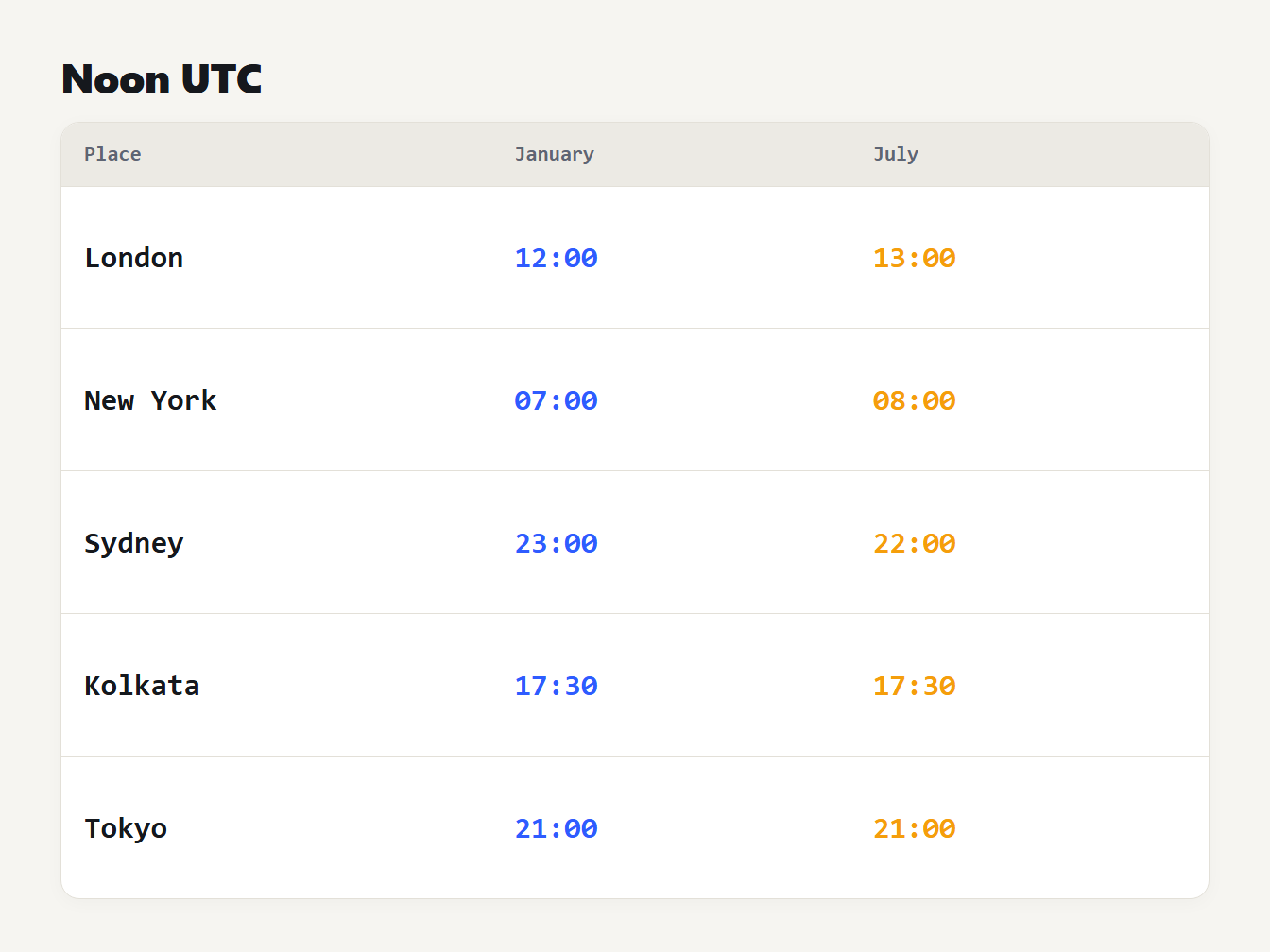
A table of what 12:00 UTC is in five places in January and July 2026. London is 12:00 and 13:00. New York is 07:00 and 08:00. Sydney is 23:00 and 22:00. Kolkata is 17:30 in both months. Tokyo is 21:00 in both months.
Sydney goes the other way, because the southern hemisphere has summer in January, so its clock is an hour earlier in July.
Two times that are not what they seem
Clock changes create two awkward cases, and any converter that doesn't deal with them will give a wrong answer without warning.
The skipped time. When the clocks spring forward, the hour from 02:00 to 03:00 doesn't exist. In New York on 8 March 2026, 02:30 never happens on any clock. Python's PEP 495 says that for a time in such a gap, the rules in effect before the transition are used when fold=0. For 02:30 that is UTC−05:00, so it works out as 07:30 UTC, which is 03:30 on the New York clock.
The repeated time. When the clocks fall back, the hour from 01:00 to 02:00 happens twice. In New York on 1 November 2026, 01:30 occurs first at UTC−04:00 and again an hour later at UTC−05:00. According to the PEP, fold=0 means the first occurrence and fold=1 the second, and Python's zoneinfo documentation shows 1:00 AM on 1 November 2020 in Los Angeles the same way.
| Case | Time in New York | In UTC |
|---|---|---|
| Skipped, 8 March | 02:30 | 07:30 |
| Repeated, first, 1 November | 01:30 | 05:30 |
| Repeated, second, 1 November | 01:30 | 06:30 |
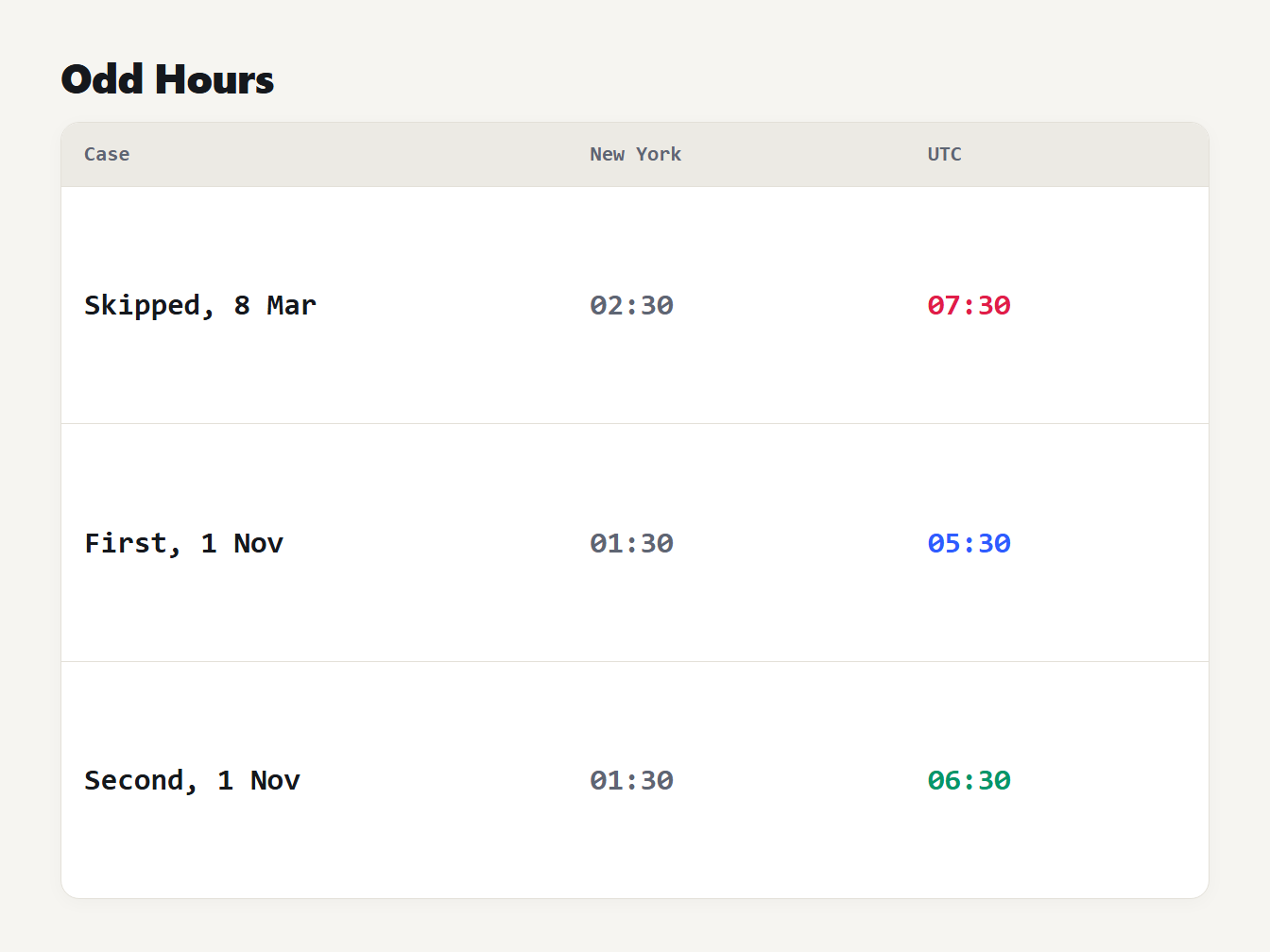
A table of the two odd cases in New York in 2026. The skipped time 02:30 on 8 March is treated as 07:30 UTC. The repeated time 01:30 on 1 November is 05:30 UTC the first time and 06:30 UTC the second time.
Our converter shows a warning for both cases. For a skipped time it tells you the clocks jump and which offset it used. For a repeated time it lets you choose the first or the second, because only you know which one you meant. The jump isn't always an hour: in our tests, Australia's Lord Howe Island moves its clocks by 30 minutes, from UTC+10:30 to UTC+11:00 on 4 October 2026.
Offsets that aren't whole hours
Don't assume that offsets are whole hours. India is UTC+05:30 and Nepal is UTC+05:45. The Chatham Islands are UTC+12:45 in July and UTC+13:45 in January. A converter that rounds offsets to whole hours will be wrong for these places.
| Place | Offset |
|---|---|
| Kolkata | UTC+05:30 |
| Kathmandu | UTC+05:45 |
| Chatham Islands, July | UTC+12:45 |
| Chatham Islands, January | UTC+13:45 |
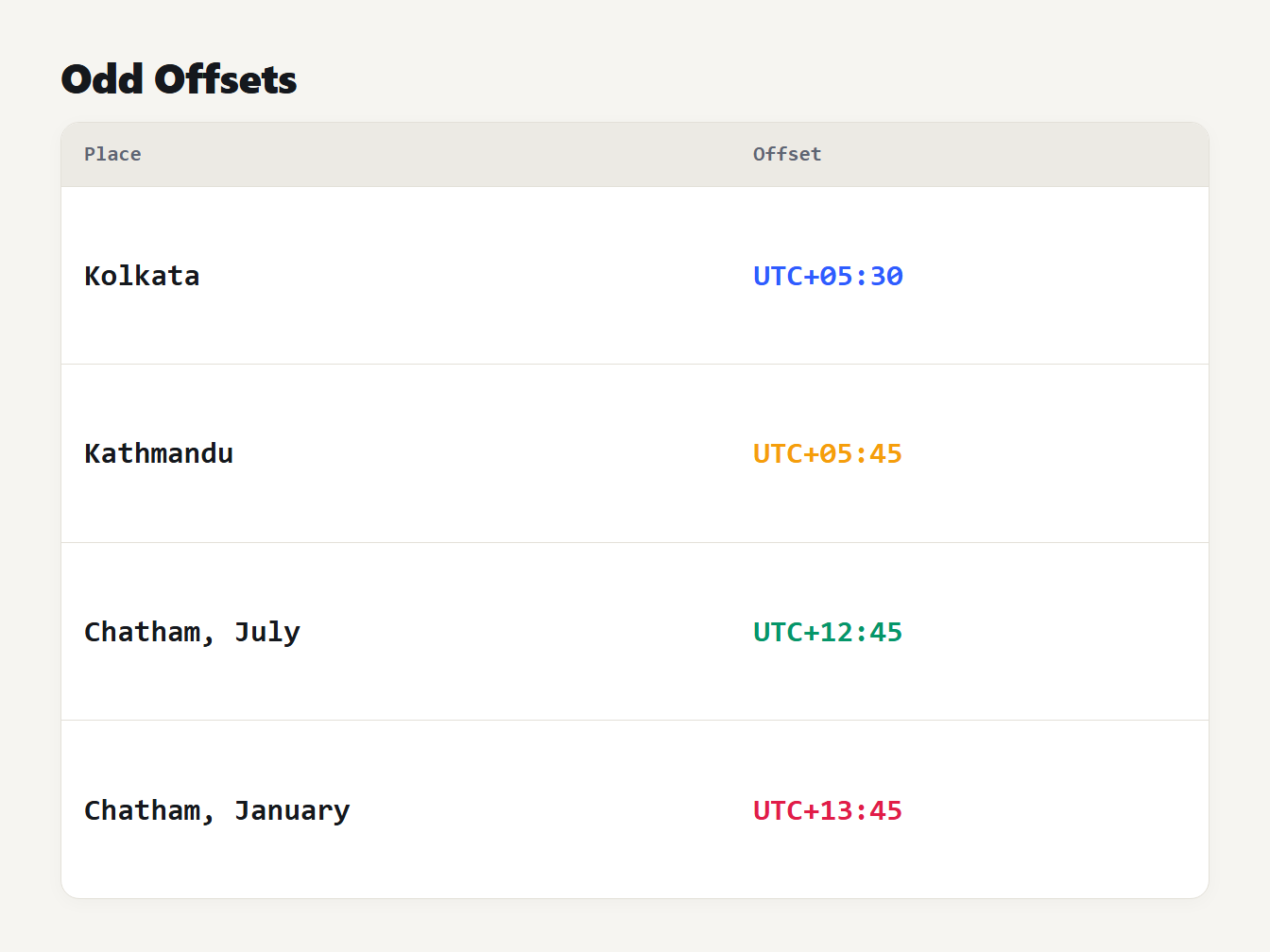
A table of four offsets from UTC that are not whole hours. Kolkata is UTC+05:30. Kathmandu is UTC+05:45. The Chatham Islands are UTC+12:45 in July and UTC+13:45 in January.
Time zone rules change
Time zone rules are laws, and laws change, so any tool that has to convert time zones depends on up-to-date data. The IANA Time Zone Database is the shared record of them. It stores machine-readable rules that software uses to find the right offset for a place on a date. At the time of writing its latest version is 2026e, released on 29 September 2026, and its listed change is that Manitoba moves to a permanent −05 offset on 31 October 2026.
We ran into this while checking our own tool. Our first comparison with Python had 627 mismatches. All of them involved one zone, Africa/Casablanca. Python's time zone data, version 2026e, treats Morocco as permanently on UTC+00. The data built into Node, which is version 2026b, still had Morocco on UTC+01 for most of the year. On the tz mailing list, Tim Parenti wrote that the change was added to the database on 25 June and released in version 2026c on 8 July.
This wasn't a bug in the logic. It was two copies of the database of different ages. But it taught us something: an old browser or device can show the wrong time for a place whose rules changed recently. We took Casablanca out of the list of zones and added Accra, which doesn't change, and the tool says it uses your browser's database.
How we checked the converter
We compared the converter with Python's zoneinfo on 49,856 combinations of a local date and time and a zone. They covered 56 zones from 2000 to 2035. Most were within a day or so of a clock change. We found 1,984 changes in those zones and, for each one, tried times every 30 minutes within three hours either side, plus ten random times within 30 hours. We added 40 random times for every zone.
Of the 49,856 cases, 294 fell in a skipped hour and 303 in a repeated hour. For every case we compared whether the time was normal, skipped or repeated, and the exact moment in UTC (both moments for a repeated time). We also compared the converted date, time and offset in three other random zones.
All matched, so there were 0 mismatches. That is the standard to hold any tool that has to convert time zones: it should agree with an independent database even on the hours that don't behave.
Limits
When you convert time zones with our tool, it uses 56 common zones, not every zone in the database. Dates run from 1900 to 2100, and it ignores seconds. It uses your browser's time zone data, so a very recent rule change can be missing in an old browser, and places that changed their rules after your browser was built will be wrong. Past dates use the rules that applied then only as far as the database records them.
Frequently asked questions
How do I convert a time from one time zone to another?
Find both zones' offsets from UTC on that date, subtract the first and add the second. For example, 09:00 in New York in July is UTC-04:00, so it is 13:00 UTC, and Tokyo at UTC+09:00 reads 22:00. The tool does it for you and knows the daylight saving rules for the date.
Why does a time sometimes not exist?
When the clocks spring forward, an hour is skipped. In New York on 8 March 2026 the clocks jump from 02:00 to 03:00, so 02:30 never happens. The tool flags it and uses the offset before the jump.
Why does a time sometimes happen twice?
When the clocks fall back, an hour is repeated. In New York on 1 November 2026 the hour from 01:00 to 02:00 happens twice, so you can choose the first or second 01:30 in the tool.
Is the time difference between two cities always the same?
No. New York and London are five hours apart for most of the year. For about three weeks in March and a week in October they are four, because the two places change their clocks on different dates.
Which time zone database does it use?
The one built into your browser, which follows the IANA time zone database. Rules change from time to time, so an old browser can be missing a recent change.
Convert a time now
Open the Time Zone Converter to see a date and time in as many zones as you like, with skipped and repeated times flagged. For converting between a date and a number of seconds, use the Timestamp Converter, and for the days between two dates, the Days Between Dates Calculator. Everything runs in your browser, so nothing you type is uploaded.