How to Calculate a Tip and Split the Bill to the Cent
Learn how to calculate a tip, tip before or after tax, split a bill to the cent, and see what rounding up does to your tip percentage. Checked on 40,000 bills.
By TheTextKit TeamPublished
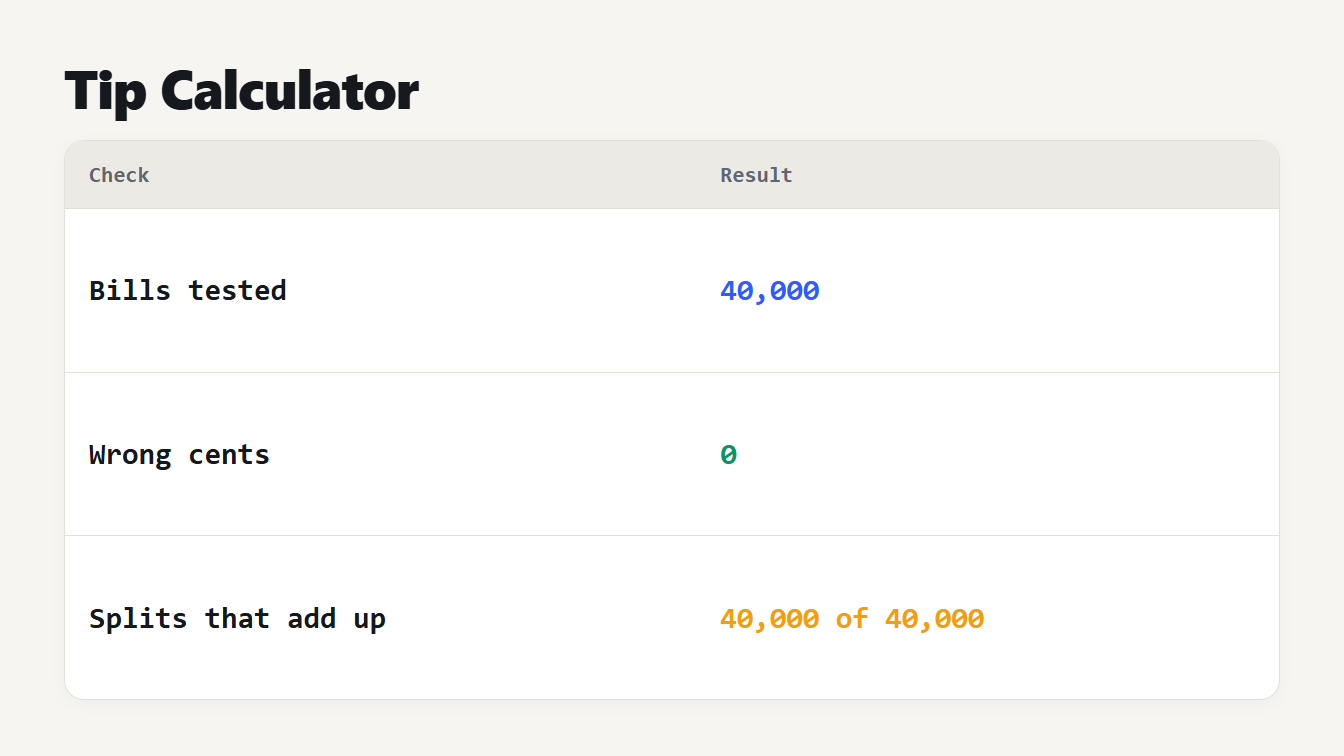
A table of three results for the tip calculator. 40,000 random bills, with tax, every tip base and every rounding choice, were compared with the Decimal type of Python. There were no wrong cents, and in all 40,000 the shares added up to the total.
To calculate a tip, multiply the bill by the tip percent written as a decimal. An 18% tip on 84.50 is 84.50 times 0.18, which is 15.21, and the total is 99.71. That is the easy part. The questions that cause arguments are different. Should you tip before or after tax? How do you split a total that does not divide into whole cents? And what happens to your tip when you round up? This guide answers them with numbers, and shows how we checked our tip calculator on 40,000 bills.
How to calculate a tip
- Turn the percent into a decimal. 18% is 0.18.
- Multiply the bill by it. 84.50 times 0.18 is 15.21.
- Round to the cent, with halves going up.
- Add the tip to the bill for the total: 84.50 plus 15.21 is 99.71.
For a quick estimate in your head, find 10% by moving the decimal point one place to the left, so 10% of 84.50 is 8.45. Then double it for 20%, or add half of it for 15%.
| Tip | How to get it | On a bill of 84.50 |
|---|---|---|
| 10% | Move the decimal point | 8.45 |
| 15% | 10% plus half of it | 12.68 |
| 18% | Multiply by 0.18 | 15.21 |
| 20% | Double the 10% | 16.90 |
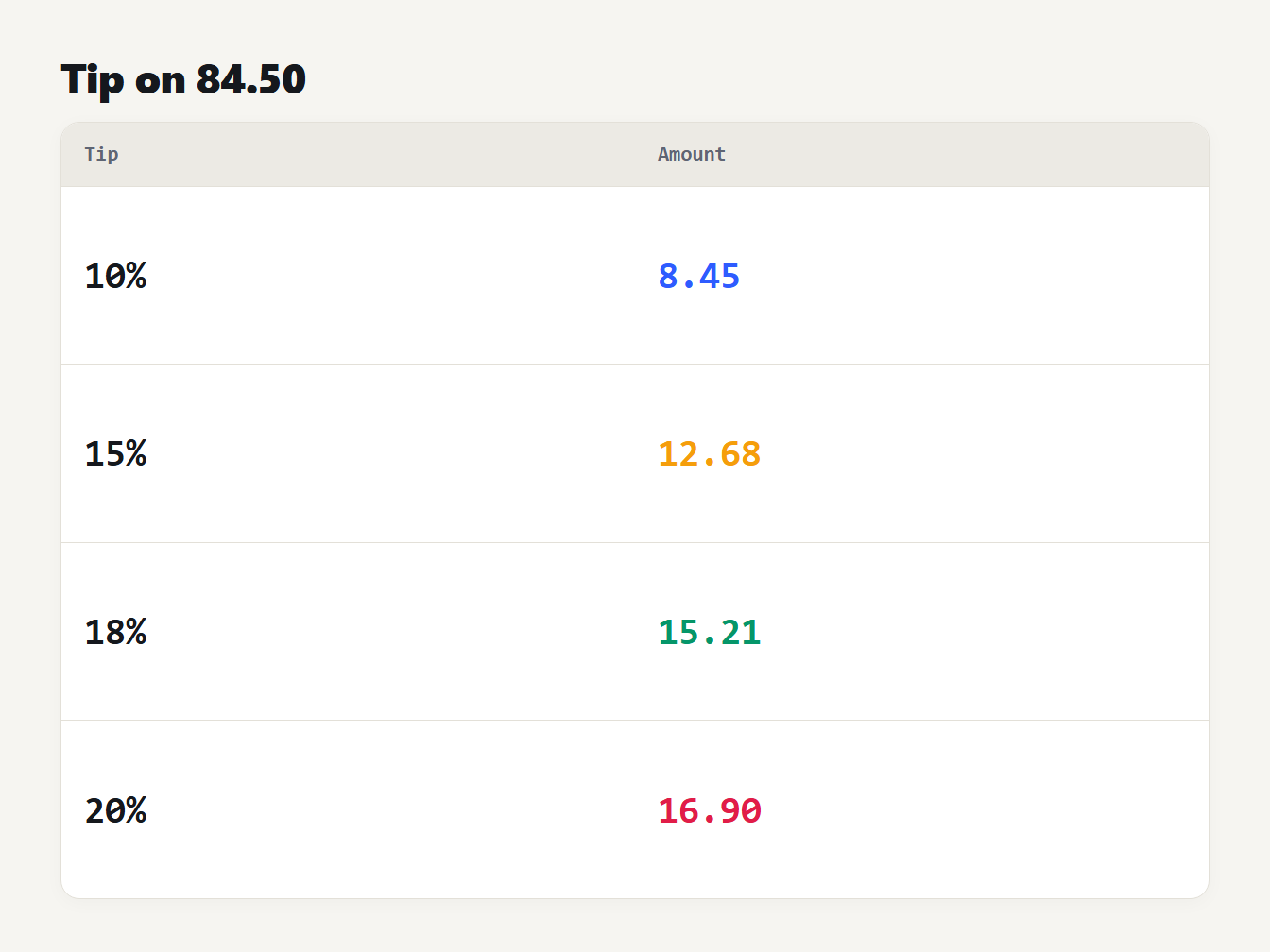
A table of four tip percentages on a bill of 84.50. A 10% tip is 8.45. A 15% tip is 12.68. An 18% tip is 15.21. A 20% tip is 16.90.
The Tip Calculator does the same for any bill and has buttons for the common percentages. The 15% row shows why rounding rules matter: 8.45 plus 4.225 is 12.675, a half cent, and it rounds up to 12.68.
Before tax or after tax?
You can base the tip on the bill before tax or on the bill plus tax. Both are used, and the answer depends on where you are and who you ask. The Wikipedia article on tipping says tipping is a matter of social custom and etiquette, and that the custom varies between countries and between settings.
What you can count is the difference. On a bill of 100.00 with 8.00 of tax and a 20% tip:
| Tip worked out on | Tip | Total |
|---|---|---|
| The bill before tax, 100.00 | 20.00 | 128.00 |
| The bill plus tax, 108.00 | 21.60 | 129.60 |
| Difference | 1.60 | 1.60 |
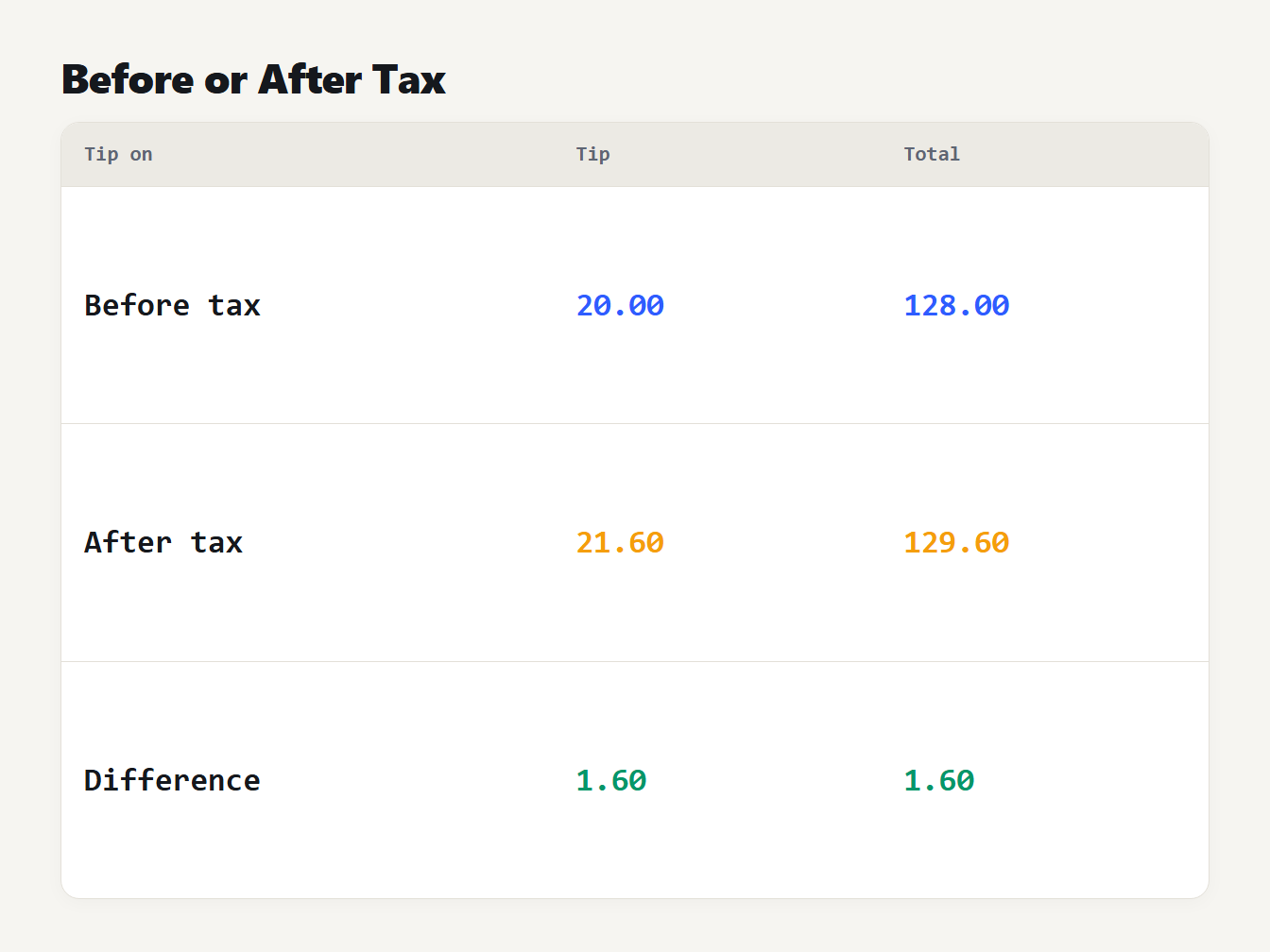
A table comparing a 20% tip worked out before tax and after tax on a bill of 100.00 with 8.00 of tax. Before tax, the tip is 20.00 and the total is 128.00. After tax, the tip is 21.60 and the total is 129.60. The difference is 1.60.
Check the bill for a service charge too. The same Wikipedia article says a fixed percentage is sometimes added to the bill. Tipping may not be expected when a fee is charged for the service, and a service charge is paid to the business and not to the staff.
Splitting the bill and the leftover cents
Splitting is easy when the total divides evenly. When it does not, you hit the penny problem. Take a total of 99.71 for 3 people. That is 9,971 cents, and 9,971 divided by 3 is 3,323 with 2 left over. So two people pay 33.24 and one pays 33.23, which adds up to exactly 99.71. If everyone paid 33.24, the table would collect 99.72, a cent too much.
The tool does this for you and tells you how many people pay each amount. It matters more often than you'd think. If bill totals are spread evenly across the cents, a share of them that is not divisible by the number of people will leave a remainder.
| People | Totals that split into whole cents | Totals that leave a remainder |
|---|---|---|
| 2 | 50.0% | 50.0% |
| 3 | 33.3% | 66.7% |
| 4 | 25.0% | 75.0% |
| 6 | 16.7% | 83.3% |
For example, 99.71 shared by 4 people gives 3 shares of 24.93 and 1 share of 24.92.
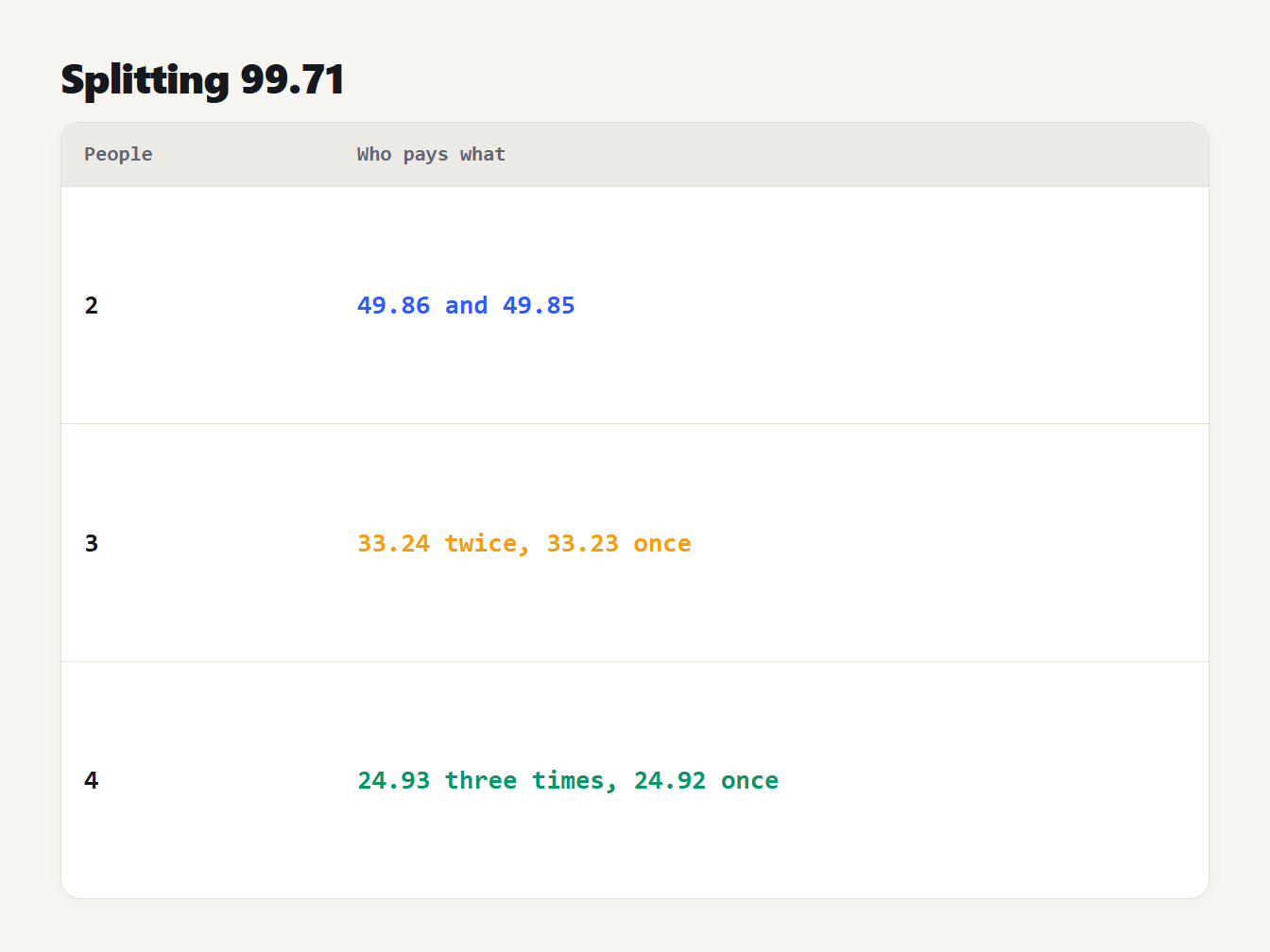
A table of how a total of 99.71 splits between 2, 3 and 4 people. Two people pay 49.86 and 49.85. Three people pay 33.24 twice and 33.23 once. Four people pay 24.93 three times and 24.92 once.
What rounding up does to the tip
Many people round up to a whole amount to make the sum easy. That raises the tip, and on small bills it raises it a lot. We took every bill from 10.00 to 50.00, and every bill from 50.00 to 200.00, in steps of one cent, with an 18% tip on the bill before tax. Then we measured the percentage the tip really came to.
| Rounding | Bills from 10 to 50 | Bills from 50 to 200 |
|---|---|---|
| Exact to the cent | 18.00% | 18.00% |
| Round the total up to a whole amount | 19.99% | 18.46% |
| Round each of 4 shares up to a whole amount | 26.22% | 19.84% |
Those are averages. The highest tip we saw when rounding the total up was 27.7% on the smaller bills. When rounding 4 shares up it was 57.2%, which happens when a share is just over a whole amount. The calculator shows the real percentage next to the tip, so you can decide whether you want that.
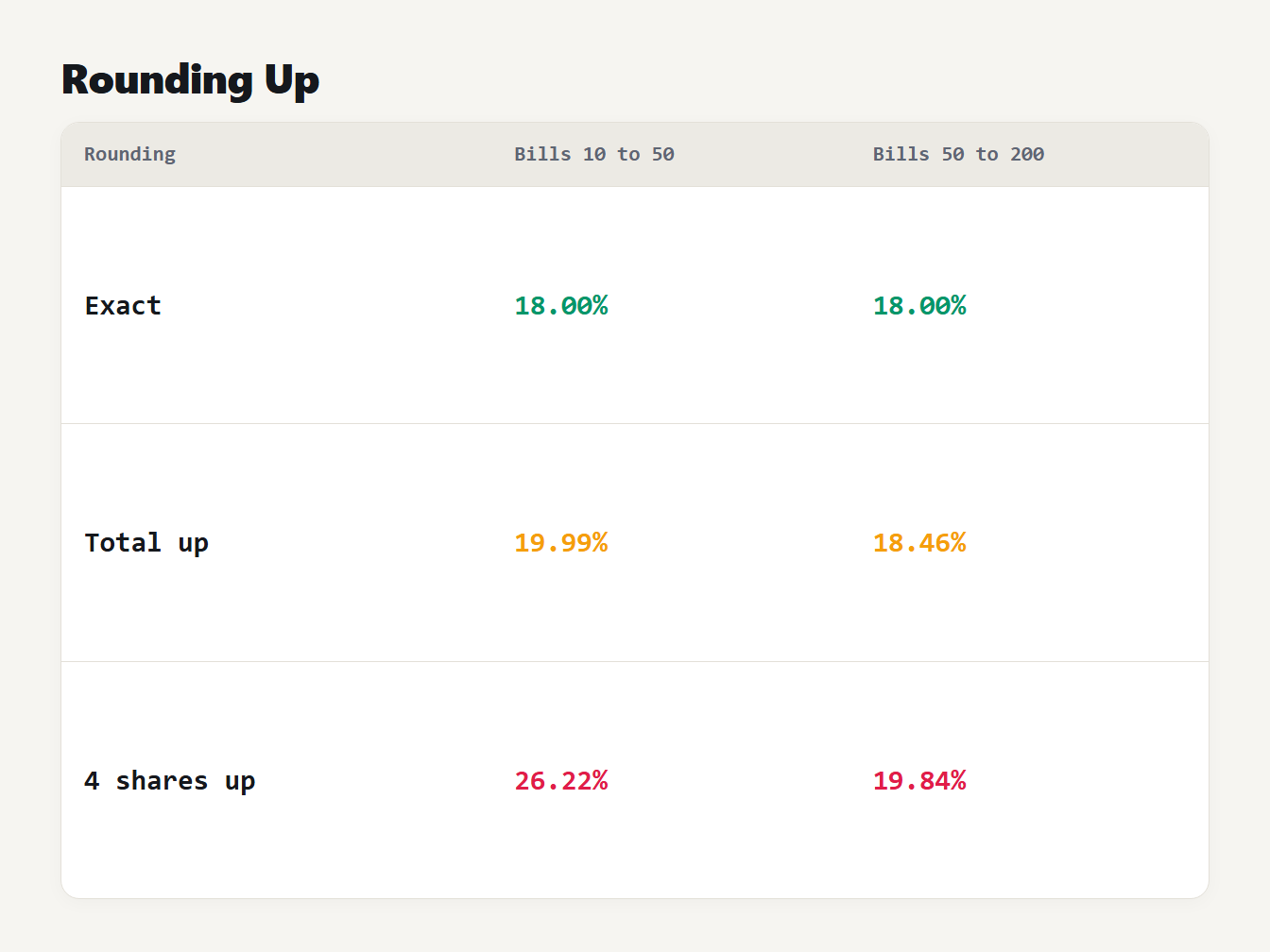
A table of the average real tip percentage when an 18% tip is rounded up. Exact tips average 18.00%. Rounding the total up gives 19.99% on bills from 10 to 50 and 18.46% on bills from 50 to 200. Rounding 4 shares up gives 26.22% and 19.84%.
A worked example for four people
Say four friends have a bill of 212.40 with 17.52 of tax, and they want to leave 18% on the bill before tax.
- The tip is 212.40 times 0.18, which is 38.232, so 38.23.
- The total is 212.40 plus 17.52 plus 38.23, which is 268.15.
- That is 26,815 cents. Divided by 4 it is 6,703 with 3 left over, so three people pay 67.04 and one pays 67.03.
If they work the tip out on the bill plus tax, 229.92, the tip is 41.39 and the total is 271.31, so three pay 67.83 and one pays 67.82. And if they round each share up to a whole amount, everyone pays 68.00, the total is 272.00 and the tip grows to 42.08, which is 19.81% of the bill before tax.
How we tested the tip calculator
A script generated 40,000 random bills, from a cent to 10 digits. About a third had tax, and each had a random tip percent, either tip base, between 1 and 100 people and one of the three rounding choices. For each one, Python's Decimal type gave the tip, the total, the tax, the real tip percentage and the share each person pays, rounding halves up to the cent. According to the Python documentation, decimal numbers are represented exactly, binary floating point cannot hold numbers like 1.1 exactly, and decimal is preferred in accounting. We also checked that the shares added up to the total.
| Check | Bills | Result |
|---|---|---|
| Tip, total and percent against Python | 40,000 | 0 mismatches |
| Shares added up to the total | 40,000 | All |
| Each of the three rounding choices | All three | 0 mismatches |
Limits
Tipping customs differ between countries, and so does what a bill includes, so the percent is your choice. It isn't something a calculator can decide. The calculator does not know whether a service charge is in your bill. It works with one tax amount that you type. And it splits equally, so it cannot handle people who ordered different things.
Frequently asked questions
How do I calculate a tip?
Multiply the bill by the tip percent as a decimal. An 18% tip on 84.50 is 84.50 times 0.18, which is 15.21. Add it to the bill for the total, 99.71. For a quick estimate, take 10% by moving the decimal point one place, then add or double it.
Should the tip be on the bill before or after tax?
Both are used, and customs vary by place. Working it out on the bill before tax gives a smaller tip. On a 100.00 bill with 8.00 tax, a 20% tip is 20.00 before tax and 21.60 after. The tool lets you pick either.
How do I split a bill with a tip evenly?
Add the tip to the bill and divide the total by the number of people. If it does not divide into whole cents, a few people pay one cent more, so the shares still add up to the total. Giving everyone the higher amount would collect a few cents too much.
What does rounding up do to the tip?
It raises the tip to make a whole amount, so the real percentage is higher than the one you chose. On bills from 10 to 50 with an 18% tip, rounding the total up gives an average of 19.99%. On bills from 50 to 200 the average is 18.46%.
Is a service charge the same as a tip?
No. A service charge is a fee added by the business, and it is usually paid to the business, not to the staff. Check the bill before you add a tip, because tipping may not be expected when a fee has already been charged for the service.
Work out your tip now
Enter the bill in the Tip Calculator to calculate a tip, split it between people and see exactly who pays the extra cent. For other percentages, use the Percentage Calculator, and to work out a sale price, the Discount Calculator. Everything runs in your browser, so nothing you enter is uploaded.