How Many Words Per Page? A Measured Guide by Font and Spacing
How many words per page? About 285 double-spaced and 570 single-spaced in 12 pt Times New Roman. See our measured table by font and a pages converter.
By TheTextKit TeamPublished
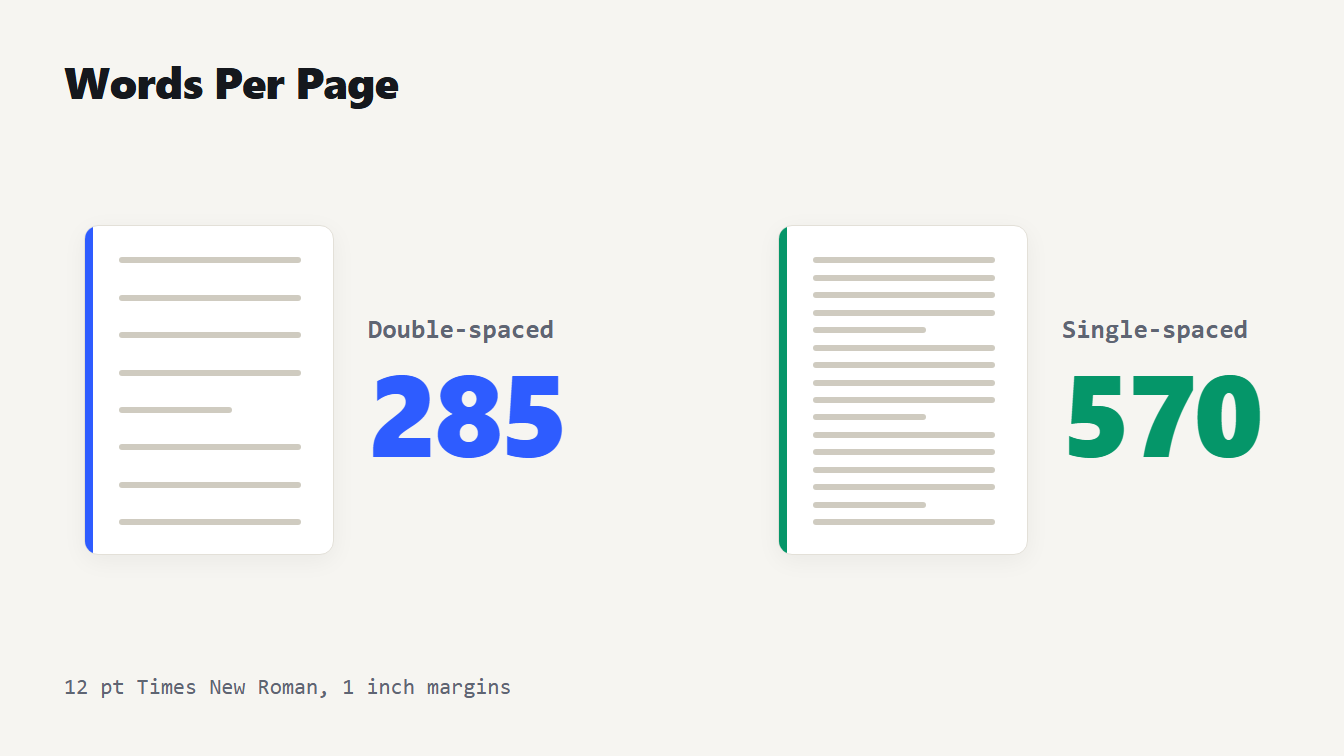
Two page illustrations show about 285 words on a double-spaced page and about 570 on a single-spaced page, in 12 point Times New Roman with 1 inch margins.
How many words per page? For typical essay prose in 12 point Times New Roman with 1 inch margins, about 285 words double-spaced and about 570 single-spaced. The usual rule of 250 and 500 is a conservative floor. We measured it by laying out real text on a US Letter page, and the result moves with word length, font size and line spacing. Below are the numbers for five fonts, how we measured them, why they change, what APA and MLA require and a table that turns pages into words.
How many words per page? The short answer
Here are the measured figures for typical essay prose, averaged over three pages, on a page with 1 inch margins:
| Font and size | Double-spaced | Single-spaced |
|---|---|---|
| Times New Roman, 12 pt | 285 | 569 |
| Times New Roman, 11 pt | 327 | 666 |
| Calibri, 11 pt | 315 | 628 |
| Arial, 11 pt | 309 | 631 |
| Georgia, 11 pt | 309 | 632 |
So the quick estimate holds up: about 300 words for a double-spaced page and about 600 for a single-spaced one. If you want a figure you can defend, use 285 and 570 for 12 pt Times New Roman, the font most assignments assume.
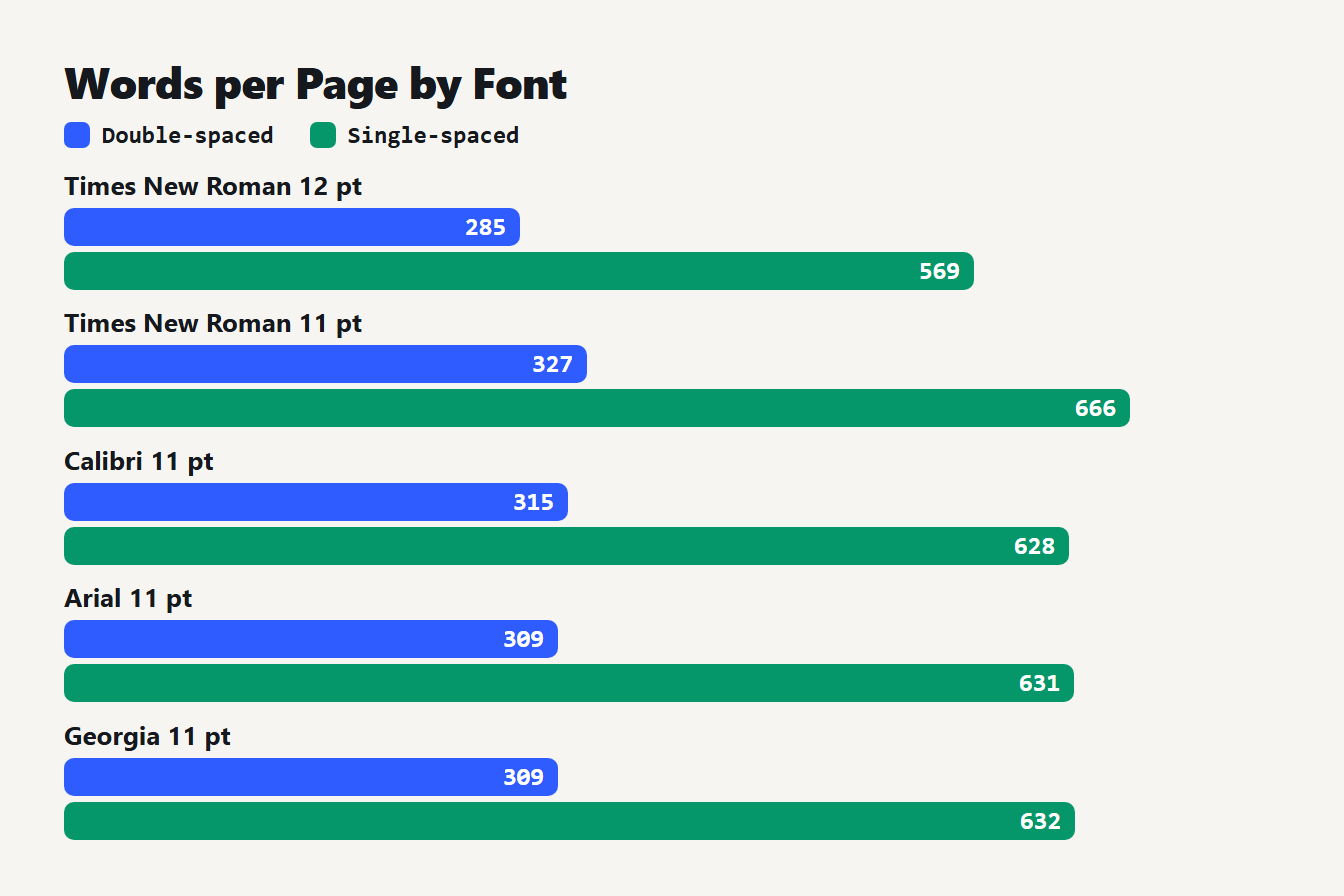
Words per page for typical prose with 1 inch margins. Double-spaced: Times New Roman 12 pt 285, Times New Roman 11 pt 327, Calibri 11 pt 315, Arial 11 pt 309, Georgia 11 pt 309. Single-spaced: 569, 666, 628, 631 and 632.
How we measured it
Most guides quote a number without saying where it came from, so here is ours. We laid out text in a Chromium browser on a page the size of US Letter paper, 8.5 by 11 inches. With 1 inch margins the text area is 6.5 by 9 inches, which is 468 by 648 points.
Line spacing came from the fonts themselves. We read the line metrics from the installed font files, and for 12 point Times New Roman they give a single line height of 13.8 points. Double spacing is twice that, 27.6 points, so a page holds 648 ÷ 27.6 = 23.5 lines, which means 23 full lines. Single spacing fits 46. Paragraphs had a half-inch first-line indent and no extra space between them.
We used two original passages. The "typical" one is student-essay prose that averages 5.5 letters per word. The "simple" one uses shorter words and averages 4.1. We counted the words that landed on each of three consecutive pages and averaged them.
Word's own line breaking can differ from a browser's by a few words per page, so treat these as close estimates, then check against your own document. The method is described so you can repeat it.
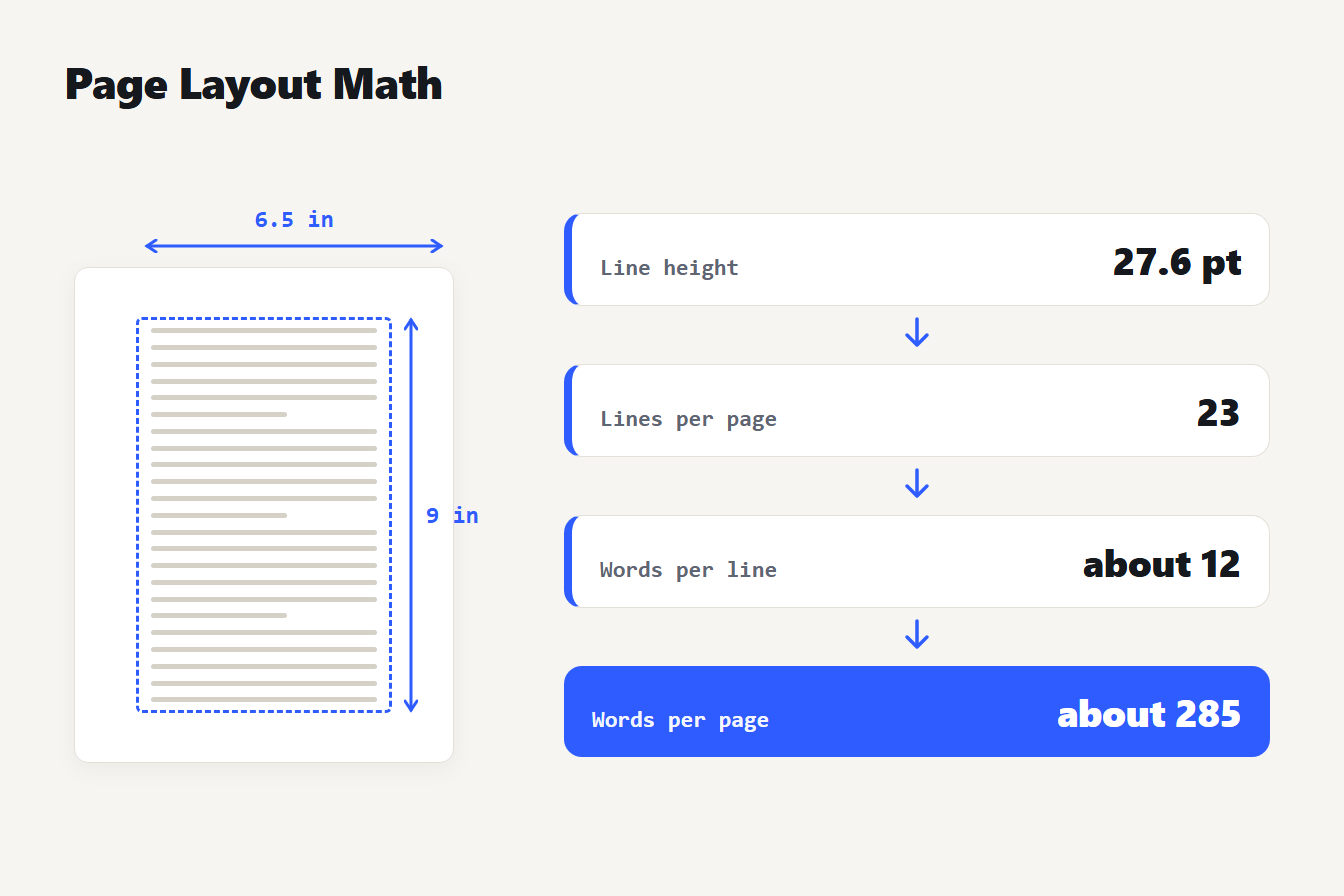
A US Letter page with 1 inch margins has a 6.5 by 9 inch text area. With 12 point Times New Roman at double spacing, each line is 27.6 points, so 23 lines fit, holding about 285 words.
Why the number changes
Word length is the biggest swing. The same layout held 364 words of simple prose and 285 of typical essay prose on a double-spaced Times New Roman page. That is 28 percent more words for the shorter-word text. Technical or academic writing with longer words sits at the low end.
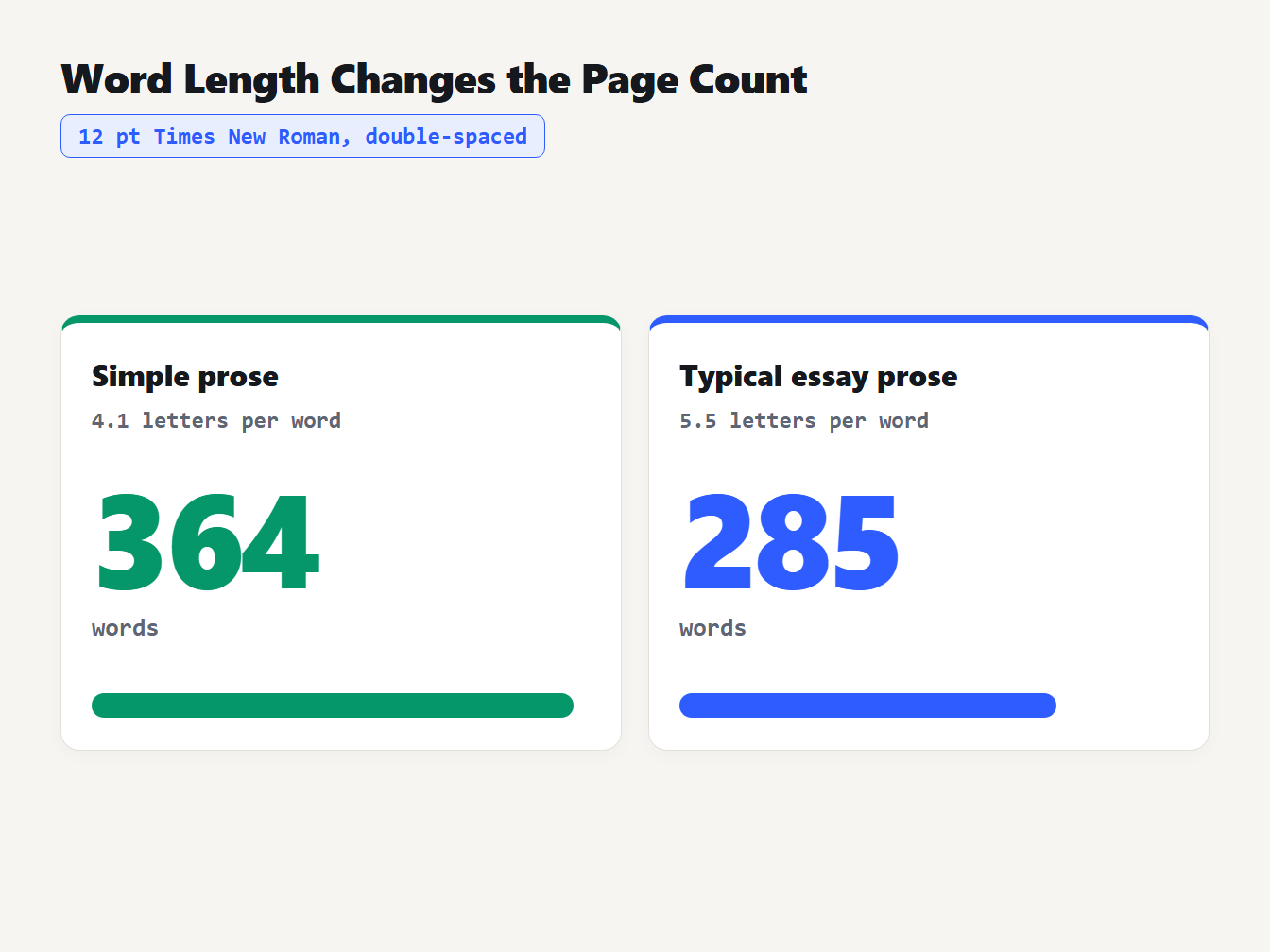
In 12 point Times New Roman with 1 inch margins and double spacing, simple prose averaging 4.1 letters per word fits 364 words per page, and typical essay prose averaging 5.5 letters per word fits 285.
Font and size. Dropping from 12 to 11 point Times New Roman raised a double-spaced page from 285 to 327 words, a gain of 15 percent. Arial, Georgia and Calibri at 11 point landed between 309 and 315.
Line spacing. This one is exact: double spacing doubles the line height, so it halves the words. 285 becomes 569.
Margins and paper size. These matter enough for their own section, just below. Headings, block quotes, tables and images also lower the count, and we did not measure them.
How many words per page with different margins?
We reran the 12 point Times New Roman test on the same typical essay text with different margins, all on US Letter paper, averaged over three pages:
| Margins | Double-spaced | Single-spaced |
|---|---|---|
| 0.75 inch | 316 | 643 |
| 1 inch | 285 | 569 |
| 1.25 inch | 272 | 543 |
| 1.5 inch | 213 | 435 |
Narrowing the margins from 1 inch to 0.75 adds about 11 percent more words per page. Widening them to 1.5 inches removes about 25 percent. That gap is why assignments specify margins at all: without the rule, the same text would run to different page counts.
Paper size matters too. On A4 paper with 1 inch margins, the same text fitted 308 words per double-spaced page (25 lines) and 617 single-spaced (50 lines). A4 is narrower but taller than US Letter, and the extra height wins. If your school uses A4, add roughly 8 percent to the Letter figures.
What APA and MLA require
When an instructor says "a five-page paper," the settings usually come from a style guide. Library guides at Augusta University summarize APA 7 this way: double-space the entire paper and use 1 inch margins on all sides. Pick a font from the approved list, which includes 12 point Times New Roman and 11 point Calibri, Arial or Georgia (Augusta University's APA 7 guide). MLA 9 asks for 1 inch margins, a double-spaced paper including the works cited list, and an easily readable font such as 12 point Times New Roman (Folsom Lake College's MLA 9 guide).
That is why 12 point Times New Roman, double-spaced, is the default for page-to-word math. Check your assignment sheet before you rely on it, because an instructor can set different rules.
Words to pages: a lookup table
Multiply the page count by the per-page figure. For typical essay prose in 12 point Times New Roman with 1 inch margins:
| Pages | Double-spaced words | Single-spaced words |
|---|---|---|
| 1 | 285 | 570 |
| 2 | 570 | 1,140 |
| 3 | 855 | 1,710 |
| 5 | 1,425 | 2,850 |
| 10 | 2,850 | 5,700 |
| 20 | 5,700 | 11,400 |
For a 5-page double-spaced paper, aim for about 1,400 words. With short-word prose the same five pages can take up to about 1,800. Title pages and reference lists usually sit outside the page count, so ask whether they count.
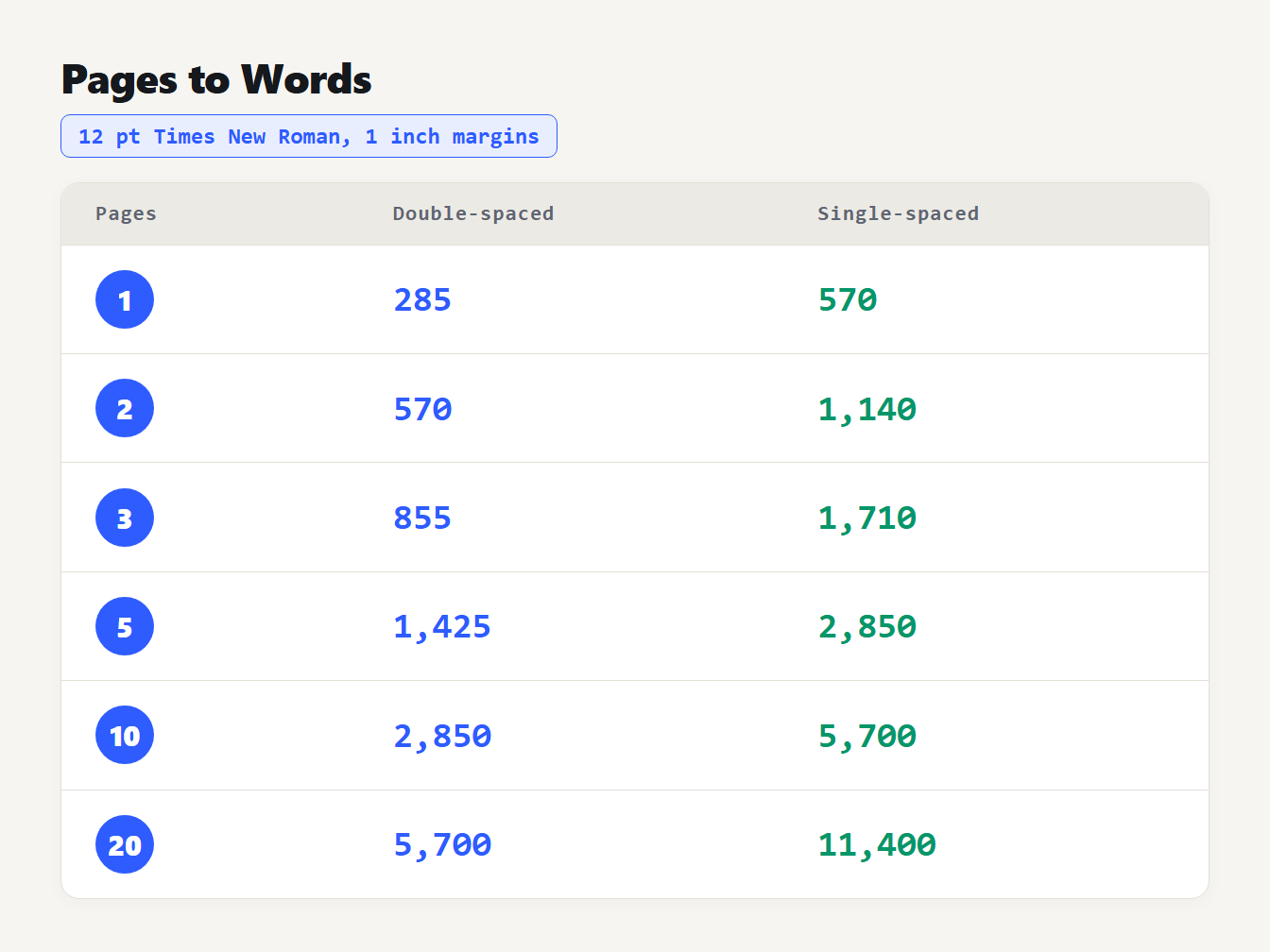
For 12 point Times New Roman with 1 inch margins: 1 page is 285 words double-spaced and 570 single-spaced, 2 pages are 570 and 1,140, 3 are 855 and 1,710, 5 are 1,425 and 2,850, 10 are 2,850 and 5,700, and 20 are 5,700 and 11,400.
Turn your own text into pages
The lookup table is a guide. Your text is the real answer, and it takes three steps:
- Count the words. Paste your draft into the Word Counter. It shows the total without any layout guesswork.
- Divide by your words per page. Use 285 for double-spaced Times New Roman 12, or the figure for your font from the first table.
- Round up. A page and a bit is two pages on paper.
Need the reverse, a word target from a page limit? Multiply instead. If you also want to know how long your piece takes to read, use the Reading Time Calculator. Our guide to how long it takes to read 1,000 words explains the research behind its speeds. For limits measured in letters rather than words, use the Character Counter.
Mistakes that throw off a page estimate
- Using 250 for everything. It is a floor. For 11 point fonts the measured figure is 25 to 30 percent higher.
- Ignoring word length. A page of long academic words holds fewer words than a page of plain prose.
- Counting the title page and references. Most instructors don't, so confirm.
- Stretching the layout. Widening margins from 1 to 1.5 inches drops a page from 285 to 213 words, so the trick is easy to spot and often against the assignment rules.
- Trusting one tool. Different programs break lines differently, so check the page count in the program you will submit from.
Frequently asked questions
How many words is a double-spaced page?
About 285 words for typical essay prose in 12 point Times New Roman with 1 inch margins. We measured 23 lines per page. Text with shorter words fits more, up to about 365, so 250 is a safe minimum rather than the usual figure.
How many words is a single-spaced page?
About 570 words in 12 point Times New Roman with 1 inch margins, for typical essay prose. That is exactly twice the double-spaced figure, because single spacing fits twice as many lines: 46 instead of 23.
How many words is a 5 page essay?
About 1,425 words double-spaced in 12 point Times New Roman with 1 inch margins, and a range of roughly 1,400 to 1,800 depending on word length. Single-spaced, five pages is about 2,850 words. Title pages and reference lists usually do not count.
Does the font change how many words fit on a page?
Yes. In our measurements, double-spaced pages held about 285 words in 12 point Times New Roman, 309 in 11 point Arial or Georgia and 315 in 11 point Calibri. Font size matters as much as the typeface.
Why do some sites say 250 words per page?
Because 250 and 500 are easy round numbers and a conservative floor. Our layout test found about 285 and 570 for typical prose in 12 point Times New Roman. Use the round numbers for a quick estimate and a counter for the real thing.
Count first, then convert
So how many words per page do you get? Paste your draft into the Word Counter, divide by 285 for a double-spaced Times New Roman 12 page, and round up. If the answer is a page over your limit, trim words rather than margins.