What Is Lorem Ipsum? Origin, Meaning and How to Use It
What is Lorem Ipsum? Altered Latin from Cicero's De finibus, compared word by word, plus why designers use it, how much text to expect and a free generator.
By TheTextKit TeamPublished
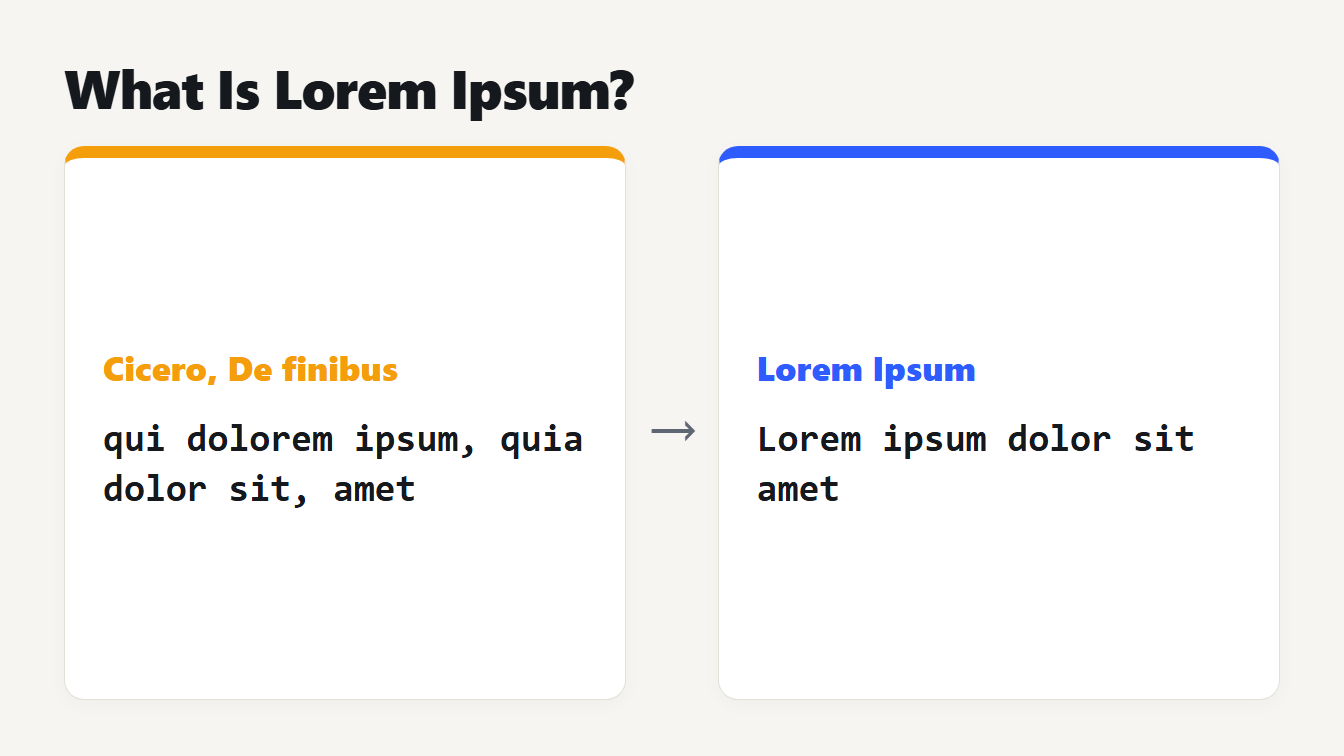
Two cards show the change. Cicero's Latin reads qui dolorem ipsum, quia dolor sit, amet. The placeholder text reads Lorem ipsum dolor sit amet. An arrow joins them.
Lorem Ipsum is placeholder text that designers use to fill a layout before the real words exist. So what is Lorem Ipsum, exactly? It is scrambled Latin taken from a work by the Roman writer Cicero, with words changed, cut and joined until it no longer makes sense. We compared it with the Latin original word by word, and the result is below. The short version: most of it is real Latin, none of it is a real sentence, and it begins with the leftover of two words, dolorem ipsum, which mean pain itself.
What is Lorem Ipsum, and where does it come from?
Lorem Ipsum comes from Cicero's De finibus bonorum et malorum, a Latin work from the first century BC. The standard text is built from sections 32 and 33 of Book 1, where the speaker Torquatus argues about pleasure and pain. Wikipedia's article on Lorem ipsum records that Richard McClintock, a Latin scholar at Hampden-Sydney College, traced it by looking up the rare word "consectetur" in classical literature. It reports that he published his finding in a 1994 letter. It also says he later admitted that his claim of 1500s use was a guess with no evidence.
The same article says Letraset transfer sheets spread the text in the late 1960s, with a first publication in 1966, and that it later appeared in word processors and web publishing software. So treat the often repeated claim that Lorem Ipsum has been filler "since the 1500s" with caution. The Latin is ancient. The use as filler text is much more recent.
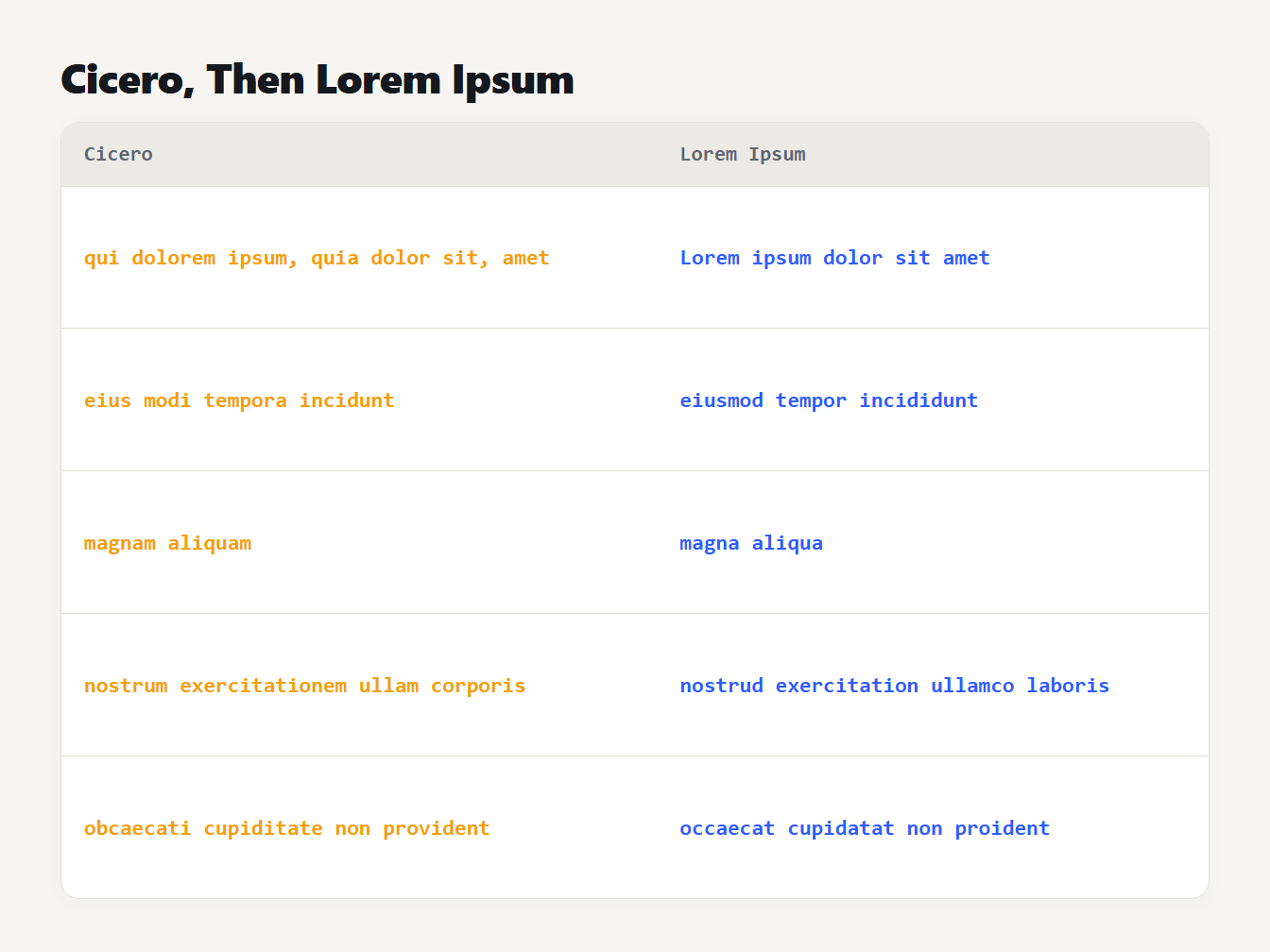
A table of five phrases, each shown in Cicero's Latin and then as it appears in Lorem Ipsum. For example dolorem ipsum, quia dolor sit, amet becomes Lorem ipsum dolor sit amet, and eius modi tempora incidunt becomes eiusmod tempor incididunt.
Lorem Ipsum compared with Cicero, word by word
We downloaded the Latin text of Book 1 from The Latin Library and compared sections 32 and 33 with the standard first paragraph of Lorem Ipsum. The Latin passage has 249 words, 182 of them distinct. The Lorem Ipsum paragraph has 69 words, 63 of them distinct. Here is how the 63 compare:
| Match with Cicero | Distinct words |
|---|---|
| Exactly the same word | 35 |
| Within two letters of a Cicero word | 25 |
| No close match | 3 (do, eiusmod, eu) |
Counting every word instead of each distinct one, 41 of the 69 words in the paragraph appear verbatim in the passage. The five phrases below show how the rest were altered:
| Cicero | Lorem Ipsum |
|---|---|
| qui dolorem ipsum, quia dolor sit, amet | Lorem ipsum dolor sit amet |
| eius modi tempora incidunt | eiusmod tempor incididunt |
| magnam aliquam | magna aliqua |
| nostrum exercitationem ullam corporis | nostrud exercitation ullamco laboris |
| obcaecati cupiditate non provident | occaecat cupidatat non proident |
Look at the first row. "Lorem" is "dolorem" without its first two letters. The next row shows two words, "eius modi", joined into the nonword "eiusmod". Most of the changes are small: a final letter dropped, "tempora" becoming "tempor", "magnam aliquam" becoming "magna aliqua". That is why the text feels like Latin when you read it and falls apart when you try to translate it.
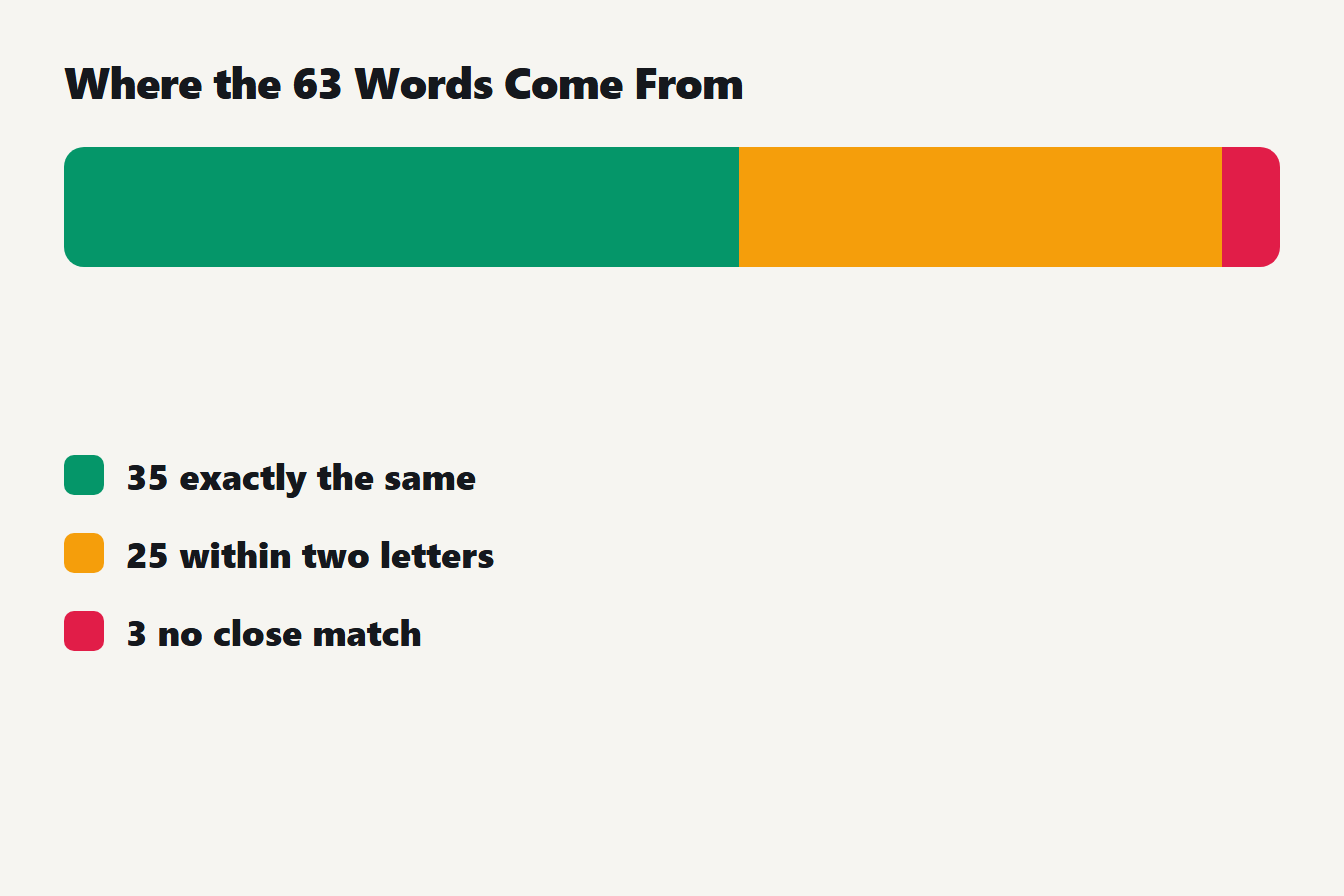
A bar split into three parts shows the 63 distinct words of the standard Lorem Ipsum paragraph. 35 appear exactly in Cicero's text, 25 are within two letters of a Cicero word, and 3 have no close match.
The text in our generator's sample shows the same thing from the other side. Its second paragraph begins "Sed ut perspiciatis unde omnis iste natus error" and runs for 54 words. We checked, and that stretch appears unchanged in Cicero's section 32, apart from punctuation. The third paragraph, which begins "At vero eos et accusamus", matches section 33 except for one word: the Latin Library prints "obcaecati" where the common Lorem Ipsum text has "occaecati". Printed editions of a Latin text differ in small ways like this.
Why designers use Lorem Ipsum
Put simply, what is Lorem Ipsum for? It stands in for words that don't exist yet. Placeholder text lets a designer look at layout, spacing and typography without the words themselves drawing attention. Wikipedia describes the purpose in the same way: filler lets you focus on the design independently of the copy that will fill it. Real sentences make people read and react to the content. Lorem Ipsum looks like text, so a column of it looks finished, but no one takes it as a message.
It has practical advantages too. It works in any layout, and it is easy to recognize as a placeholder, so people don't mistake it for finished copy. It also gives you a way to fill a page quickly. You can see how headings, body text and buttons behave before the writer has delivered a word.
How much Lorem Ipsum do you need?
It depends on how long your real text will be. To help you plan, we measured the output of our generator by running it thousands of times. A random sentence has between 6 and 13 words, with an average of 9.5. A paragraph has 4 to 6 sentences and averages 47.5 words, or about 317 characters. Here are the totals for the paragraph mode, with the classic opening sentence switched on:
| Paragraphs | Average words |
|---|---|
| 1 | 57 |
| 3 | 152 |
| 5 | 247 |
| 10 | 485 |
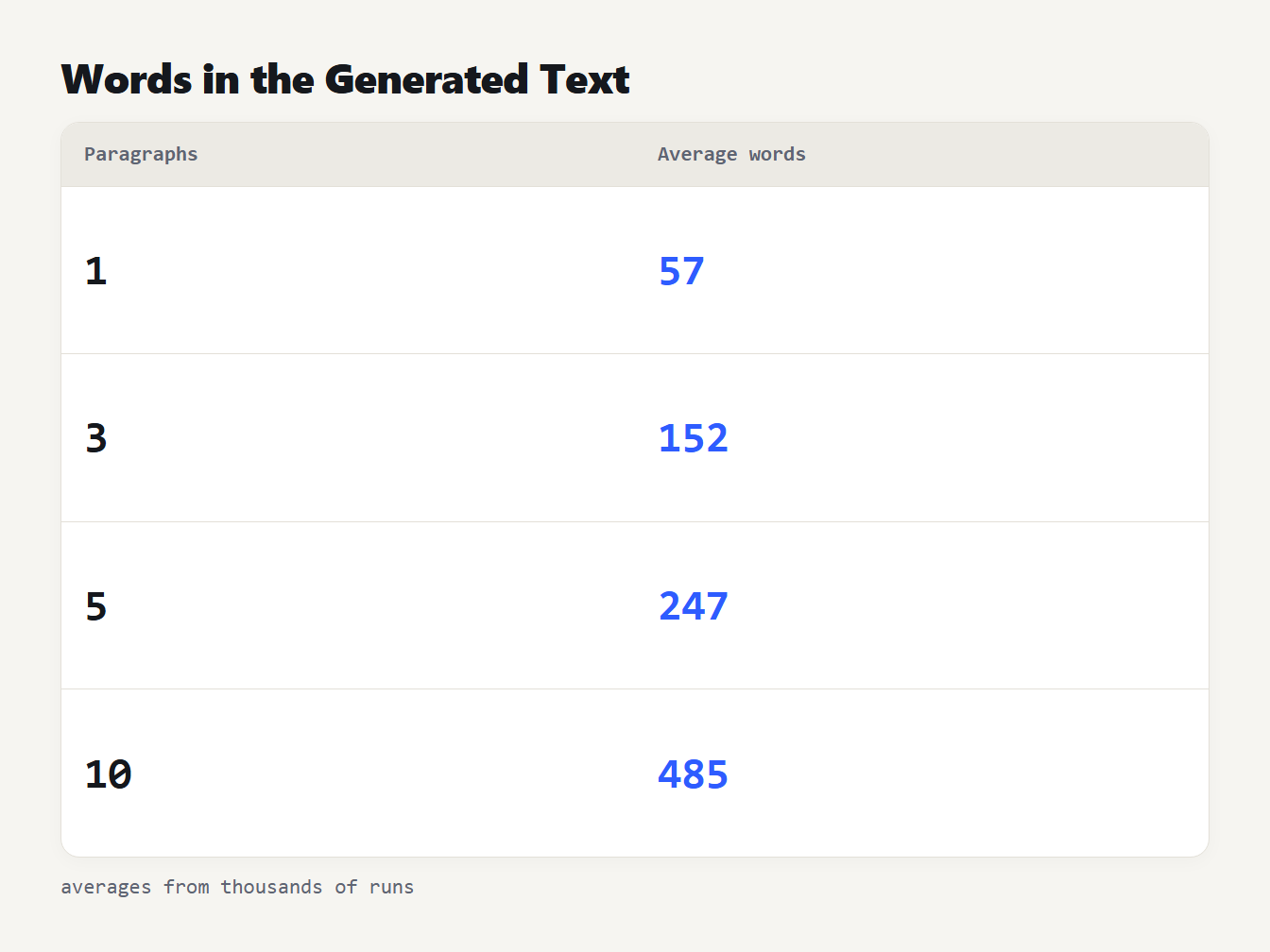
A table of average word counts from the generator. One paragraph gives 57 words, three give 152, five give 247, and ten give 485. The averages come from thousands of runs.
If you need an exact length, generate more than you need and trim, or count what you have with the Word Counter. The Character Counter is better for headings and buttons that have a fixed limit. For context on how much text a real page holds, see our guide to how many words fit on a page.
Which placeholder to use for which job
Lorem Ipsum suits body text, but not everything on a page is body text. Match the placeholder to the job:
| Part of the design | Better placeholder | Why |
|---|---|---|
| Body paragraphs | Lorem Ipsum | Looks like text and shows line length and spacing |
| Headlines and buttons | Realistic short phrases, including the longest you expect | Fixed widths break on real wording |
| Form fields and labels | Real examples such as names and emails | Shows how values wrap or get cut off |
| Data tables | Real numbers and names | Column widths depend on the longest value |
| Email templates | A full draft with the real signature | Clients render short and long text differently |
When Lorem Ipsum is the wrong choice
Placeholder text hides problems that real content shows. A headline that is twice as long as the sample line wraps differently. A product name with no spaces overflows a card. A text with a single short paragraph looks nothing like a page that has twelve. Use Lorem Ipsum to start a design, then test it with real words as soon as you have them, including the longest and shortest ones you expect.
The other risk is forgetting it. Placeholder text left on a live page reads as unfinished. Before you publish, search your pages for "lorem ipsum", and check titles, descriptions and image alt text, which are easy to overlook.
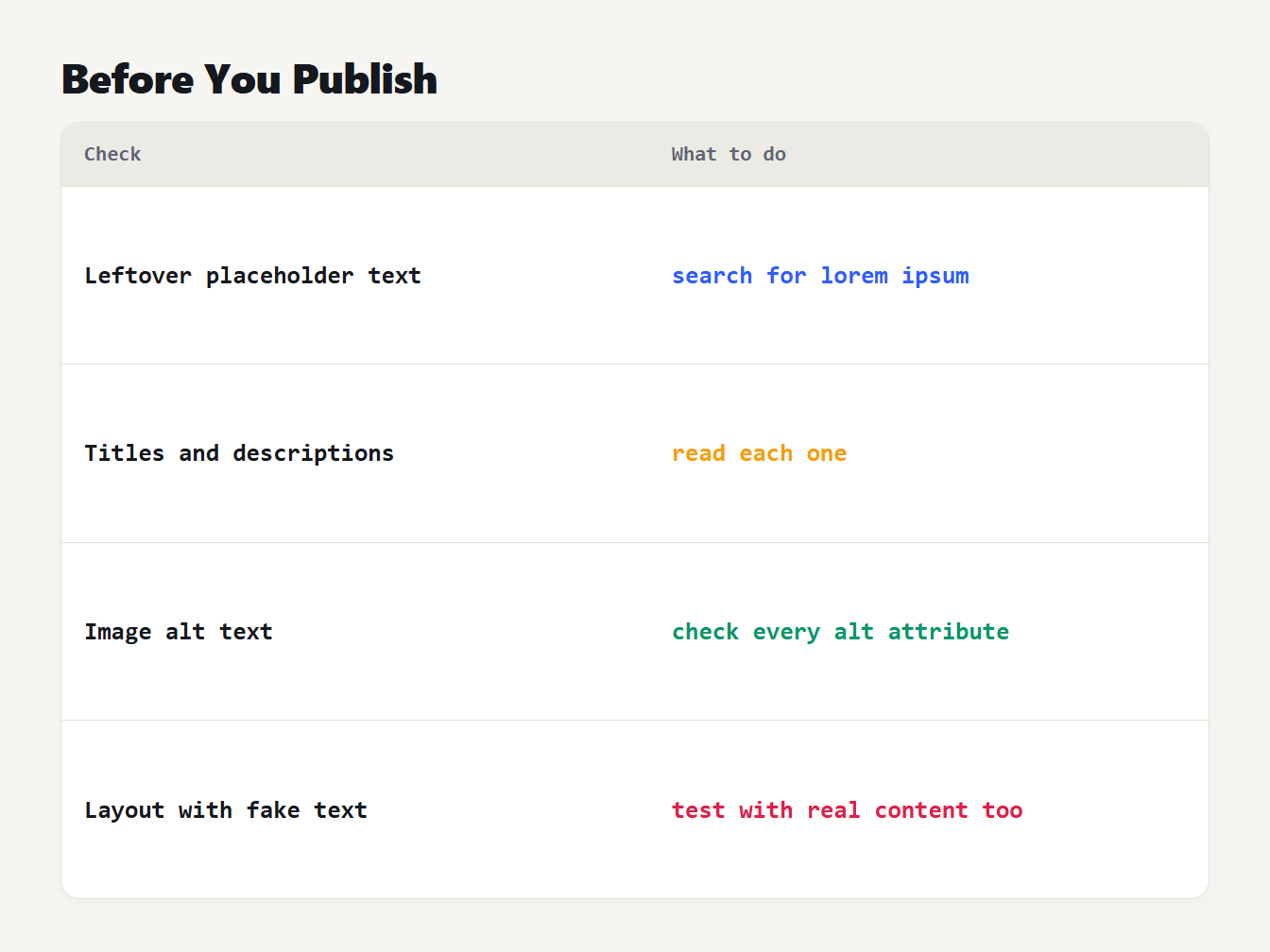
A table of four checks. Leftover placeholder text: search your pages for lorem ipsum. Titles and descriptions: check them. Image alt text: check every one. Layout with fake text: test with real content too.
How to generate Lorem Ipsum
Open the Lorem Ipsum Generator, pick paragraphs, sentences or words, and set a quantity from 1 to 50. By default the first sentence is the classic "Lorem ipsum dolor sit amet, consectetur adipiscing elit" opening. Switch that option off if you want every sentence to be random. The words come from the 63 distinct words of the standard paragraph, so the output always looks like the familiar text. Word mode runs through that paragraph in order and then repeats it.
We found one mistake in our own tool while writing this guide. Its word list had 62 words and was missing "eu", which the standard paragraph contains. We added it, and the generator now uses all 63.
Frequently asked questions
What does Lorem Ipsum mean?
It has no meaning as a text. It is scrambled Latin taken from Cicero. The two words dolorem ipsum in his original mean pain itself, and lorem is what is left of dolorem after the first two letters are cut off.
Where does Lorem Ipsum come from?
From sections 32 and 33 of Book 1 of De finibus bonorum et malorum, a Latin work by Cicero from the first century BC. The words were altered, cut and joined, so the result looks like Latin but isn't correct Latin.
Is Lorem Ipsum real Latin?
Partly. Of the 63 distinct words in the standard paragraph, 35 appear exactly in Cicero's text and 25 more are within two letters of a word that does. Only do, eiusmod and eu have no close match, and the sentences make no sense.
Why do designers use Lorem Ipsum?
It lets them judge layout, spacing and typography without the meaning of the words getting in the way. It looks like text, so a page looks finished, but nobody reads it as a message.
How do I generate Lorem Ipsum?
Use a generator, choose paragraphs, sentences or words, and copy the result. Our generator can start with the classic Lorem ipsum dolor sit amet sentence, and about five paragraphs give you roughly 250 words.
Generate your placeholder text
Open the Lorem Ipsum Generator, choose the number of paragraphs your layout needs and copy the text into your design. You now have the answer to what is Lorem Ipsum, and you can tell a colleague where it comes from. Remember to replace it with real words before launch.