Flesch Reading Ease Score: Formula, Scale and How to Improve It
The Flesch reading ease score explained: the formula, the 0 to 100 scale, a worked example, how to raise your score and a free readability checker.
By TheTextKit TeamPublished
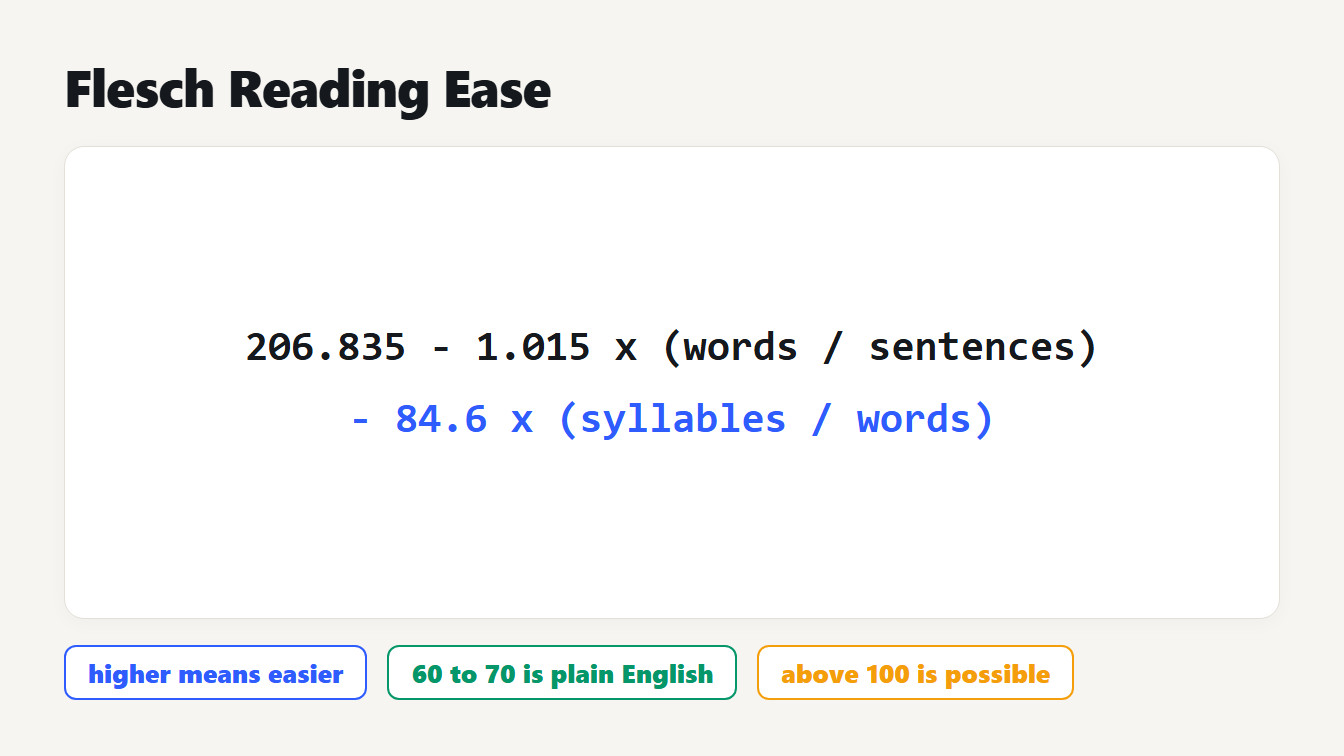
A card with the formula 206.835 minus 1.015 times words per sentence minus 84.6 times syllables per word, and three notes: higher means easier, 60 to 70 is plain English, and above 100 is possible.
The Flesch reading ease score rates how easy an English text is to read on a scale where a higher number means easier. It is 206.835, minus 1.015 times the average number of words per sentence, minus 84.6 times the average number of syllables per word. A score of 60 to 70 is called plain English. Rudolf Flesch devised it, and it is the number Word shows as "Flesch Reading Ease". This guide covers the formula, what each score means, a worked example you can follow by hand, and how to raise a low score.
The Flesch reading ease score formula
The formula uses only two measurements of your text. Both come from counting, and neither needs a dictionary of hard words:
score = 206.835 - 1.015 x (words / sentences) - 84.6 x (syllables / words)
The first part is average sentence length. The second is average word length, measured in syllables. The Wikipedia article on the Flesch-Kincaid tests gives the same constants. Each extra word in the average sentence costs 1.015 points. Each extra syllable in the average word costs 84.6 points, which is why short words matter so much.
The two levers work together. Cutting 10 words from the average sentence adds about 10 points, because 1.015 times 10 is 10.15. Cutting 0.1 syllables from the average word adds about 8, because 84.6 times 0.1 is 8.46.
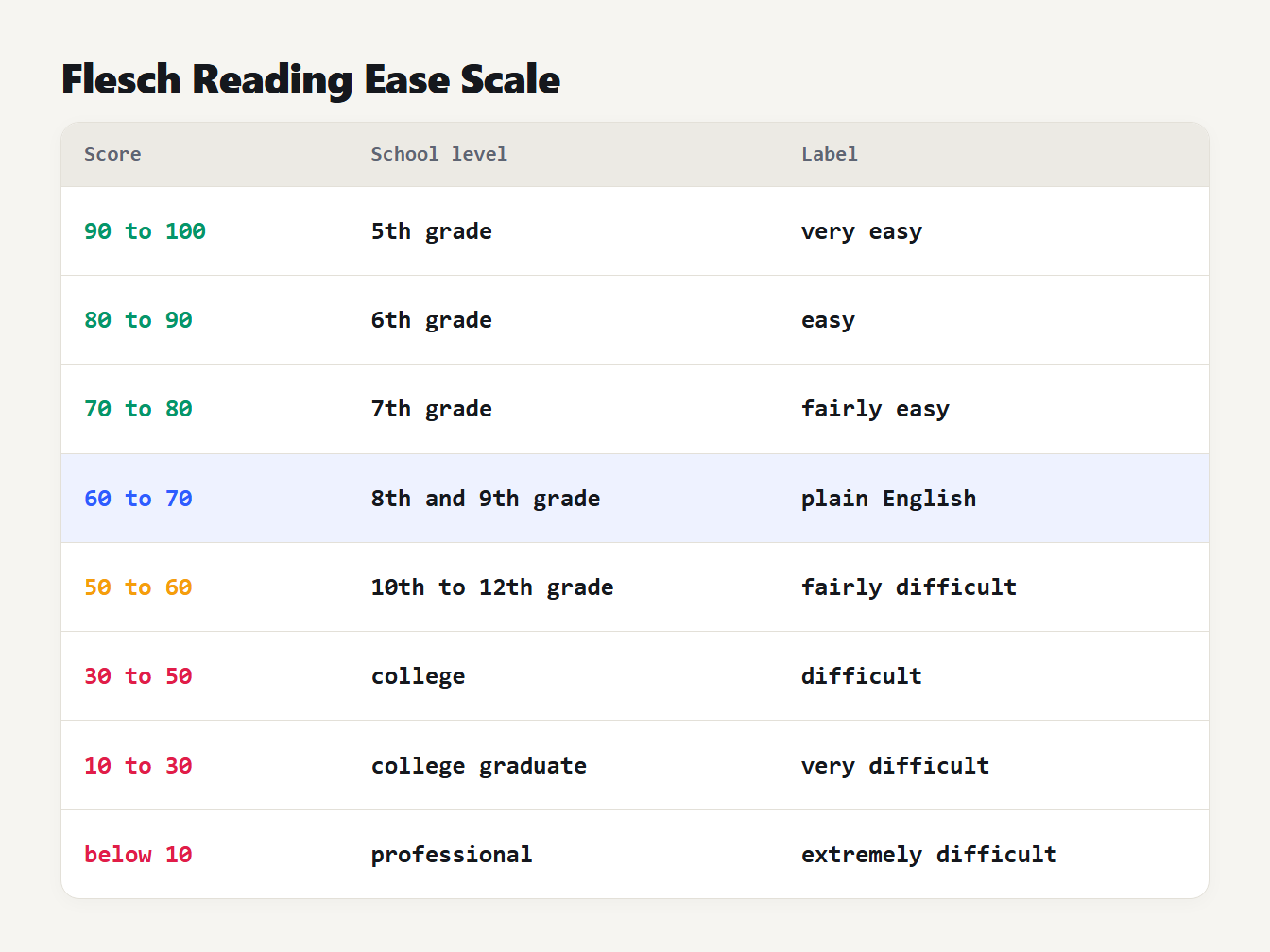
A table of eight score bands with a school level and a label, from 90 to 100 for 5th grade and very easy, through 60 to 70 for 8th and 9th grade and plain English, to below 10 for professional and extremely difficult.
What each score means
The Wikipedia article gives this table for reading the result. We checked that our Readability Checker uses the same bands:
| Score | School level | Label |
|---|---|---|
| 90 to 100 | 5th grade | Very easy to read |
| 80 to 90 | 6th grade | Easy to read |
| 70 to 80 | 7th grade | Fairly easy to read |
| 60 to 70 | 8th and 9th grade | Plain English |
| 50 to 60 | 10th to 12th grade | Fairly difficult to read |
| 30 to 50 | College | Difficult to read |
| 10 to 30 | College graduate | Very difficult to read |
| Below 10 | Professional | Extremely difficult to read |
Microsoft's help page on readability statistics describes the score as a 100-point scale and says that for most standard files you want it between 60 and 70. Treat that as a starting point. A legal notice and a children's story should not aim for the same number.
How sentence length and word length trade off
Because the formula is a sum, you can trade one measure for the other. This grid is plain arithmetic from the formula, and it shows the score for typical combinations:
| Average sentence length | 1.3 syllables per word | 1.5 syllables per word | 1.7 syllables per word |
|---|---|---|---|
| 10 words | 86.7 | 69.8 | 52.9 |
| 15 words | 81.6 | 64.7 | 47.8 |
| 20 words | 76.6 | 59.6 | 42.7 |
| 25 words | 71.5 | 54.6 | 37.6 |
Read across a row and you see how much word choice costs. With 20-word sentences, the average word has to stay near 1.5 syllables to reach 60. Short sentences give you room for longer, more exact words.
A worked example you can follow by hand
Take three short sentences:
The cat sat on the mat. It was a sunny day. We went out to play.
Count the words, the sentences and the syllables. There are 16 words in 3 sentences, so the average sentence has 5.33 words. Only "sunny" has two syllables, so the 16 words have 17 syllables, which is 1.0625 per word. Then:
206.835 - 1.015 x 5.333 - 84.6 x 1.0625 = 111.53
Yes, that is above 100. The scale is not capped, and Wikipedia gives a theoretical maximum of 121.22, which would be one-syllable words with one word per sentence. We ran the same text through the Readability Checker and it reported 16 words, 3 sentences, 17 syllables and 111.53, in the "very easy" band.
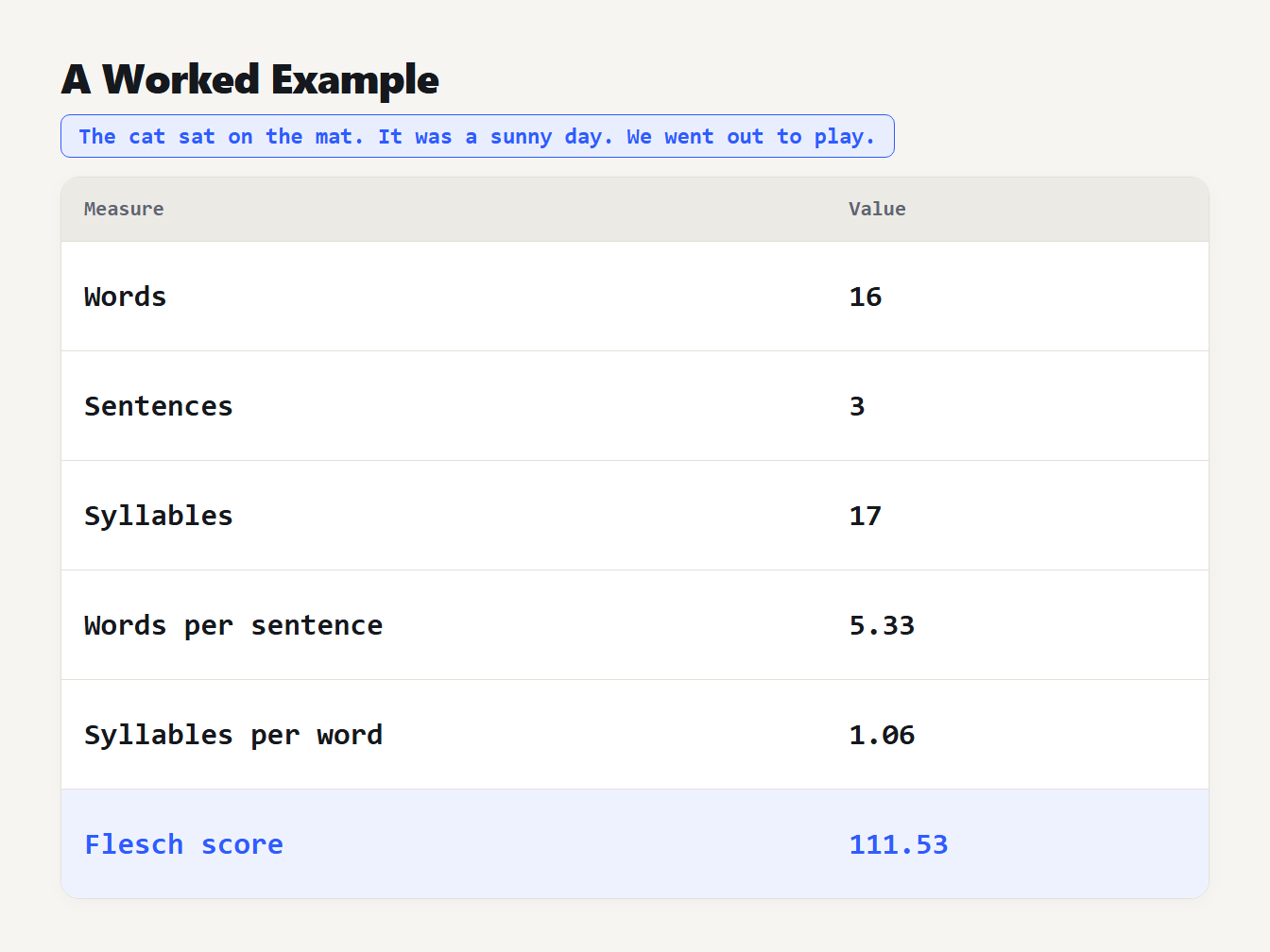
A table for the text The cat sat on the mat. It was a sunny day. We went out to play. It has 16 words, 3 sentences and 17 syllables, 5.33 words per sentence and 1.06 syllables per word, and a score of 111.53.
Flesch-Kincaid grade level, the other score
The same two measurements feed a second formula, the Flesch-Kincaid grade level: 0.39 times the average sentence length, plus 11.8 times the average syllables per word, minus 15.59. According to Wikipedia, Flesch and the psychologist J. Peter Kincaid developed it together for the U.S. Navy in 1975. It gives a U.S. school grade, where 8.0 means an eighth grader can follow the text.
The two scores point in opposite directions. Higher reading ease is easier, and a higher grade is harder. Microsoft suggests a grade of about 7.0 to 8.0 for most documents. Our cat text comes out at minus 0.97, which is below the first grade and shows that the formula can go negative.
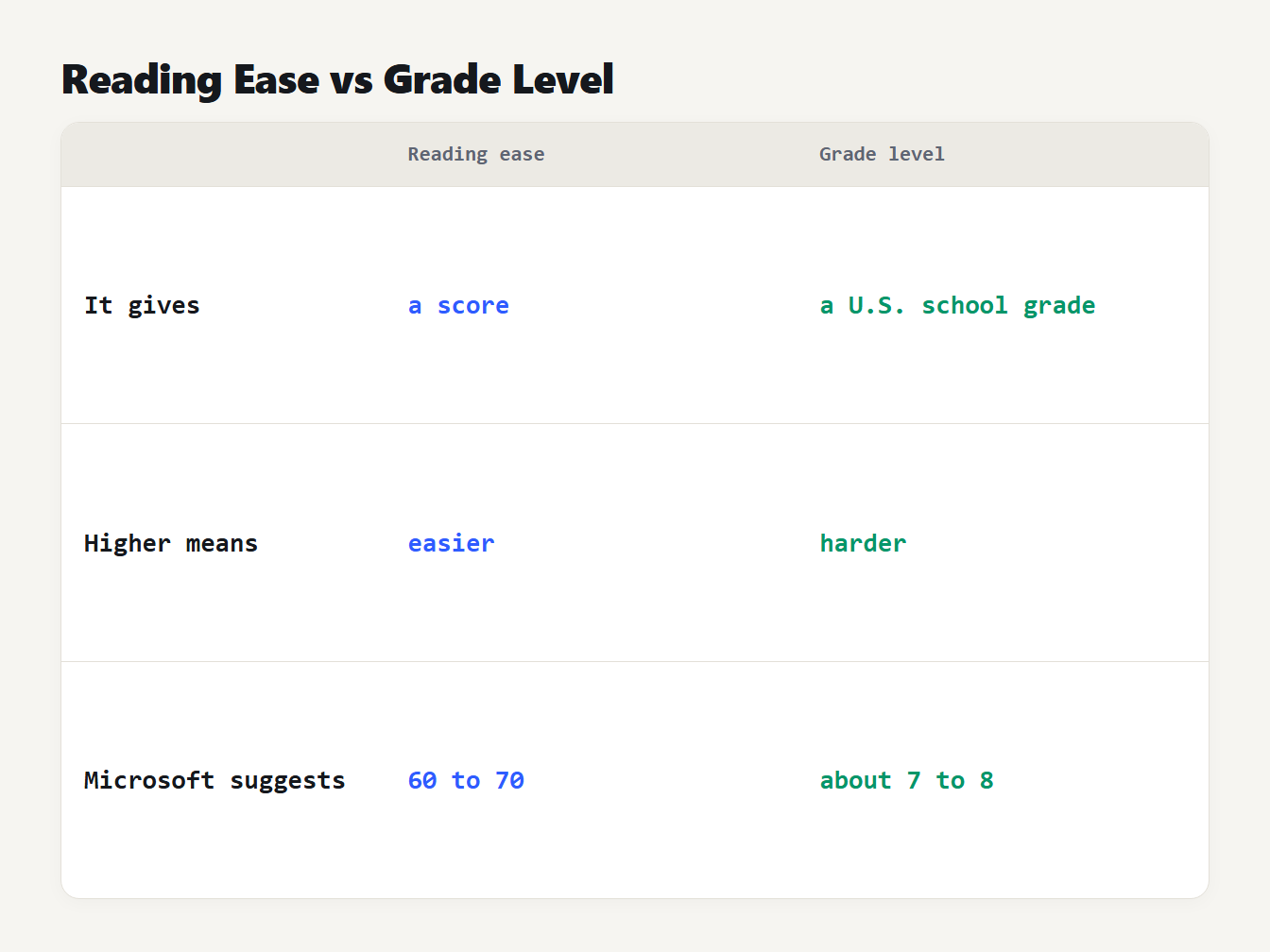
A table with two columns. Flesch reading ease gives a score where higher means easier and Microsoft suggests 60 to 70. Flesch-Kincaid grade level gives a U.S. school grade where higher means harder and Microsoft suggests about 7 to 8.
How to improve your Flesch reading ease score
Because the score is about sentence length and word length, those are the two things to edit. Here is one sentence at three levels of editing. Every row was run through the readability checker, and we counted the syllables by hand to confirm them:
| Version | Words | Syllables | Score | Band |
|---|---|---|---|---|
| In order to facilitate the implementation of the new procedure, it is imperative that all employees familiarize themselves with the documentation. | 21 | 44 | 8.26 | Extremely difficult |
| To put the new procedure in place, every employee needs to read the guide. | 14 | 19 | 77.81 | Fairly easy |
| All staff must read the guide before they start the new process. | 12 | 14 | 95.95 | Very easy |
All three say the same thing. The first gets a grade level of 17.32, the second 5.88 and the third 2.86. The second version is the practical target for most business writing: it keeps "procedure" and "employee" and still reads easily. The quick wins are to cut stock openings such as "in order to", swap "facilitate" and "implement" for plain verbs, and split any sentence over 25 words.
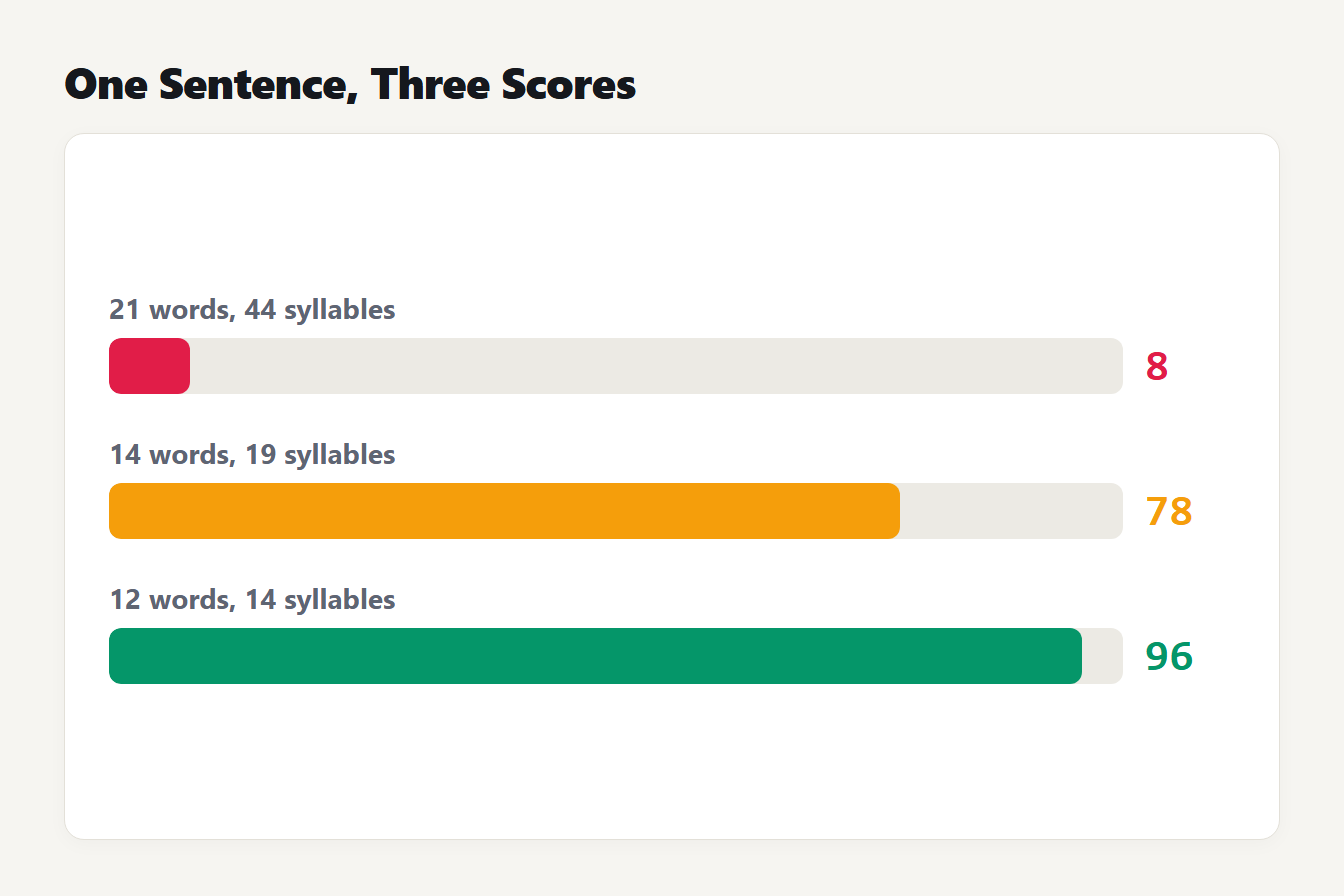
Three bars for three versions of one sentence. The first has 21 words and 44 syllables and scores 8. The second has 14 words and 19 syllables and scores 78. The third has 12 words and 14 syllables and scores 96.
What readability scores cannot tell you
Readability scores measure two things, so they miss everything else. A text can score as easy and still be unclear, and a technical text can score as hard and still be well written for its readers. Tools also count syllables by rule, not from a dictionary, so each tool's count differs a little. Our checker is right for most words but still estimates, and a wrong count is usually off by one. Texts under about 100 words give unstable scores.
Use the score the way an editor uses a ruler. It tells you where to look, such as the longest sentences and the longest words, and it cannot tell you whether the writing is good. Our guide to how long it takes to read 1000 words covers the other side of reader effort, which is time.
How to check your score in Word and with the Readability Checker
In Microsoft 365, choose the Home tab, then Editor, then Document stats to see the Flesch Reading Ease and Flesch-Kincaid scores. In older versions, go to File, Options, Proofing, and turn on "Show readability statistics" before you run the spelling and grammar check.
For text outside Word, paste it into the Readability Checker. It shows the reading ease score, the grade level and the Coleman-Liau index, which uses letters instead of syllables. It also lists the sentences over 25 words so you know where to cut first. For other counts, the Sentence and Paragraph Counter and Word Counter cover the basics.
Frequently asked questions
What is a good Flesch reading ease score?
For most documents, 60 to 70 is a good target. That band is called plain English and suits readers around eighth and ninth grade. Microsoft also recommends 60 to 70 for most standard files. Higher scores read more easily.
Can a Flesch reading ease score be above 100 or below zero?
Yes. Very short sentences made of one-syllable words score above 100, up to a theoretical maximum of 121.22. Long sentences full of long words can score below zero.
What is the difference between Flesch reading ease and Flesch-Kincaid grade level?
They use the same two measures, words per sentence and syllables per word. Reading ease gives a score where higher is easier, while the grade level gives a U.S. school grade where higher is harder.
How do I improve my Flesch reading ease score?
Shorten your sentences and choose shorter words. Cutting ten words from an average sentence adds about 10 points, and cutting 0.1 syllables from the average word adds about 8.
Does a high score mean good writing?
No. The score only measures the length of sentences and words. It cannot judge clarity, accuracy, tone or structure, so use it as a guide for editing and not as a goal.
Score your next draft
Paste the last thing you wrote into the Readability Checker and look at two numbers: the reading ease and the longest sentence. If the score is under 50 and the reader is a general one, cut the five longest sentences in half. Then run it again and watch the score climb.