How to Calculate Percentage Increase and Decrease, With Examples
Calculate a percentage increase or decrease with one formula. Examples for prices, scores and tax, and why +50% then -50% does not get you back.
By TheTextKit TeamPublished
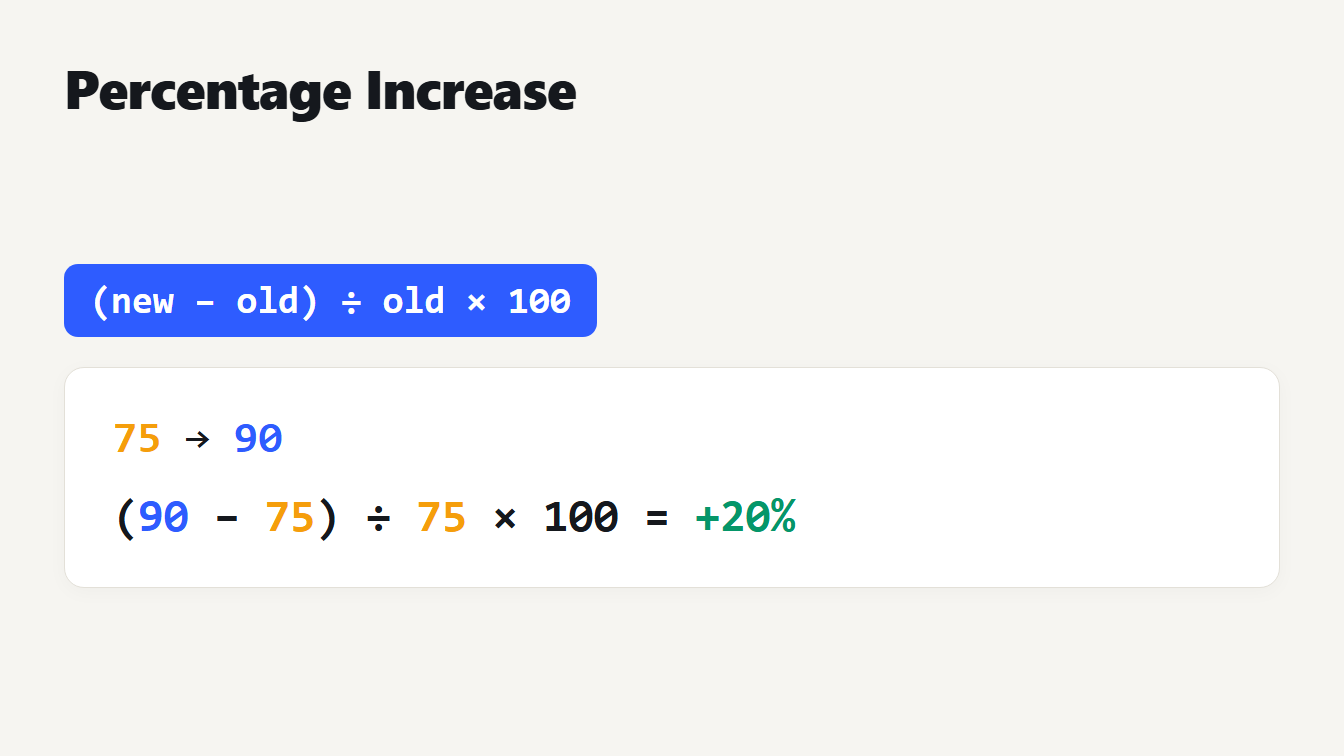
A card shows the formula new value minus old value, divided by the old value, times 100. Below it the worked example reads 90 minus 75 divided by 75 times 100 equals plus 20 percent, with the old value, the new value and the result in color.
A percentage increase tells you how much a number grew compared with where it started, and a percentage decrease tells you how much it fell. One formula covers both, and it takes a minute to learn. The problems start when people use the wrong starting value, assume a rise and an equal fall cancel out, or trust a calculator that rounds the last digit the wrong way. We checked each of these with exact arithmetic, and this guide shows the results.
The percentage increase formula
The percentage change is the new value minus the old value, divided by the old value, times 100. A positive answer is an increase and a negative one is a decrease. We worked through three examples with the Percentage Calculator:
| Old value | New value | Change | Result |
|---|---|---|---|
| 75 | 90 | +15 | 15 / 75 = 0.2, a 20% increase |
| 80 | 60 | -20 | 20 / 80 = 0.25, a 25% decrease |
| 100 | 200 | +100 | 100 / 100 = 1, a 100% increase |
Follow these steps for any pair of numbers:
- Subtract the old value from the new one.
- Divide the answer by the old value, not the new one.
- Multiply by 100 and add the percent sign.
- Read the sign: positive is an increase, negative is a decrease.
The most common mistake is step 2. A price that goes from 80 to 60 fell by 25% of the old price. Dividing by the new price, 60, gives 33.3%, which is wrong.
Why +50% and then -50% does not get you back
A percentage always applies to the number in front of it. After the first change the number is different, so the second percentage is a different amount. We tested a round trip with 200:
| Step | Value |
|---|---|
| Start | 200 |
| Decrease by 50% | 100 |
| Increase by 50% | 150 |
| Increase needed to return to 200 | 100% |
The same thing happens at smaller sizes. 1,000 increased by 10% is 1,100, and 1,100 decreased by 10% is 990. You end up 1% below where you began. This is why a shop that raises a price by 20% and later gives 20% off does not return to the old price.
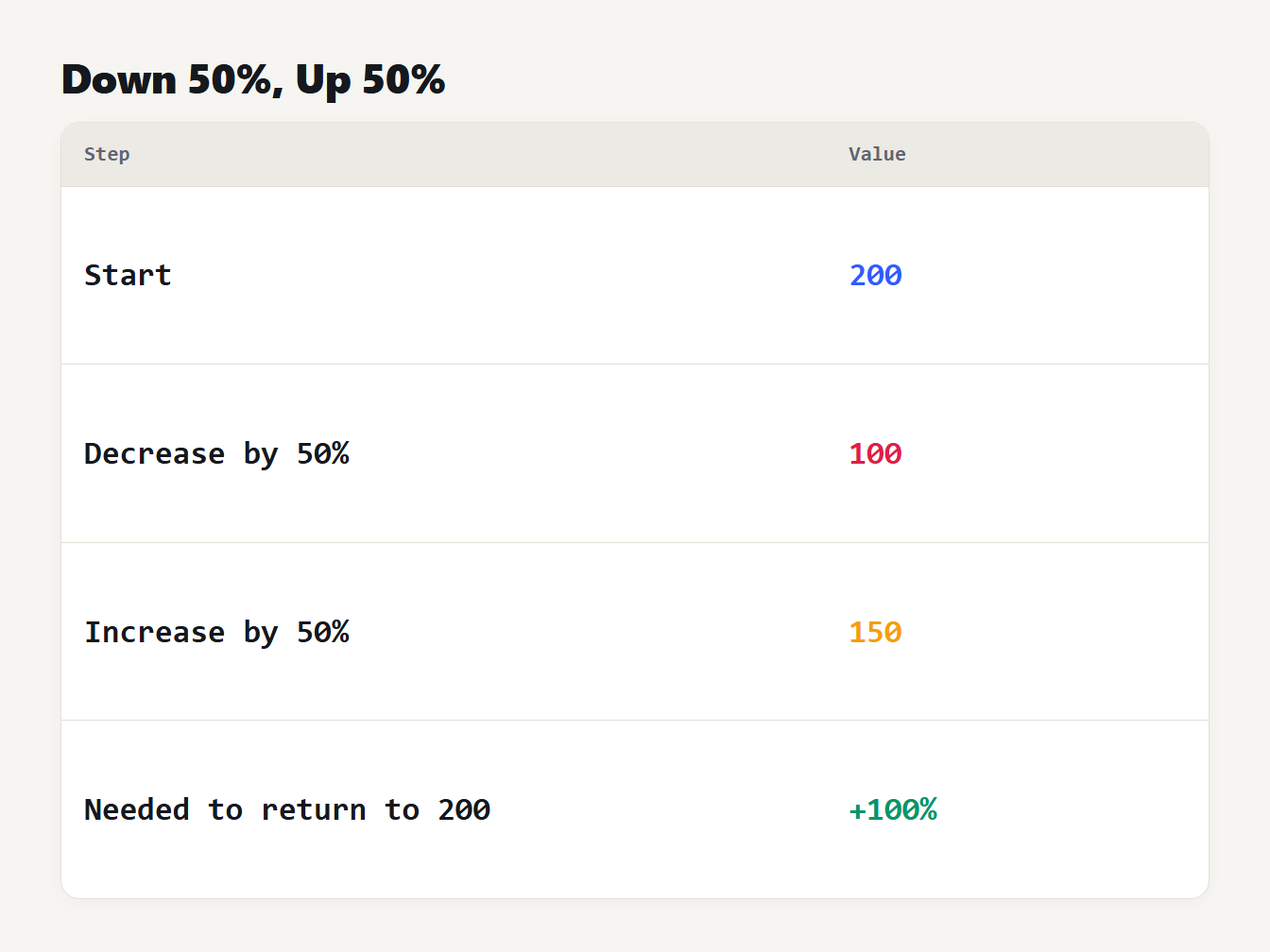
A table of four steps. The start is 200. After a 50 percent decrease the value is 100. After a 50 percent increase the value is 150. Getting back to 200 needs an increase of 100 percent.
What percentage undoes an increase
Because the second percentage applies to a bigger number, the fall that undoes a rise is always smaller than the rise. It equals the rise divided by 1 plus the rise. We checked each pair with the calculator, going from the raised value back to the start:
| Percentage increase | Decrease that undoes it |
|---|---|
| 10% | 9.09% |
| 20% | 16.67% |
| 25% | 20% |
| 50% | 33.33% |
| 100% | 50% |
Two increases in a row also add up to more than their sum. A 10% increase twice turns 1,000 into 1,100 and then 1,210, which is a 21% increase overall, not 20%.
Working backwards from the new value
Sometimes you know the new value and the percentage but not the start. Divide the new value by 1 plus the percentage as a decimal. A price of 240 after a 20% rise started at 240 divided by 1.2, which is 200. For a fall, divide by 1 minus the percentage: 60 after a 25% discount started at 60 divided by 0.75, which is 80.
Adding and removing tax or a discount
Adding a percentage means multiplying by 1 plus the percentage divided by 100, and taking one off means multiplying by 1 minus it. The tool's fourth mode does this directly:
| Question | Calculation | Result |
|---|---|---|
| 200 plus 20% tax | 200 × 1.2 | 240 |
| 80 with 25% off | 80 × 0.75 | 60 |
| 240 minus 20% | 240 × 0.8 | 192 |
| What 20% tax was added to get 240 | 240 to 200 is a change of -40 | -16.67% |
The third row is a classic error. If a price of 240 includes 20% tax, taking 20% off does not give the price before tax: it gives 192. The tax was 20% of 200, not of 240. To remove it, divide by 1.2, which gives 200, or take off 16.67%.
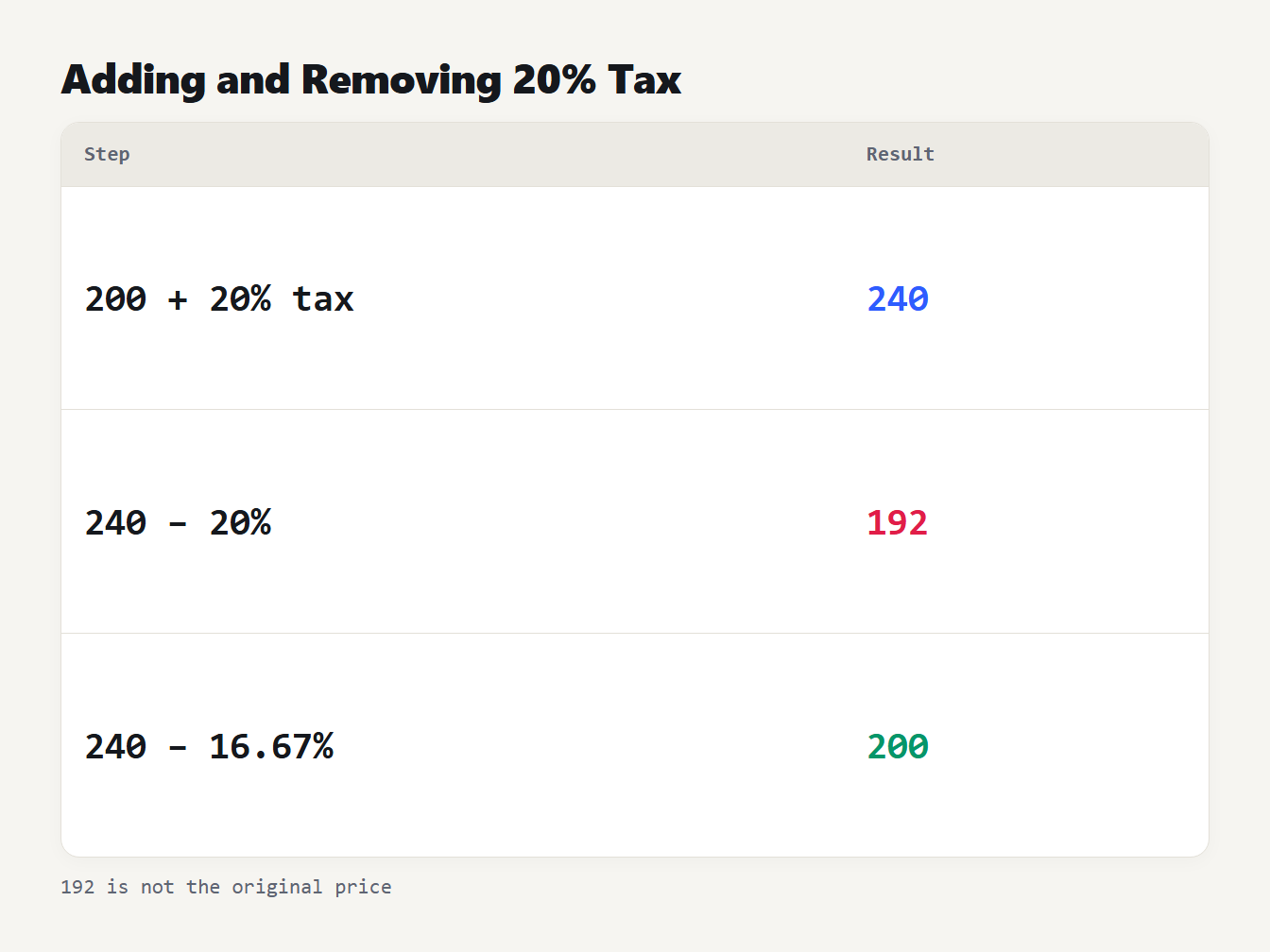
A table of three steps. 200 plus 20 percent tax is 240. 240 minus 20 percent is 192, which is wrong. 240 minus 16.67 percent is 200, which is the original price.
Percent against percentage points
A percentage point is a plain subtraction of two percentages. A savings rate that rises from 4% to 5% has gone up by 1 percentage point. Measured as a percentage change, the same rise is 25%, because 1 is a quarter of 4. In the other direction, from 5% to 4% is a fall of 1 percentage point, or 20%. News reports use both, and they are not interchangeable, so check which one a figure means.
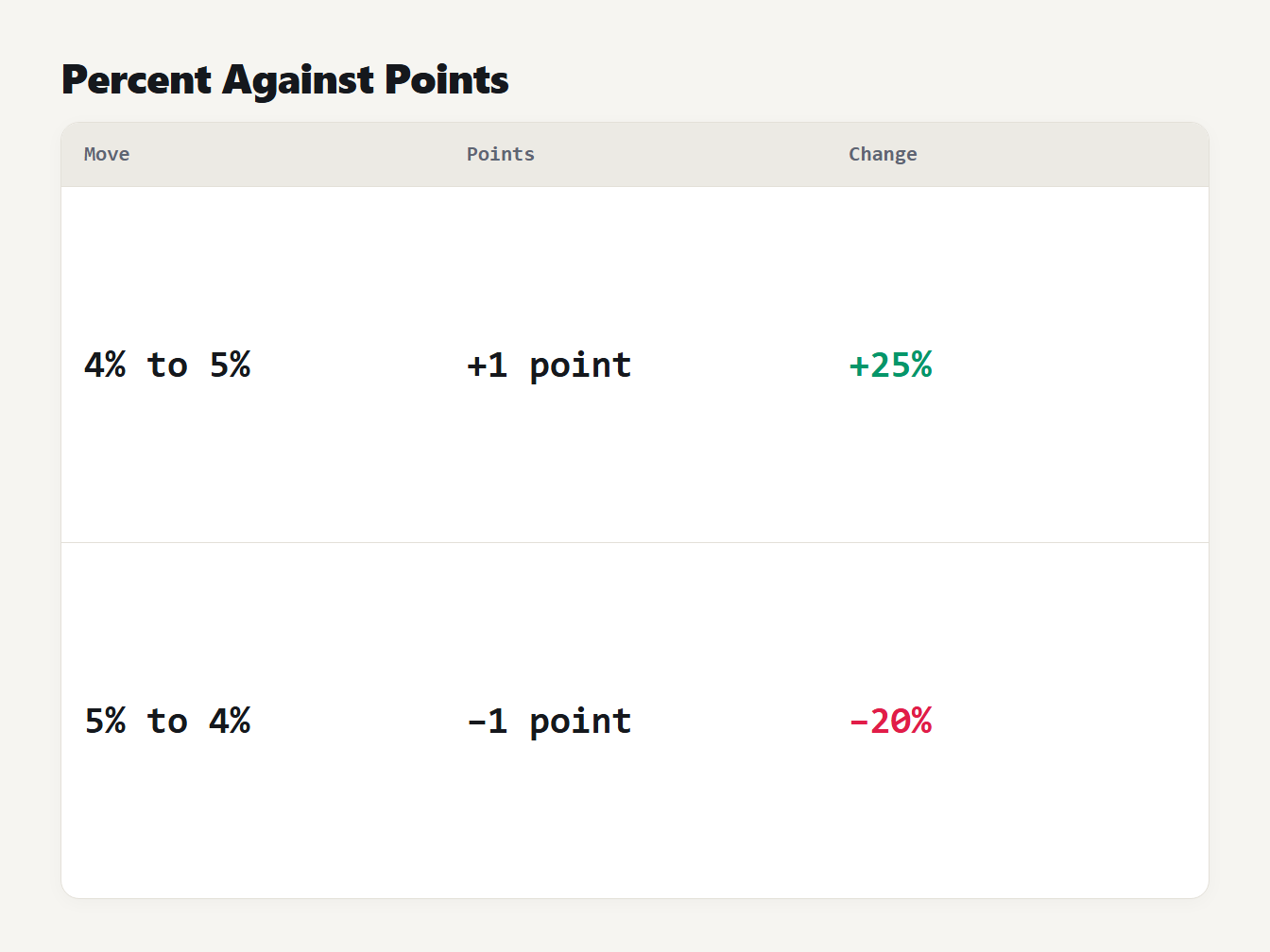
A table for a rate that moves between 4 percent and 5 percent. From 4 to 5 percent is a rise of 1 percentage point and a 25 percent increase. From 5 to 4 percent is a fall of 1 percentage point and a 20 percent decrease.
Negative numbers and zero
The formula divides by the old value, so two cases need care. If the old value is 0, the percentage change does not exist, because you cannot divide by zero. A rise from 0 to 5 has a size of 5 but no percentage.
If the old value is negative, tools disagree. Our calculator divides by the size of the old value, so a move from -50 to -25 is an increase of 50%, which matches the fact that the number went up. A formula without the absolute value would call it a decrease of 50%. When you share a result involving negative numbers, say which method you used.
Percentage change against percentage difference
Percentage change compares a new value with an old one. Percentage difference compares two values that have no order, such as the prices in two shops. It divides the gap by the average of the two. For 75 and 90, the change from 75 is 20%, while the difference is 15 divided by 82.5, which is 18.18%. Use change when one value came first and difference when neither did.
Calculators can round the last digit wrong
Most calculators on the web use floating point numbers, which cannot hold most decimals exactly. For 322.20 out of 800, the exact answer is 40.275%, and rounding to two places should give 40.28%. In JavaScript the division gives 40.274999999999998579 internally, and rounding it gives 40.27.
MDN's documentation of toFixed shows the same effect: (2.55).toFixed(1) returns 2.5, because the closest float to 2.55 is slightly lower.
We measured how often this happens. We used 200,000 random pairs of numbers with up to three decimal places. At two decimal places, floating point rounding gave a different last digit in 66 of the "what percent is A of B" answers. At four decimal places, it did so in 2,777 of the "A% of B" answers. Every one of these was a result that lay exactly halfway between two roundings. The cases are rare, but they matter in marking, invoices and tests.
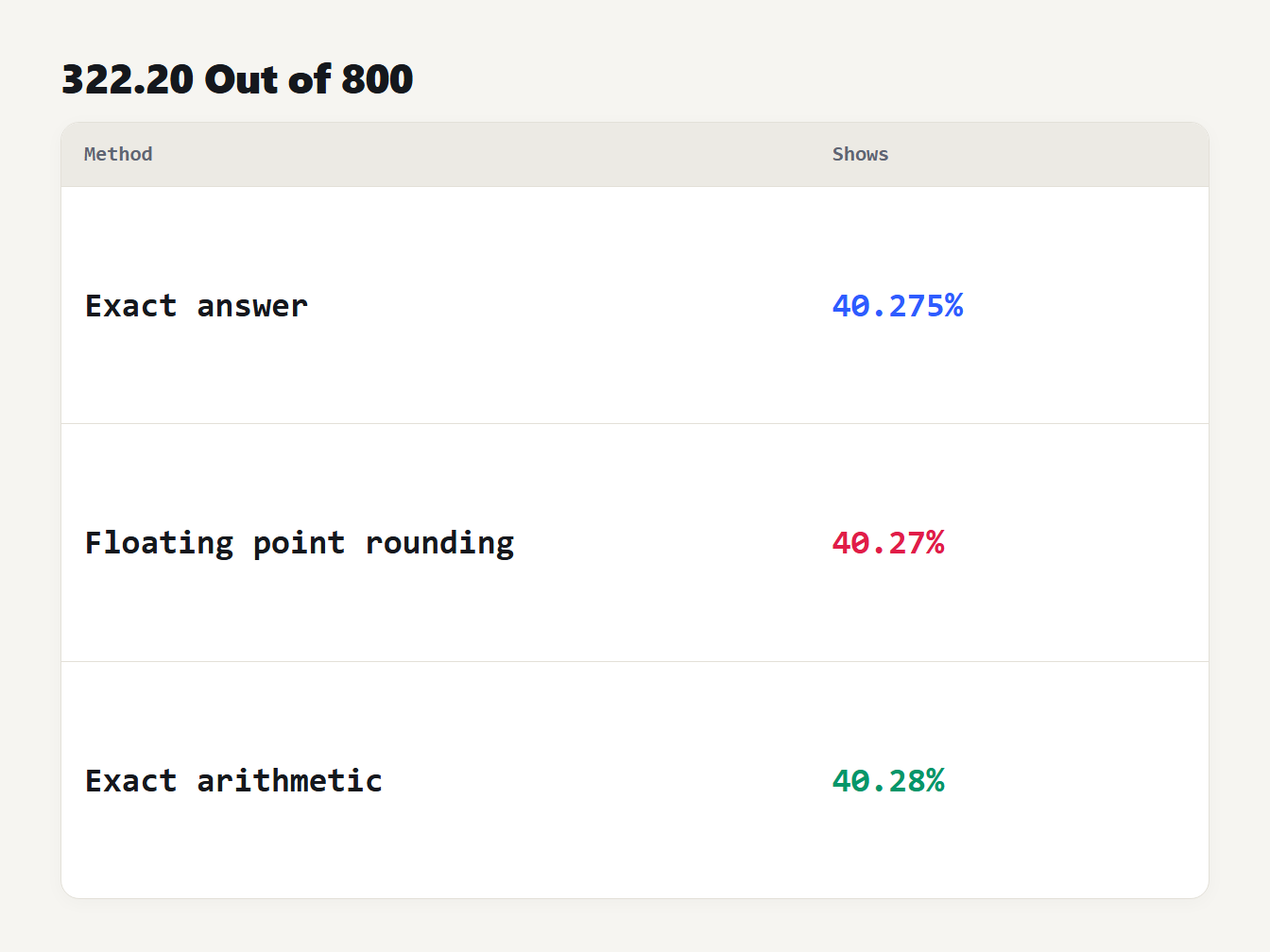
A table for 322.20 out of 800. The exact answer is 40.275 percent. Floating point rounding shows 40.27 percent. Exact arithmetic, as used by the calculator, shows 40.28 percent.
The Percentage Calculator reads your numbers as exact fractions and rounds only once at the end, so 322.20 out of 800 gives 40.28%. We checked its results against Python's exact fractions on 30,000 random inputs, including negative numbers and exponent notation, and found no differences.
Frequently asked questions
How do you calculate percentage increase?
Subtract the old value from the new value, divide the result by the old value and multiply by 100. From 75 to 90 the change is 15, and 15 divided by 75 is 0.2, so the increase is 20 percent. If the result is negative, it is a decrease.
How do you add a percentage to a number?
Multiply the number by 1 plus the percentage divided by 100. To add 20 percent to 200, multiply 200 by 1.2 to get 240. To take 25 percent off 80, multiply by 0.75 to get 60.
Why is a 50% decrease not undone by a 50% increase?
Each percentage applies to a different starting value. 200 reduced by 50 percent is 100, and 100 increased by 50 percent is 150, not 200. To get from 100 back to 200 you need a 100 percent increase.
What is the difference between percent and percentage points?
A percentage point is the plain difference between two percentages. A rate that rises from 4 percent to 5 percent has gone up by 1 percentage point, which is a 25 percent increase in the rate.
Can you calculate a percentage change from zero?
No. The formula divides by the starting value, and you cannot divide by zero. A rise from 0 to 5 is an increase of 5, but it has no percentage. Compare the new value with a different base instead.
Calculate your own percentage change
Enter the old and new values into the Percentage Calculator to get the increase or decrease with its formula, or use the fourth mode to add a tax or take off a discount. The results are exact, and zero and negative values are handled as described above.
Percentages come up in grades, too. A score of 42 out of 50 is 84%, and our Grade Calculator turns weighted scores into a course grade. Our guide to calculating GPA shows how those percentages become a grade point average, and the GPA Calculator does the sums.