Title Case Rules: AP, APA, MLA and Chicago Compared
Title case rules compared for AP, APA, MLA and Chicago 18, with a table of which words to capitalize, common mistakes, and a free title case converter.
By TheTextKit Team
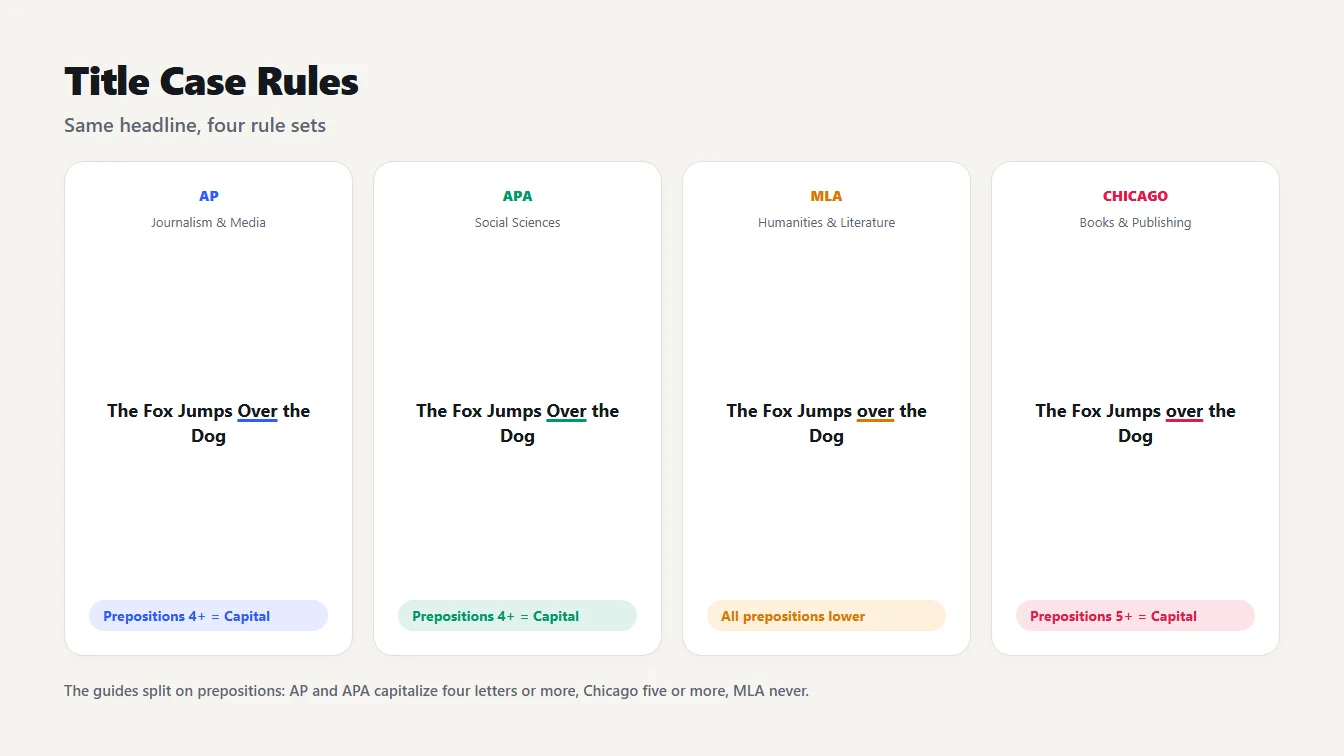
Four cards compare how AP, APA, MLA and Chicago capitalize the same headline, differing on whether the word Over is capitalized.
Title case rules change depending on the style guide. AP and APA capitalize every word of four letters or more, MLA lowercases every preposition, and Chicago (18th edition) capitalizes prepositions only from five letters up. All four capitalize the first word and the last word.
So is "with" capitalized in a title? Under AP and APA, yes. Under MLA and Chicago, no. Pick the wrong guide and an editor will mark up your headline, which is why this question never goes away. Below you'll find the four rule sets side by side, the places where a guide switches to sentence case, the mistakes people make most, and a fast way to check a title.
What every title case guide agrees on
Start with the common ground, because it covers most of what you'll ever type.
Capitalize the first word and the last word, whatever they are. Capitalize nouns, pronouns, verbs, adjectives and adverbs. That includes the small verbs people forget: "Is", "Are", "Be" and "Was" all take capitals because they're verbs, and so does "It" because it's a pronoun.
Lowercase articles (a, an, the) and short coordinating conjunctions (and, but, for, nor, or, yet) when they sit in the middle of a title. Lowercase "to" there as well. And capitalize the first word after a colon, even if it's a small one. "How to Cook: A Beginner's Guide" shows two rules at once: "to" stays lowercase, while "A" gets a capital because it follows the colon.
Everything else comes down to one question: how long does a preposition have to be before it earns a capital?
Title case rules compared: AP, APA, MLA and Chicago
Here is the whole disagreement in one table. The first three rows are identical in every guide. The argument is about prepositions.
| Word type | AP | APA | MLA | Chicago (18th ed.) |
|---|---|---|---|---|
| Articles: a, an, the | lowercase | lowercase | lowercase | lowercase |
| Coordinating conjunctions: and, but, or | lowercase | lowercase | lowercase | lowercase |
| Prepositions of 1 to 3 letters: of, in, on, to | lowercase | lowercase | lowercase | lowercase |
| Prepositions of 4 letters: with, from, over, into | Capitalize | Capitalize | lowercase | lowercase |
| Prepositions of 5 or more letters: between, through, about | Capitalize | Capitalize | lowercase | Capitalize |
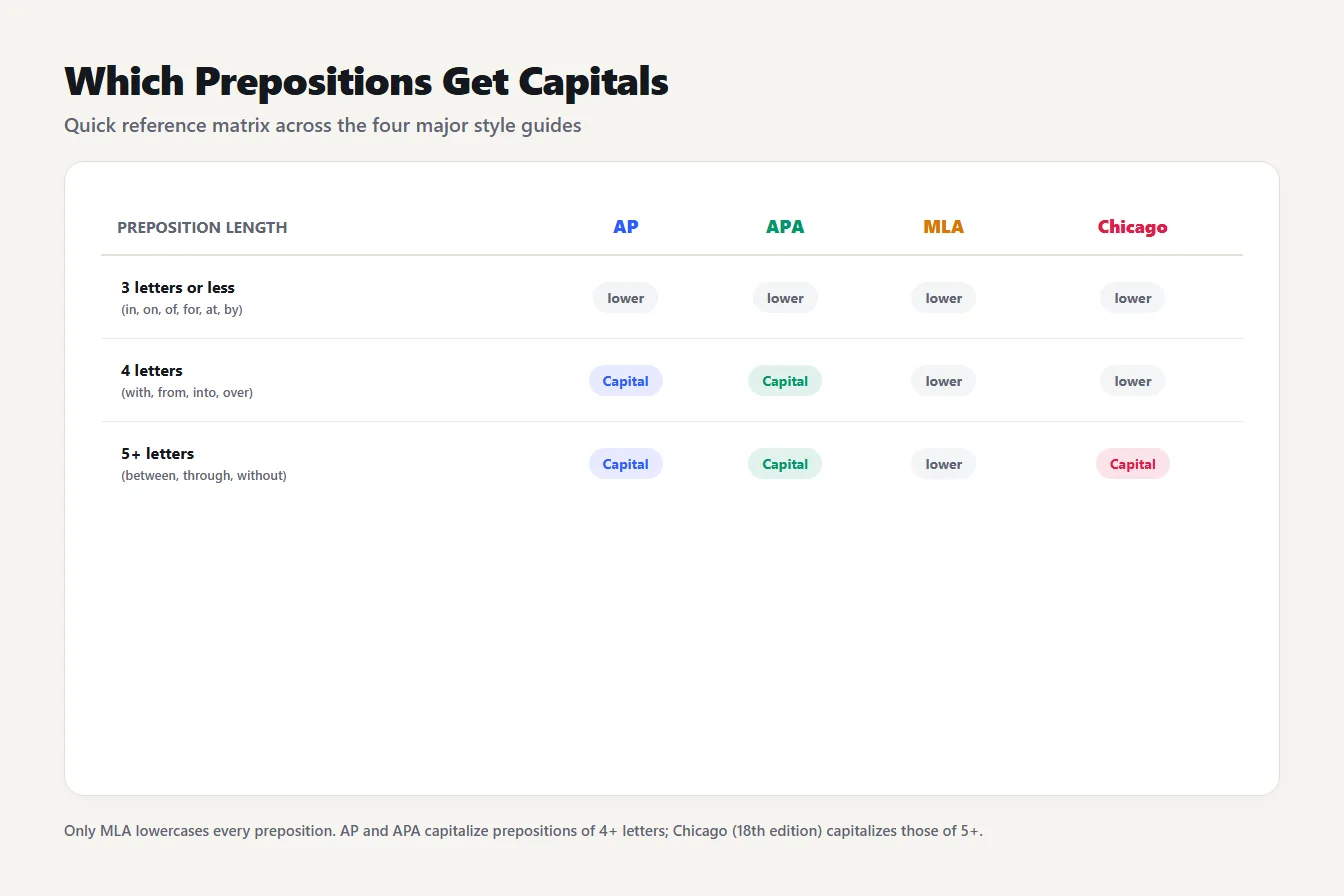
A grid showing that all four guides lowercase short prepositions like of, in and on, but split on four letter words like with and five letter words like between.
Two details deserve a closer look.
First, the four-letter prepositions: with, from, over, into, onto, upon. They cause most of the arguments. AP and APA capitalize any word of four letters or more, so these get capitals. MLA lowercases them because they're prepositions, and Chicago lowercases them because it only starts capitalizing prepositions at five letters.
Second, the Chicago change. Up to the 17th edition, Chicago lowercased every preposition regardless of length. Since the 18th edition in 2024, its own Q&A says words longer than four letters take capitals, while "to" and "of" stay lowercase. So "between" now gets a capital in Chicago, but "with" does not. MLA hasn't followed: its style center still says a preposition in the middle of a title is lowercase no matter how long it is. If your publisher uses the 17th edition, keep every preposition lowercase.
The AP and APA columns also cover conjunctions of four or more letters, so "Because", "While" and "Since" get capitals there.
Try it: the Title Case Converter applies these rules to any headline, one line at a time, and runs entirely in your browser.
Where each guide uses title case (and where it doesn't)
Plenty of people assume "APA title case" means every title in APA gets it. It doesn't.
APA uses title case for headings in your paper and for the titles of works you mention in the text. In the reference list it switches to sentence case: only the first word, the first word of a subtitle, the first word after a colon, and proper nouns are capitalized.
AP splits titles by type. Headlines in AP style use sentence case, so only the first word and proper nouns take capitals. The four-letter rule is for composition titles, meaning books, movies, songs and similar works. The AP Stylebook is paywalled, so most free guides summarize it this way, and it's worth checking against your copy if the detail matters.
MLA asks for title case on the titles of English-language works, and Chicago uses it for titles of works too (it now calls it title case; older editions said headline style).
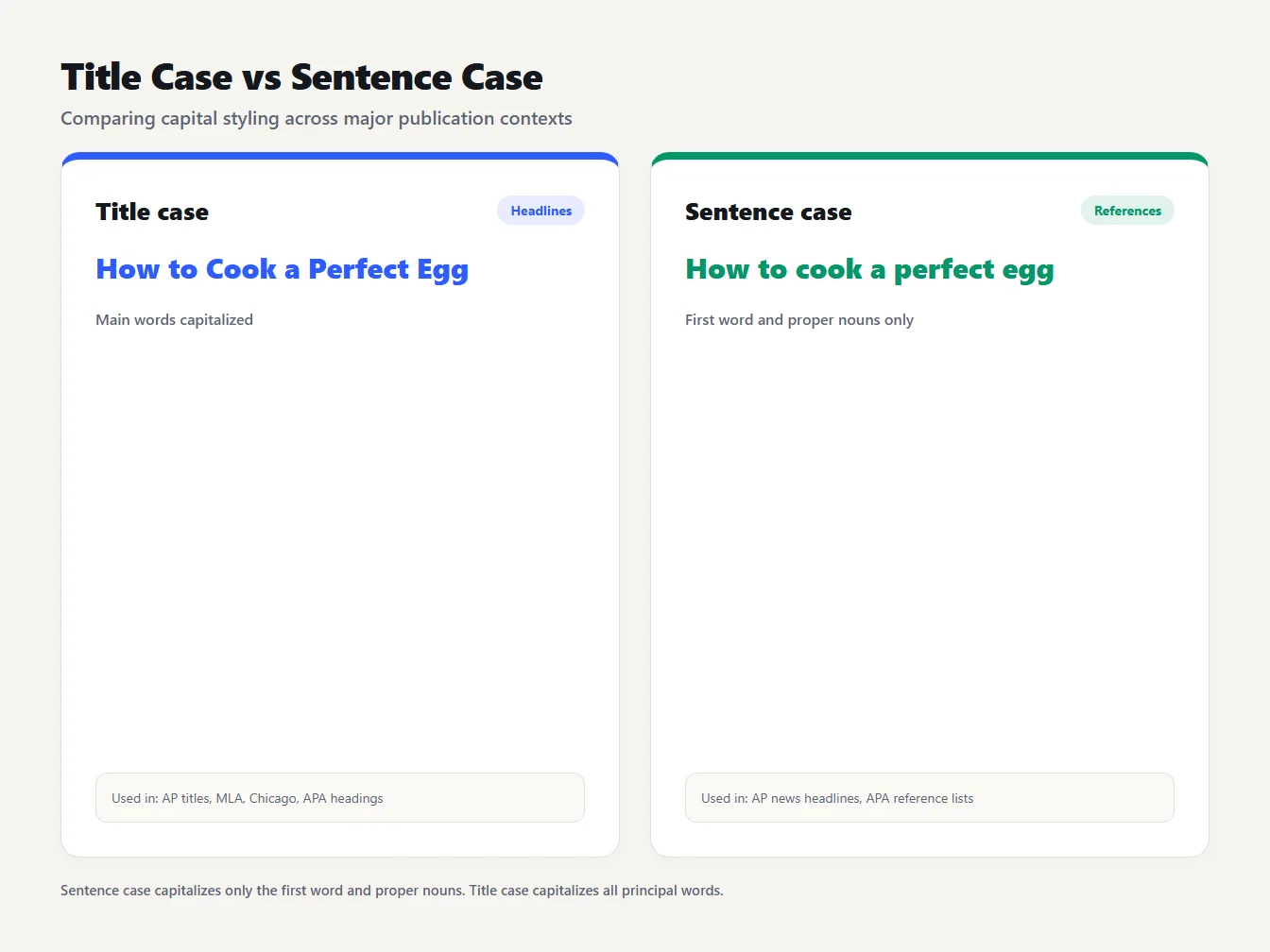
How to Cook a Perfect Egg in title case beside How to cook a perfect egg in sentence case, with where each is used: AP titles, MLA, Chicago and APA headings against AP headlines and APA references.
If you're writing for school, the assignment sheet usually names the guide and the edition. For a blog headline, you pick. The only rule that really matters then is consistency.
Worked example: one title, four results
Rules are easier to trust once you've seen them produce different answers. Here are four titles run through each guide. Read down a column to see a guide's habit, and across a row to see why editors argue.
| Starting title | AP | APA | MLA | Chicago (18th ed.) |
|---|---|---|---|---|
| the fox jumps over the dog | The Fox Jumps Over the Dog | The Fox Jumps Over the Dog | The Fox Jumps over the Dog | The Fox Jumps over the Dog |
| life between the lines | Life Between the Lines | Life Between the Lines | Life between the Lines | Life Between the Lines |
| a walk through the forest | A Walk Through the Forest | A Walk Through the Forest | A Walk through the Forest | A Walk Through the Forest |
| how to cook with cast iron | How to Cook With Cast Iron | How to Cook With Cast Iron | How to Cook with Cast Iron | How to Cook with Cast Iron |
The MLA column never capitalizes a preposition in the middle of a title. The Chicago column does it only for "between" and "through", the two prepositions with five letters or more. AP and APA treat "over", "between", "through" and "with" the same way, because all four are at least four letters long.
Use this as a quick test for any tool, including ours. If a converter gives you the same answer for every guide, it isn't following the guides.
Which guide fits your situation
You rarely get to choose. Students follow the assignment sheet. Psychology, education and most social science papers use APA, while literature and the humanities lean toward MLA or Chicago. Newsrooms use AP. Business writing and blogs are the exception, because nobody is going to mark you down. Pick AP and APA for their one simple four-letter rule, or Chicago if you prefer a lighter touch. Then write your choice into your style notes so every writer on the team applies the same title case rules.
Words people capitalize wrong
A short list covers most of the corrections editors make.
Short verbs get capitals
"Is", "are", "be" and "was" are verbs, so they're capitalized in every guide. "Why Your Title Is Too Long" is correct. "Why Your Title is Too Long" is the classic slip.
Hyphenated compounds
Capitalize each main part and lowercase the small words in the middle: "State-of-the-Art Tools" and "Step-by-Step Guide". MLA spells out that the principal words after a hyphen take capitals too.
Acronyms and brand names
NASA, FAQ, iPhone and eBay keep their own capitalization. Flattening them to "Nasa" or "Iphone" is the error you'll see most in automatic converters that don't check.
Last words and ALL CAPS input
The last word always gets a capital, even a preposition: "What Are You Looking At". If a headline arrives in ALL CAPS, lowercase it first and then apply the rules, otherwise you can't tell an acronym from a shouted word.
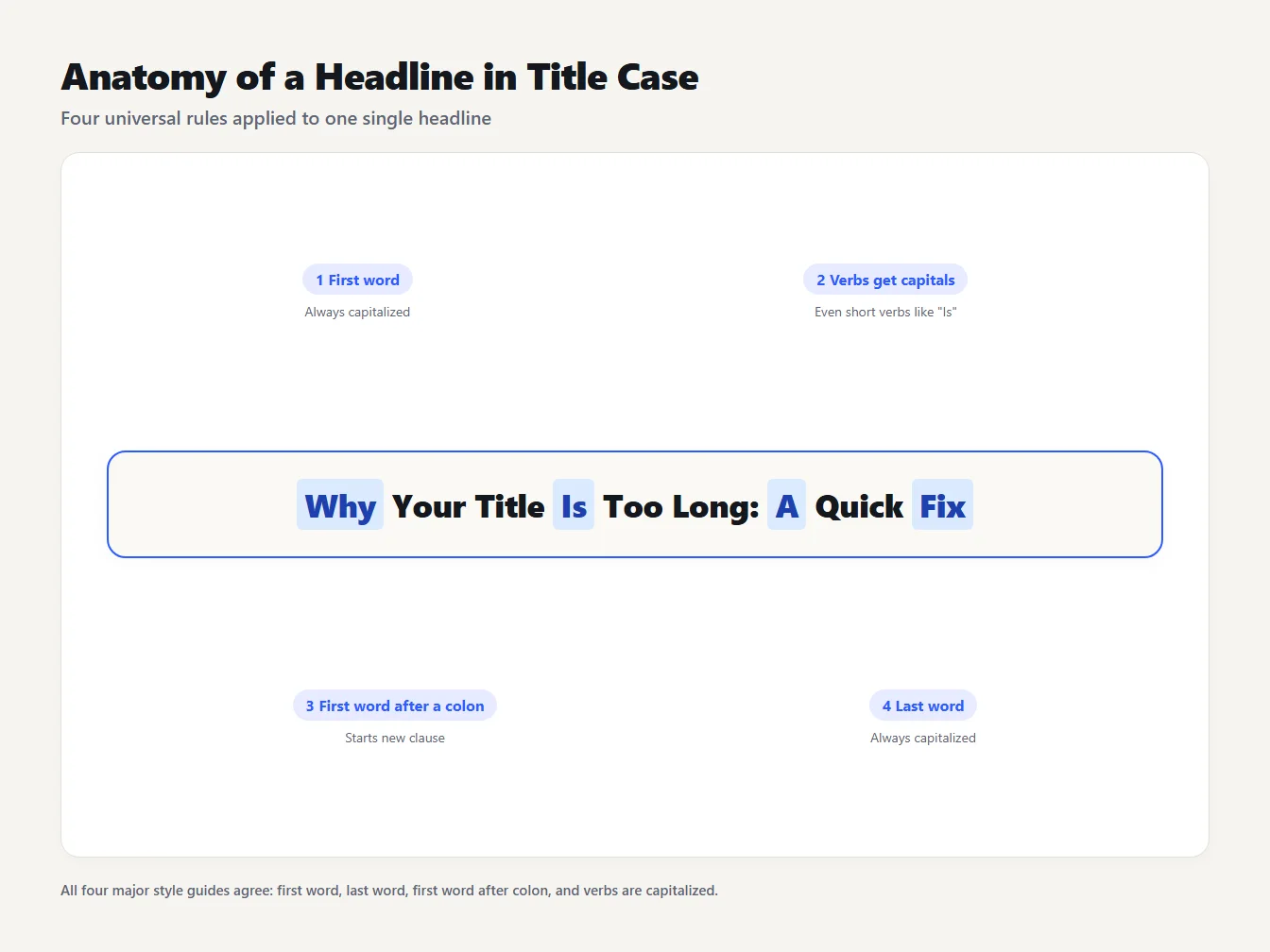
The headline Why Your Title Is Too Long: A Quick Fix with callouts for the first word, verbs, the first word after a colon and the last word.
How to apply title case rules in five steps
Doing this by hand works for a single title. Follow the same order every time and you'll catch most mistakes.
- Pick the guide. Check the assignment, the journal or your editor. If none applies, choose one and write it down.
- Write the title as a normal sentence first. Fix the wording before you worry about capitals.
- Capitalize the first word, the last word and the first word after any colon.
- Walk through the rest. Capitalize nouns, verbs, adjectives, adverbs and pronouns. Lowercase articles, short conjunctions and the prepositions your guide says to lowercase.
- Check the leftovers. Hyphenated words, acronyms and brand names.
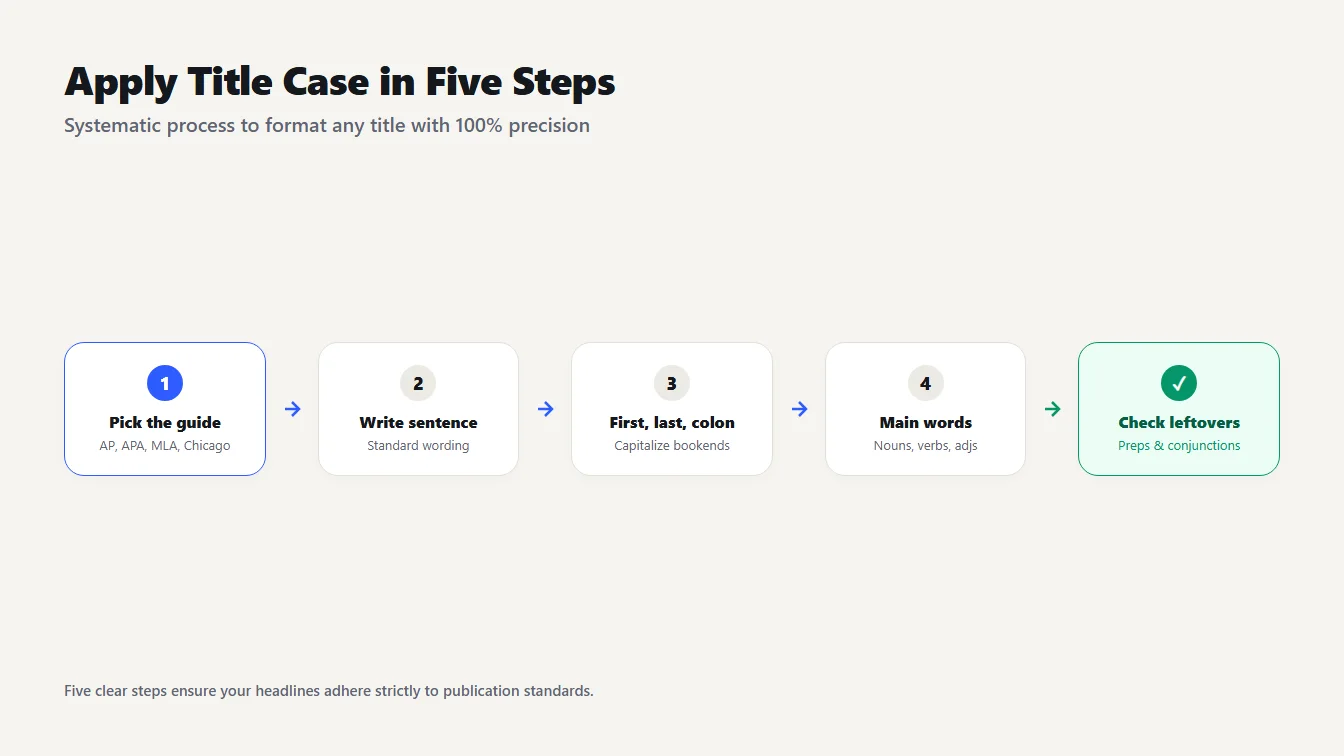
A five step flow: pick the guide, write the sentence, capitalize the first, last and colon words, capitalize the main words, then check the leftovers.
For forty headlines at once, this gets tedious and the exceptions slip through. That's the job of the Title Case Converter. Paste your titles, choose the style that matches your guide, and copy the result. Every line is converted on its own, acronyms and brand names are left alone, and nothing is uploaded. Need sentence case instead? The Case Converter handles that.
Title case or sentence case for headlines and SEO titles?
Searchers don't type in title case, and I'm not aware of any evidence that Google rewards either style, so choose for readability and brand consistency. Title case looks formal and suits article titles and navigation. Sentence case reads friendlier and works well for buttons, long headings and interface text. The mistake to avoid is mixing both on the same site.
One practical point for search results: titles are cut off by pixel width, not by character count, and the cutoff lands at roughly 60 characters. Capital letters are wider than lowercase ones, so the same words can run out of room sooner in title case. Run your title through the Character Limit Checker, then see how it looks in the SERP Preview.
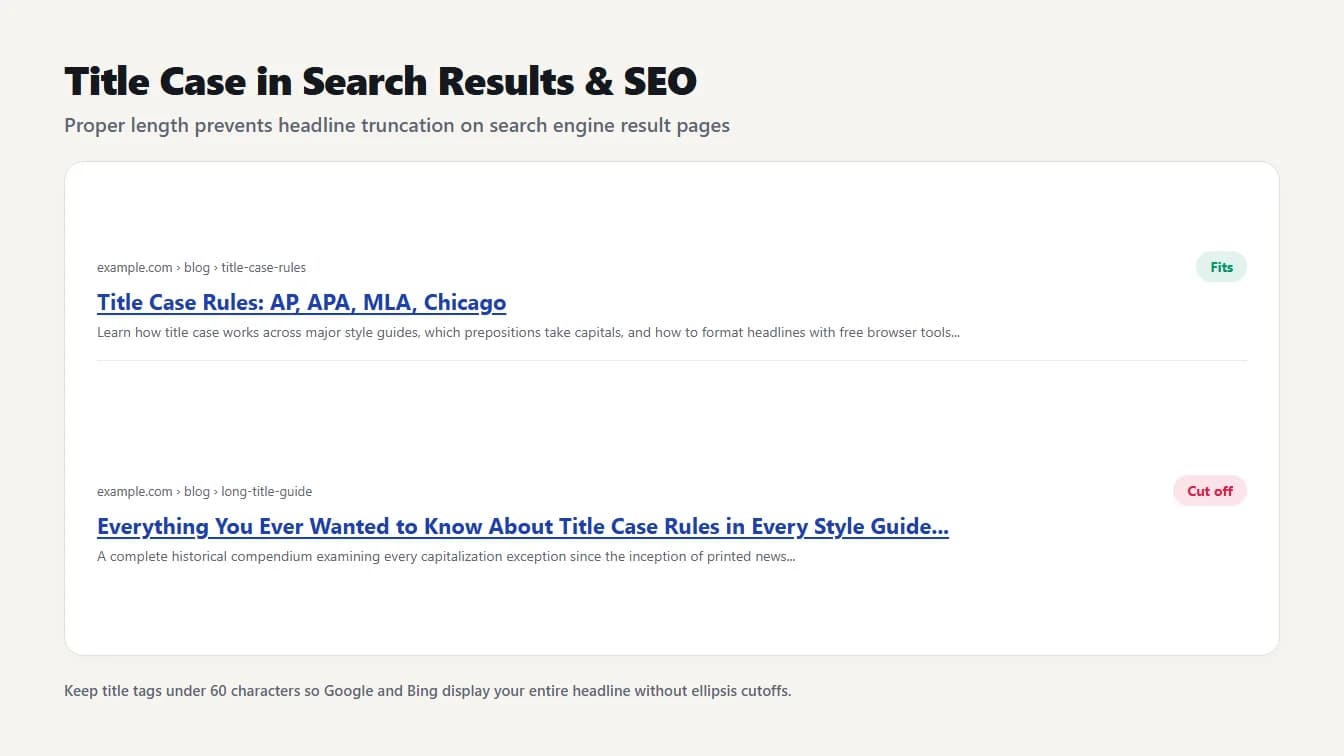
Two generic search result mockups: a short title that fits in full and a long one that ends in an ellipsis when it passes the width limit.
Frequently asked questions
Is "with" capitalized in a title?
It depends on the guide. AP and APA capitalize it because it has four letters. MLA and Chicago lowercase it, since MLA lowercases every preposition and Chicago only capitalizes prepositions of five letters or more. If nobody has told you which guide to follow, pick one and apply it everywhere.
Is "is" capitalized in a title?
Yes. "Is" is a verb, and every major guide capitalizes verbs, including short ones like is, are, be and was. People lowercase it by mistake because it looks small, but length only matters for prepositions and conjunctions.
Do you capitalize "to" in a title?
Not in the middle of a title. All four guides lowercase it there, whether it's an infinitive marker or a preposition. Capitalize it only when it is the first word, the last word, or the first word after a colon.
What is the difference between title case and sentence case?
Title case capitalizes the main words, as in "How to Cook a Perfect Egg". Sentence case capitalizes only the first word, the first word after a colon, and proper nouns, as in "How to cook a perfect egg". APA reference lists and AP headlines both use sentence case.
Which style guide should I follow for title case?
Follow whoever is publishing you: your teacher, journal or editor. For a blog or website with no guide, choose one set of rules, such as AP and APA for their simple four-letter rule, and apply it to every title so your site looks consistent.
Put the title case rules to work on your next headline
Take the last five titles you wrote, convert them, and compare the output with the table above. The pattern in the title case rules shows up within minutes. Keep the table handy, and if your publisher is moving to Chicago 18, check how it treats prepositions of five letters or more before you convert an old archive.