How to Write Numbers in Words: Rules, Checks and Examples
Learn how to write numbers in words: hyphens, the word and, check amounts, ordinals and lakh and crore. Rules tested on 29,794 numbers.
By TheTextKit TeamPublished
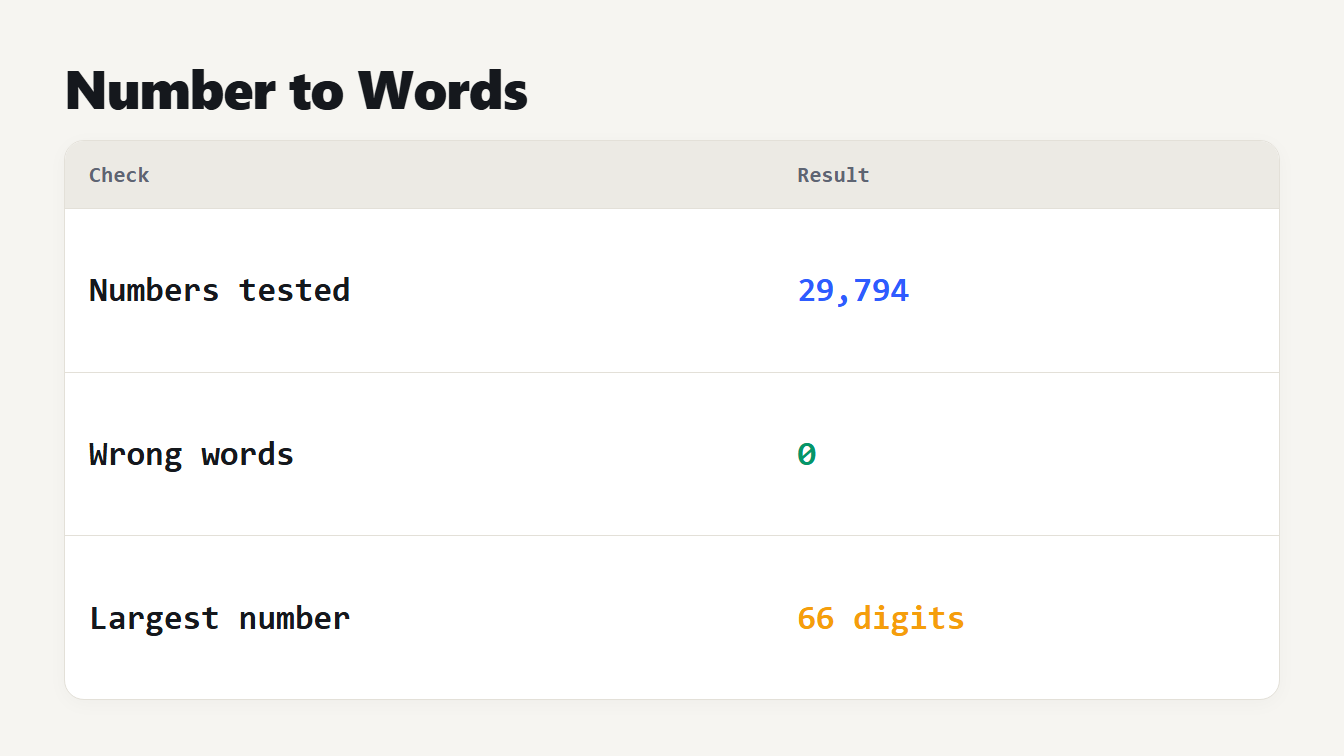
A table of three results for the number to words converter. 29,794 numbers were compared with a Python library. There were no wrong words. The largest number it writes has 66 digits.
To write numbers in words, split the number into groups of three digits from the right and say each group as hundreds, tens and units. Then add the scale word after it: thousand, million, billion. Put a hyphen between the tens and units from 21 to 99. So 1,234,567 is one million two hundred thirty-four thousand five hundred sixty-seven. American style leaves out the word "and", and British style adds it, as in one hundred and five. This guide covers hyphens, check amounts, decimals, ordinals and the Indian lakh and crore, and shows how we tested our number to words converter on 29,794 numbers.
How to write numbers in words
Take 4,207,938 as an example.
- Read the number in groups of three digits from the right: 4, 207 and 938.
- Say each group the way you would say a number under 1,000. The group 207 is two hundred seven.
- Add the scale word after each group except the last: four million, two hundred seven thousand.
- Skip a group of three zeros. 4,000,938 has no thousands, so it is four million nine hundred thirty-eight.
- Join tens and units from 21 to 99 with a hyphen, as in thirty-eight.
The result is four million two hundred seven thousand nine hundred thirty-eight. By hand this works well up to a few digits. For long numbers, currency or a check, the Number to Words Converter does the grouping for you and handles numbers up to 66 digits.
Hyphens and the word "and"
The hyphen rule is the same everywhere. According to the Wikipedia article on English numerals, a number from 21 to 99 with a second digit above zero is typically written as two words joined by a hyphen, as in twenty-one. Multiples of ten such as thirty have no hyphen, and neither do hundreds or thousands on their own. A hyphenated pair stays hyphenated inside a longer number: two hundred thirty-four.
The word "and" is where styles split. The same article notes that many American students are taught to leave "and" out of whole numbers, so 373 is three hundred seventy-three, and that some Americans still use it. British writing keeps it after the hundreds, so 101 is one hundred and one. Our converter offers both, and the British option follows the common pattern: "and" after the hundreds, and before a last group of one or two digits when a larger group comes first.
| Number | American style | British style |
|---|---|---|
| 105 | one hundred five | one hundred and five |
| 1,001 | one thousand one | one thousand and one |
| 1,100 | one thousand one hundred | one thousand one hundred |
| 2,300,005 | two million three hundred thousand five | two million three hundred thousand and five |
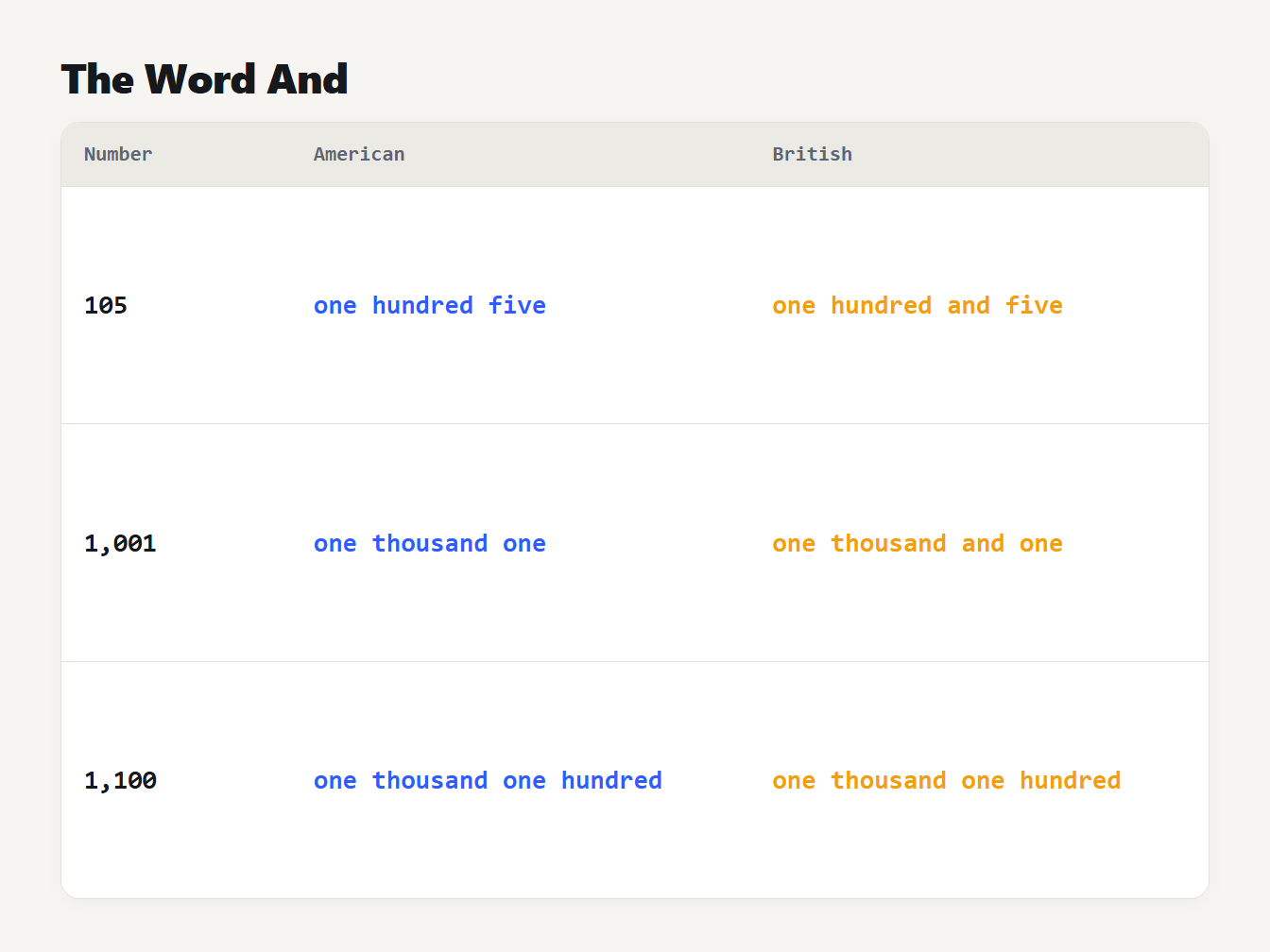
A table of three numbers written in words in the American style and the British style. 105 is one hundred five and one hundred and five. 1,001 is one thousand one and one thousand and one. 1,100 is one thousand one hundred in both styles.
Style guides disagree on edge cases, so if you write for a publisher or an exam board, follow their sheet over any tool.
How to write the amount on a check
A check has two amounts: the digits in the small box and the words on the long line. The words follow a fixed pattern. Write the whole dollars in words, then "and", then the cents as a fraction over 100. The word Dollars is usually printed at the end of the line.
Bankrate's guide to writing a check, as published by Fox Carolina, gives "One hundred and 30/100" for $100.30 and "Fifty and 00/100" for $50.00. It says to write 00/100 even for round amounts, so that no one can add cents, and to draw a line through any blank space. The words must match the digits exactly, because a mismatch can make the bank reject or delay the check.
| Amount | Words on the line |
|---|---|
| $1,234.56 | One thousand two hundred thirty-four and 56/100 |
| $50.00 | Fifty and 00/100 |
| $7.05 | Seven and 05/100 |
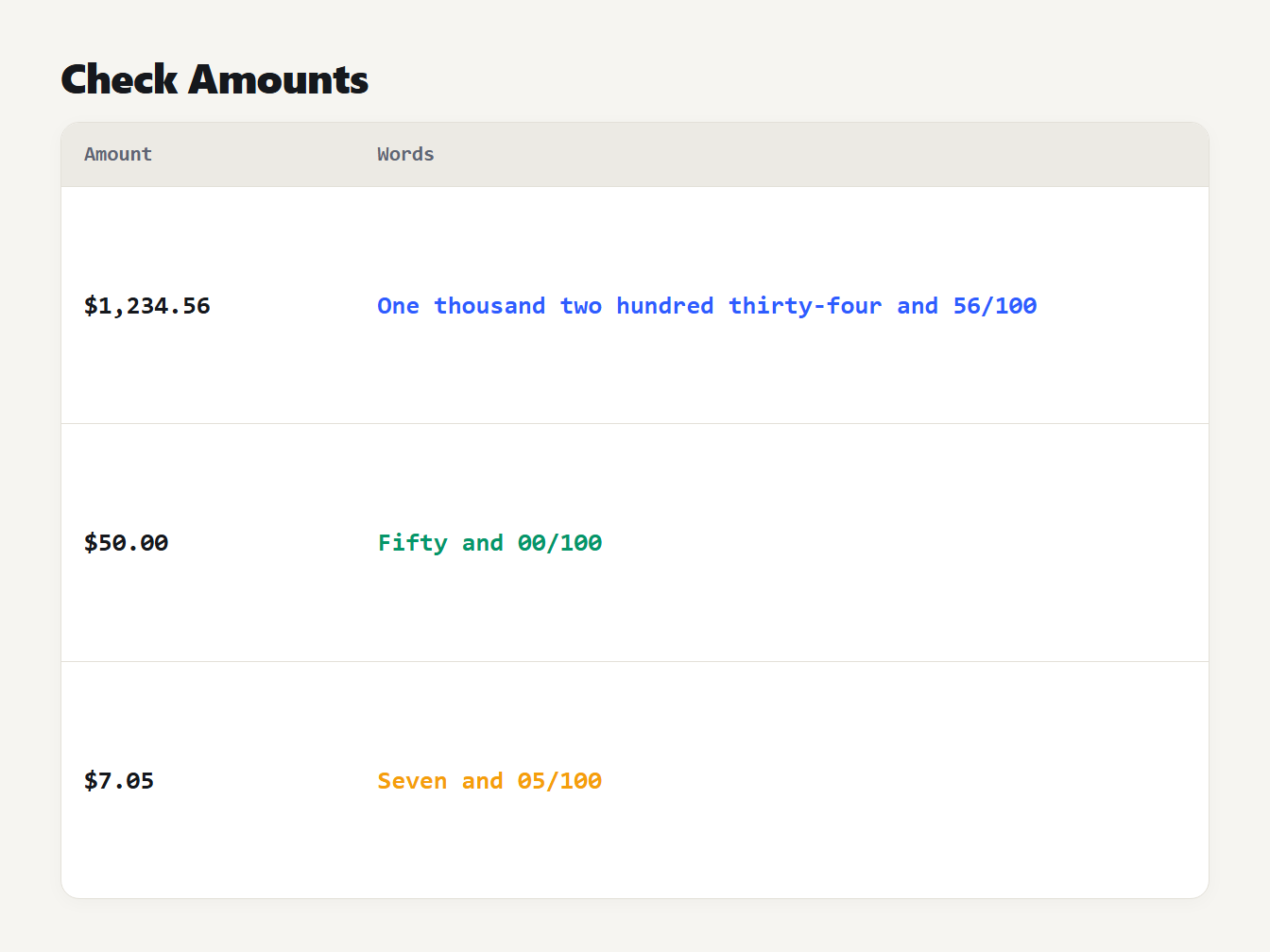
A table of three check amounts and the words written on the line. 1,234.56 is one thousand two hundred thirty-four and 56/100. 50.00 is fifty and 00/100. 7.05 is seven and 05/100.
If the two amounts disagree, the words usually win. In the United States, section 3-114 of the Uniform Commercial Code, as published by Cornell's Legal Information Institute, says that when an instrument has contradictory terms, "words prevail over numbers". States adopt their own versions of the code and banks have their own policies, so treat this as the general rule and not as legal advice.
In the converter, choose Check amount. An amount with more than two decimals, such as 1.005, is rounded half up to the nearest cent, and the tool tells you when it has done that. Conventions for amounts under a dollar vary, so ask your bank if it matters. The converter writes $0.50 as zero and 50/100.
Decimals, negative numbers and ordinals
When you write numbers in words, a decimal point is read as "point", followed by each digit on its own: 3.14 is three point one four. Zeros after the point count, so 2.50 is two point five zero. A negative number starts with "minus".
Ordinal numbers change only the last word. Twenty-one becomes twenty-first and one hundred becomes one hundredth. Five, eight, nine and twelve change their spelling (fifth, eighth, ninth, twelfth), a word that ends in y becomes ieth (twentieth), and one, two and three become first, second and third. Everything else just adds th. Zero becomes zeroth, and an ordinal needs a whole number above zero, so the converter reports an error for 1.5 or negative numbers instead of guessing.
Roman numerals are another way to write numbers with letters. For those, use the Roman Numeral Converter.
The Indian system: lakh and crore
India, Pakistan and Bangladesh use a different grouping, according to the Wikipedia article on the Indian numbering system. The first group has three digits and every later group has two. A lakh is 100,000, written 1,00,000, and a crore is 10,000,000, written 1,00,00,000. So 123,456,789 is written 12,34,56,789 and read as twelve crore thirty-four lakh fifty-six thousand seven hundred eighty-nine.
| Name | International grouping | Indian grouping |
|---|---|---|
| Lakh | 100,000 | 1,00,000 |
| Crore | 10,000,000 | 1,00,00,000 |
| Both | 123,456,789 | 12,34,56,789 |
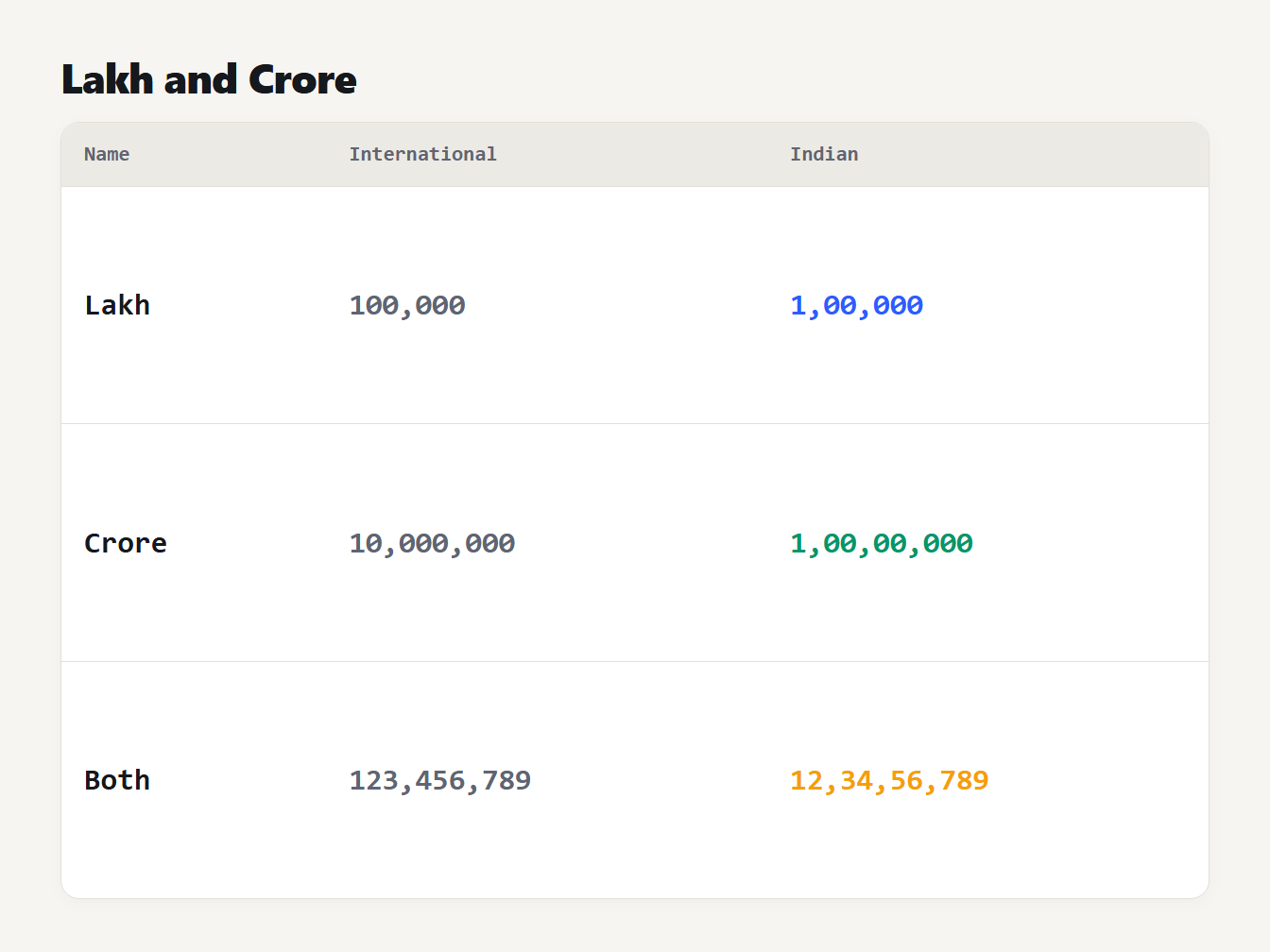
A table of three numbers in international grouping and Indian grouping. A lakh is 100,000 or 1,00,000. A crore is 10,000,000 or 1,00,00,000. The number 123,456,789 is 12,34,56,789 in the Indian system.
Above a crore, speakers repeat the units. The same article says that a lakh crore means 10^12, though it also notes that usage is inconsistent. Our converter reads 1,000,000,000 as one hundred crore and 10^12 as one lakh crore. It stops at 13 digits in the Indian system, so that it never has to choose between competing names.
Very large numbers
When you write numbers in words above a million, English has two systems to choose from. The Wikipedia article on English numerals says the short scale, where a billion is a thousand million, is always used in American English. British English has used it almost always since the 1970s. The long scale, where a billion is a million million, survives in several other European languages.
In the short scale each name is a thousand times the one before. After thousand (10^3), million (10^6), billion (10^9) and trillion (10^12) come quadrillion, quintillion, sextillion, septillion, octillion, nonillion and decillion at 10^33. The names continue to vigintillion at 10^63, and our converter stops there, at 66 digits. The reason is that, according to the same article, the powers of a thousand between vigintillion and centillion have no standardized names.
How we tested the converter
We compared the converter with the Python library num2words, which writes numbers in English words. A script generated random numbers of every length, with plenty of zeros inside them, and also every whole number from 0 to 3,000.
| Kind of test | Numbers | Real differences |
|---|---|---|
| Whole numbers and decimals | 10,793 | 0 |
| Ordinals | 5,001 | 0 |
| Indian numbering | 7,000 | 0 |
| Currency and check amounts | 7,000 | 0 |
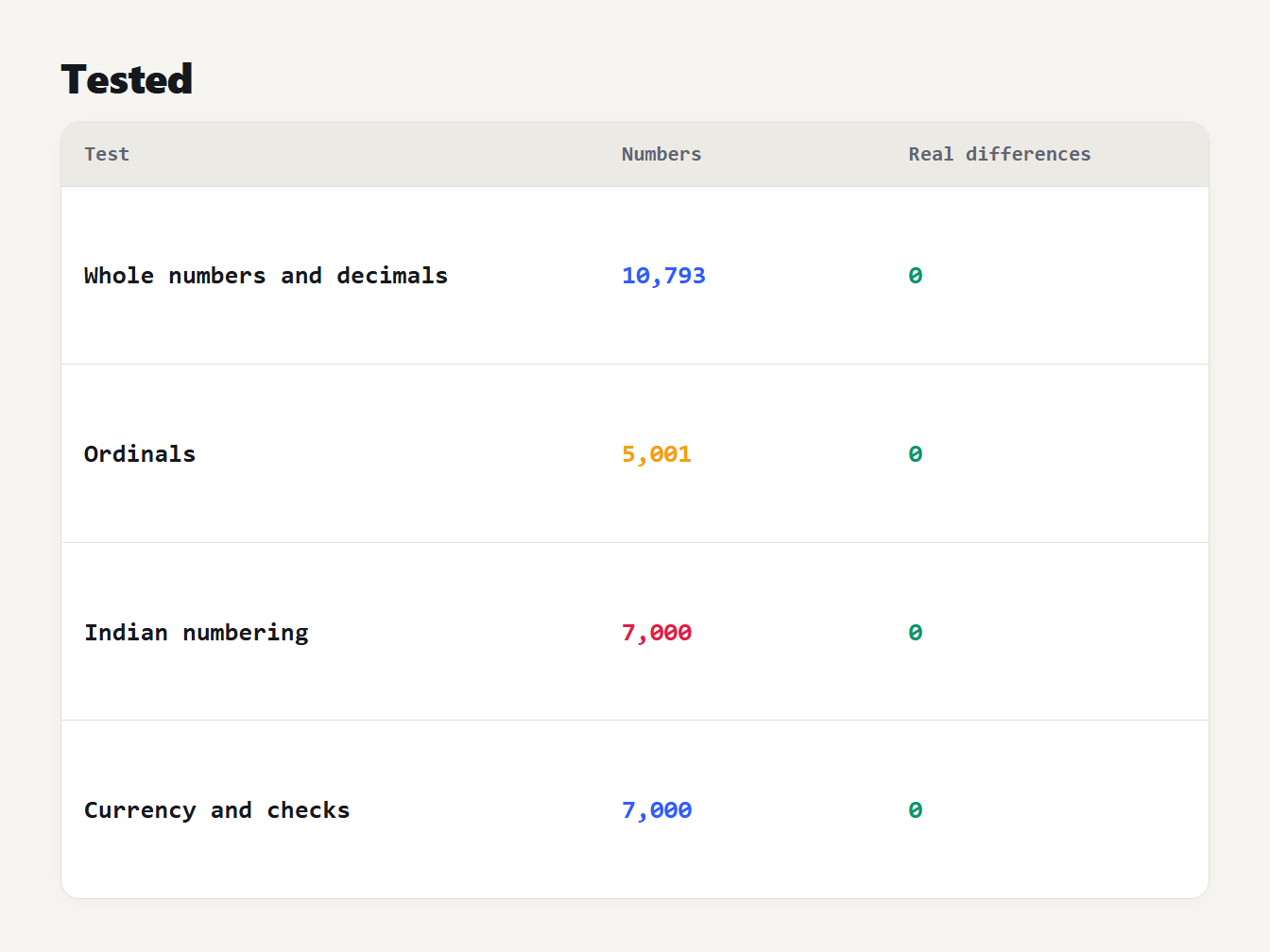
A table of four kinds of tests. 10,793 whole numbers and decimals, 5,001 ordinals, 7,000 numbers in the Indian system and 7,000 currency and check amounts. Each had 0 real differences from the Python library.
Two differences turned up, and both were in the library. It spells 10^51 as "septdecillion", while the Wikipedia list of short scale names gives "septendecillion", which is what the converter uses. And for a decimal such as 612037288698.86856, the library dropped or changed the last digits, while the converter reads every digit, which we checked by turning the words back into digits. The library also refuses Indian numbers of 10,000,000,000 and above. So we compared 3,000 numbers of up to 13 digits with a second implementation we wrote separately, which agrees with the library on 2,000 numbers below that limit.
The currency and check tests compared the dollars with the library's words and used our own rule for the cents. That makes them a weaker check than the others, because the fraction format is a convention and not something a library can confirm.
Limits
The converter writes English only. It follows common American and British patterns, and style guides differ in small ways, such as commas between groups and the "and" in numbers like 1,100. Ordinals work for whole numbers above zero. Check conventions vary by bank, so use the output as a draft and read it against the digits before you sign.
Frequently asked questions
How do I write a number in words?
Split the number into groups of three digits from the right, say each group as hundreds, tens and units, and add the scale word after it: thousand, million, billion. Put a hyphen between tens and units from 21 to 99. So 1,234,567 is one million two hundred thirty-four thousand five hundred sixty-seven.
Do you write "and" in numbers like 105?
It depends on the style. American style usually leaves it out: one hundred five. British style puts it after the hundreds: one hundred and five. Both are in common use, so follow the style of your reader or your publisher.
How do I write the amount in words on a check?
Write the whole dollars in words, then "and", then the cents as a fraction over 100. For $1,234.56 that is one thousand two hundred thirty-four and 56/100. Write 00/100 for a round amount so no one can add cents, and draw a line through any space that is left.
What is a lakh and a crore?
A lakh is 100,000 and a crore is 10,000,000. They belong to the Indian numbering system, which groups digits as 12,34,56,789 instead of 123,456,789. That number is read as twelve crore thirty-four lakh fifty-six thousand seven hundred eighty-nine.
How do I write an ordinal number in words?
Change only the last word of the number. Twenty-one becomes twenty-first and one hundred becomes one hundredth. Five, eight, nine and twelve change their spelling: fifth, eighth, ninth, twelfth. Words that end in y become ieth, as in twentieth.
Write your number in words now
Type or paste a number into the Number to Words Converter to write numbers in words in one step, and choose number words, ordinal, currency or check amount. If you work with other numbers, the Extract Numbers tool pulls them out of a text first. Everything runs in your browser, so nothing you type is uploaded.