How to Count Words: What Counts as a Word in English, Chinese and More
Learn how to count words correctly: how hyphens, dashes, numbers and symbols are treated, and how Chinese and Japanese text is counted. Tested on 60 articles.
By TheTextKit TeamPublished
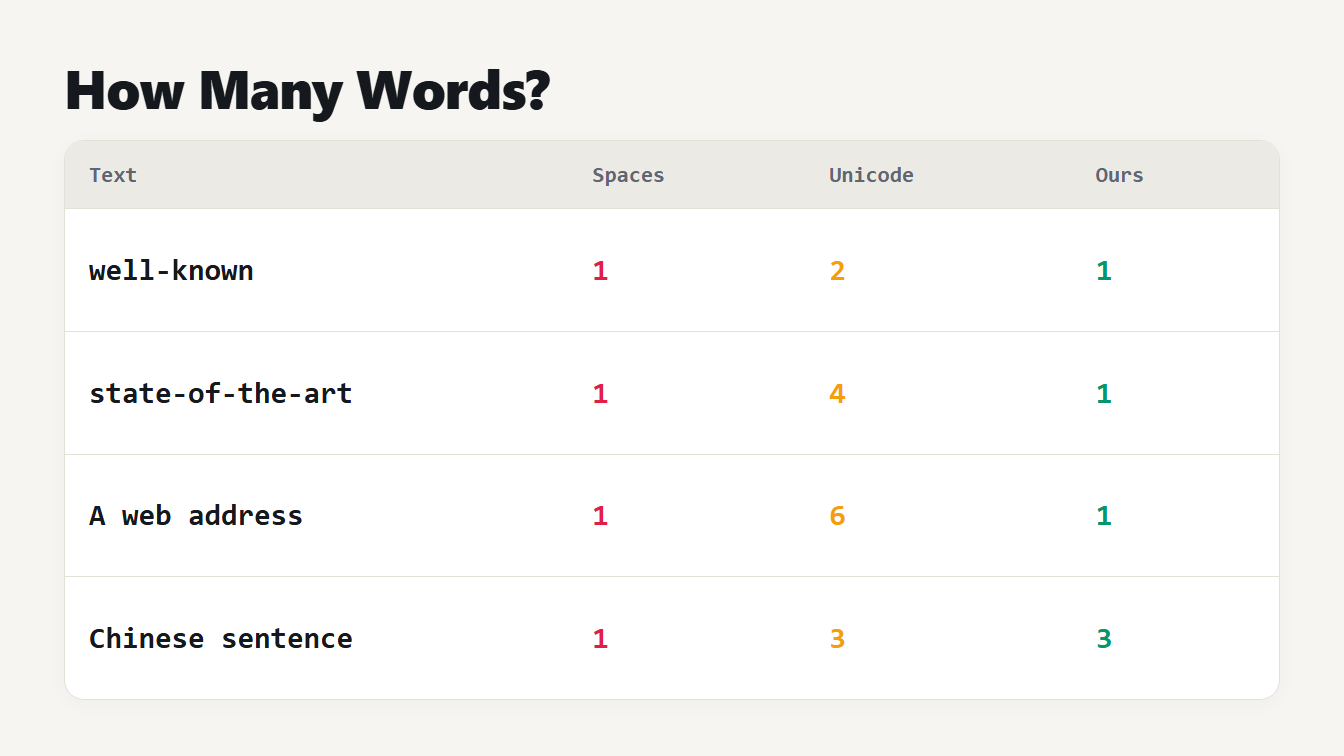
A table of four texts and how many words three rules count in each. Well-known: 1 by spaces, 2 by Unicode, 1 by TheTextKit. State-of-the-art: 1, 4 and 1. A web address: 1, 6 and 1. A six-character Chinese sentence: 1, 3 and 3.
To count words, treat a word as a run of characters between spaces, tabs or line breaks, and count each run that has a letter or a digit in it. That is the rule most counters follow, and it works for English. It fails for text without spaces, such as Chinese, and it leaves open what to do with a hyphen, a dash or a lone symbol. This guide shows how to count words, what the standards say, and how our own counter's rules changed after we tested it.
How to count words
- Open the Word Counter and paste or type your text.
- Read words, characters and unique words, which update as you type.
- For Chinese, Japanese or Thai text, read the same figure. The counter cuts those scripts into words for you.
- If you must meet an exact limit, compare the figure with the one in the program your reader will use, because programs differ on dashes and symbols.
For reading time, paste the same text into the Reading Time Calculator, and see our guide to how long it takes to read 1,000 words.
What the standards say
Two sources define a word, and they disagree on purpose. The POSIX standard for wc, the Unix word-count command, defines a word as "a non-zero-length string of characters delimited by white space". That is the space rule: count the runs between blanks.
Unicode's text segmentation report (UAX #29) is built for software that must find word boundaries in any language. It says plain boundary rules are inadequate for Chinese, Japanese and the Southeast Asian scripts, because those scripts don't mark word boundaries with spaces. Reliable word detection in Thai, Lao, Chinese and Japanese, it adds, requires dictionary lookup. Browsers expose those rules through Intl.Segmenter, which marks each piece as word-like or not.
The two rules give the same answer for one two and different answers for almost everything else.
Hyphens, slashes, numbers and symbols
We ran the same short texts through three rules: the space rule, the Unicode rule from Intl.Segmenter, and our counter.
| Text | Space rule | Unicode rule | Our counter |
|---|---|---|---|
well-known | 1 | 2 | 1 |
state-of-the-art | 1 | 4 | 1 |
and/or | 1 | 2 | 1 |
e-mail | 1 | 2 | 1 |
don't | 1 | 1 | 1 |
3.14 and 1,000 | 1 | 1 | 1 |
U.S.A. | 1 | 1 | 1 |
| Two words joined by an em dash, no spaces | 1 | 2 | 1 |
AT&T | 1 | 2 | 1 |
| A web address | 1 | 6 | 1 |
A lone - | 1 | 0 | 0 |
| A lone emoji | 1 | 0 | 0 |
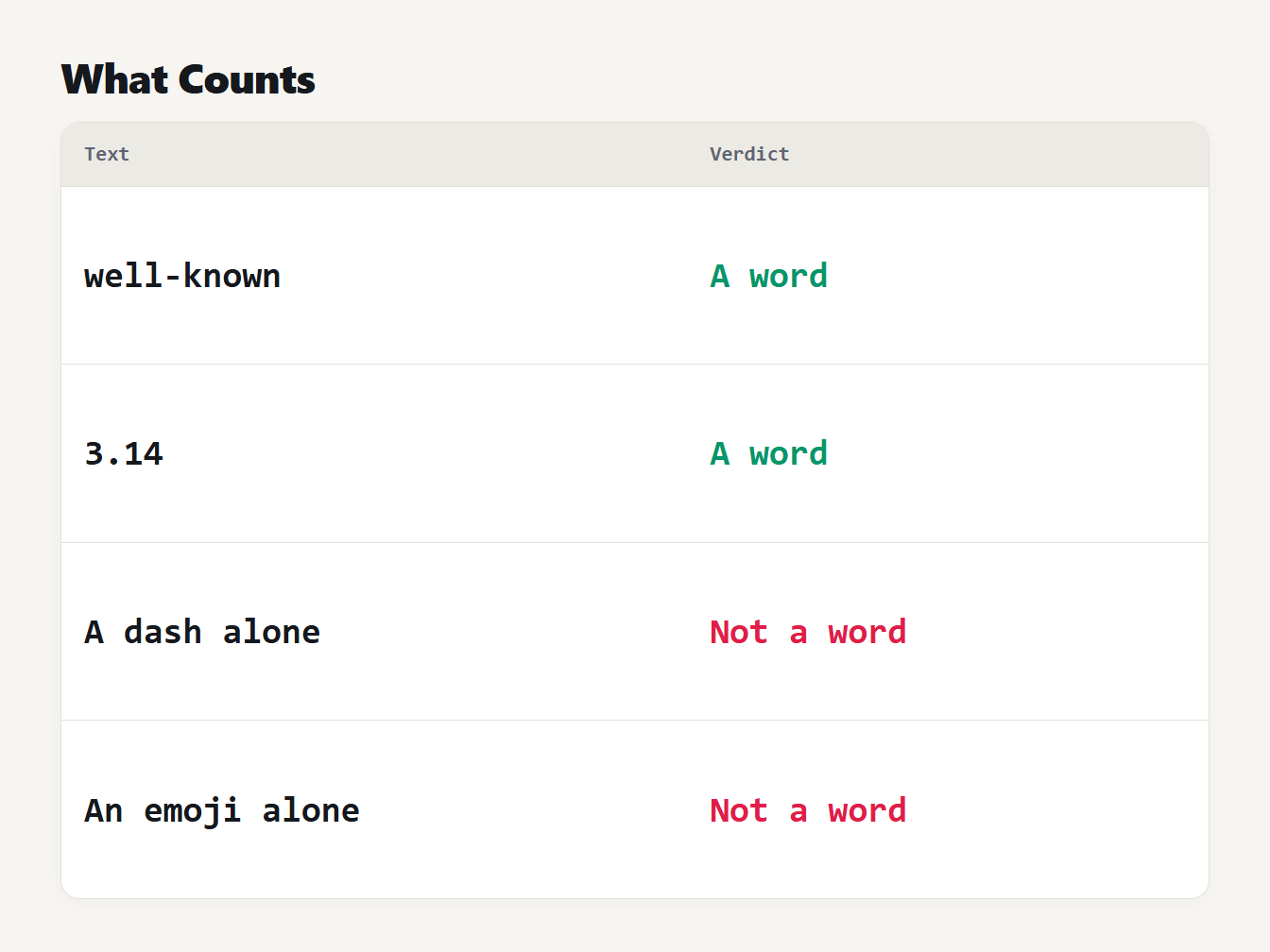
A table of four texts and whether the word counter counts each. Well-known is a word. 3.14 is a word. A dash on its own is not a word. An emoji on its own is not a word.
Our counter follows the space rule for hyphens, slashes and dashes between letters, because writers and style guides treat well-known as one word and because most counters do. It departs from the pure space rule in one way: a token with no letter or digit in it isn't a word. A dash standing alone between two spaces, a bullet or an emoji doesn't add to your count. It follows the Unicode rule in the other direction, where it matters most: for text without spaces.
Chinese, Japanese and Thai
The space rule counts 今天天气很好, a six-character Chinese sentence, as 1 word. A person would count three: today, weather, very good. Under the Unicode rule the browser's dictionary finds those three. For the Japanese 私は学生です ("I am a student") the count is 4, and for the Thai สวัสดีครับ ("hello", polite) it is 2.
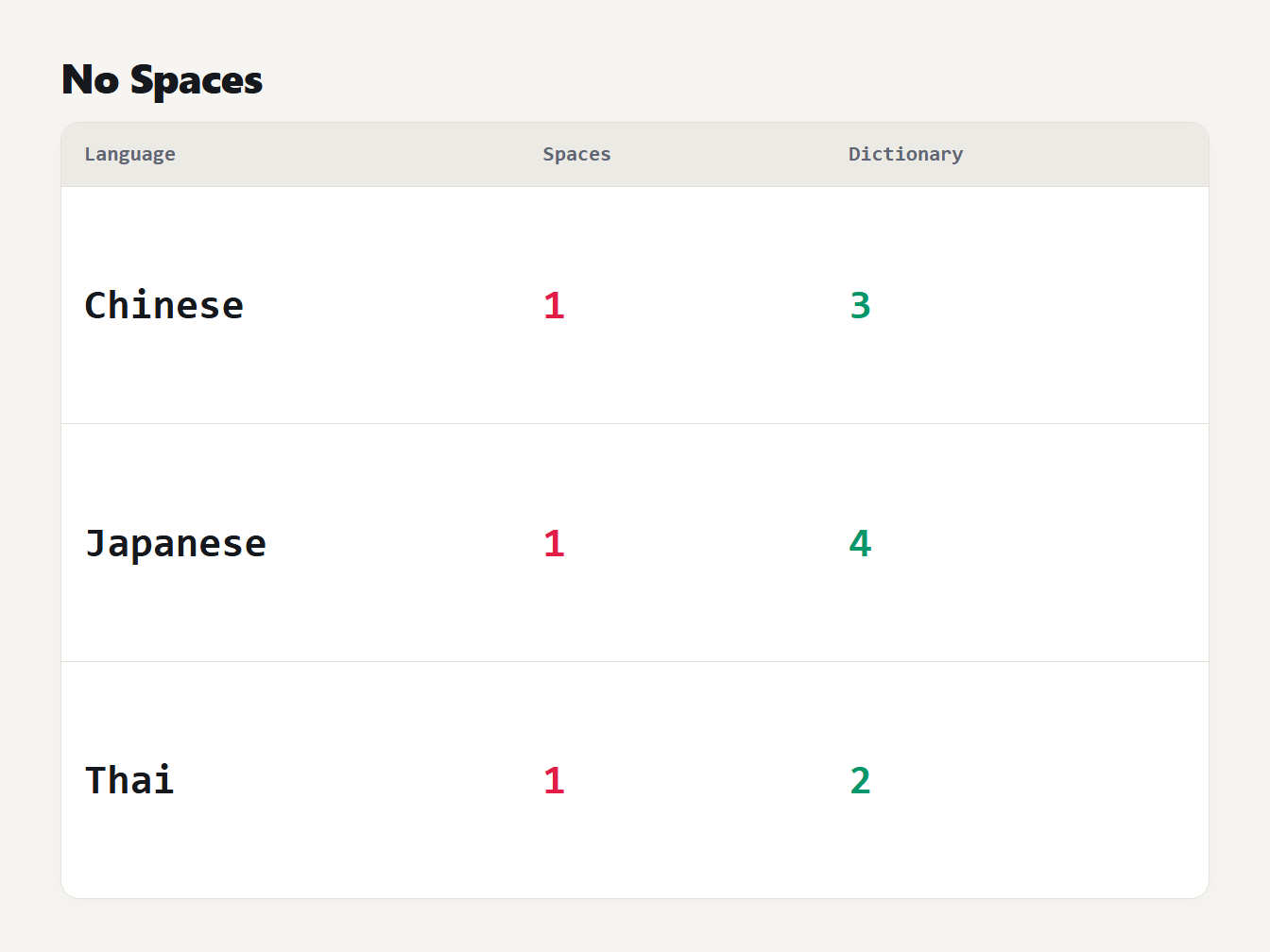
A table of three short sentences and their word counts. A Chinese sentence is 1 word by the space rule and 3 by dictionary. A Japanese sentence is 1 and 4. A Thai sentence is 1 and 2.
These counts come from the dictionary in the browser, so a different browser or version may cut a sentence differently. If a browser has no word dictionary, our counter falls back to one word per Chinese character, which is a rough guess. For mixed text, such as hello 世界 world, only the token with Chinese in it is cut by the dictionary, so the English words are counted as usual.
Where the space rule is only approximate
Even in scripts with spaces, a space is not always a word boundary. Vietnamese puts a space between syllables, so one word can take two or three blank-separated pieces, and a space rule counts the pieces. Korean puts spaces between phrases, so a noun and its ending sit together and count as one. German joins words into long compounds, and one compound counts once. A counter that wants to be exact in these languages needs a language-specific dictionary, which no browser offers for all of them. Treat the count as a good estimate for such text, and use characters when a limit must be exact.
Unique words
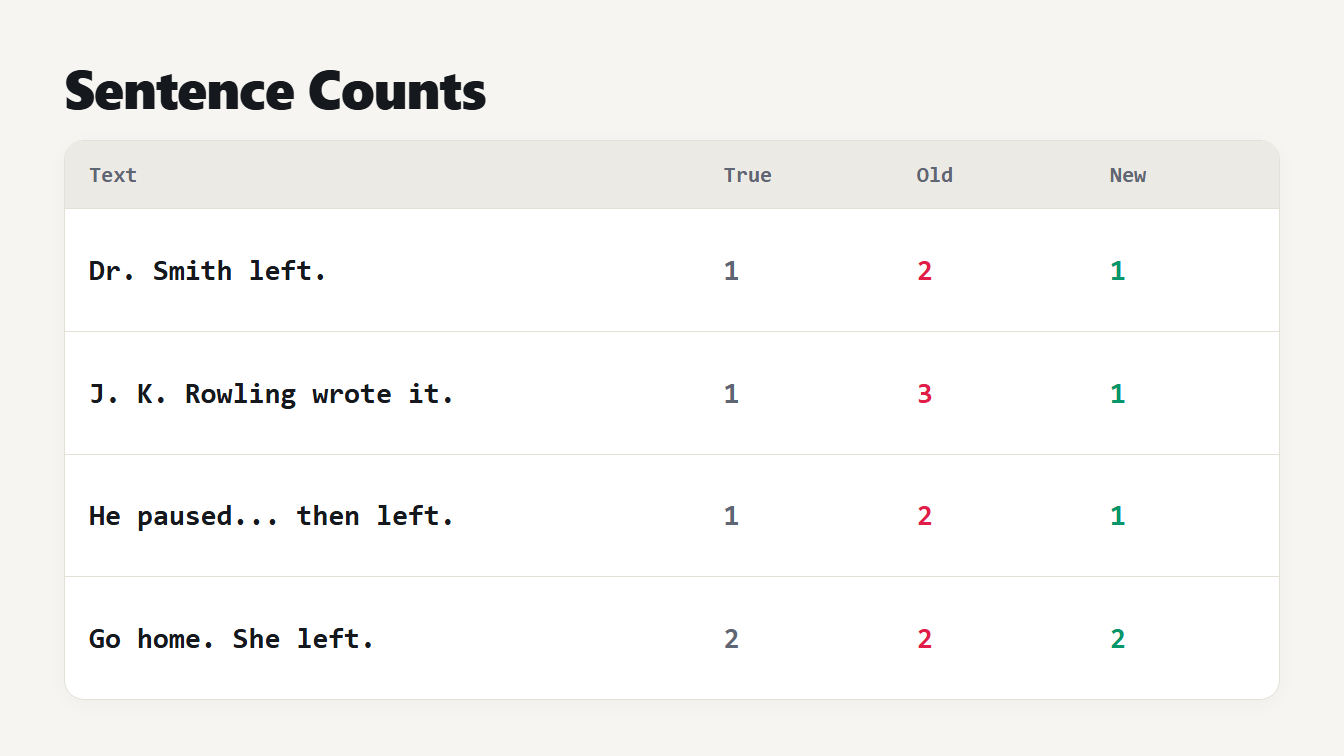
The unique-word count tells you how many different words you used. Our old version stripped everything except English letters, digits, spaces, apostrophes and hyphens before it compared words, so a Russian text of two words gave 0 unique words. The new version keeps letters from every alphabet. It ignores capital letters and the punctuation at the ends of a word, and it treats a curly apostrophe like a straight one.
| Text | Old count | New count |
|---|---|---|
| Two Russian words | 0 | 2 |
don’t don't (curly and straight apostrophes) | 2 | 1 |
The the THE, the. | 1 | 1 |
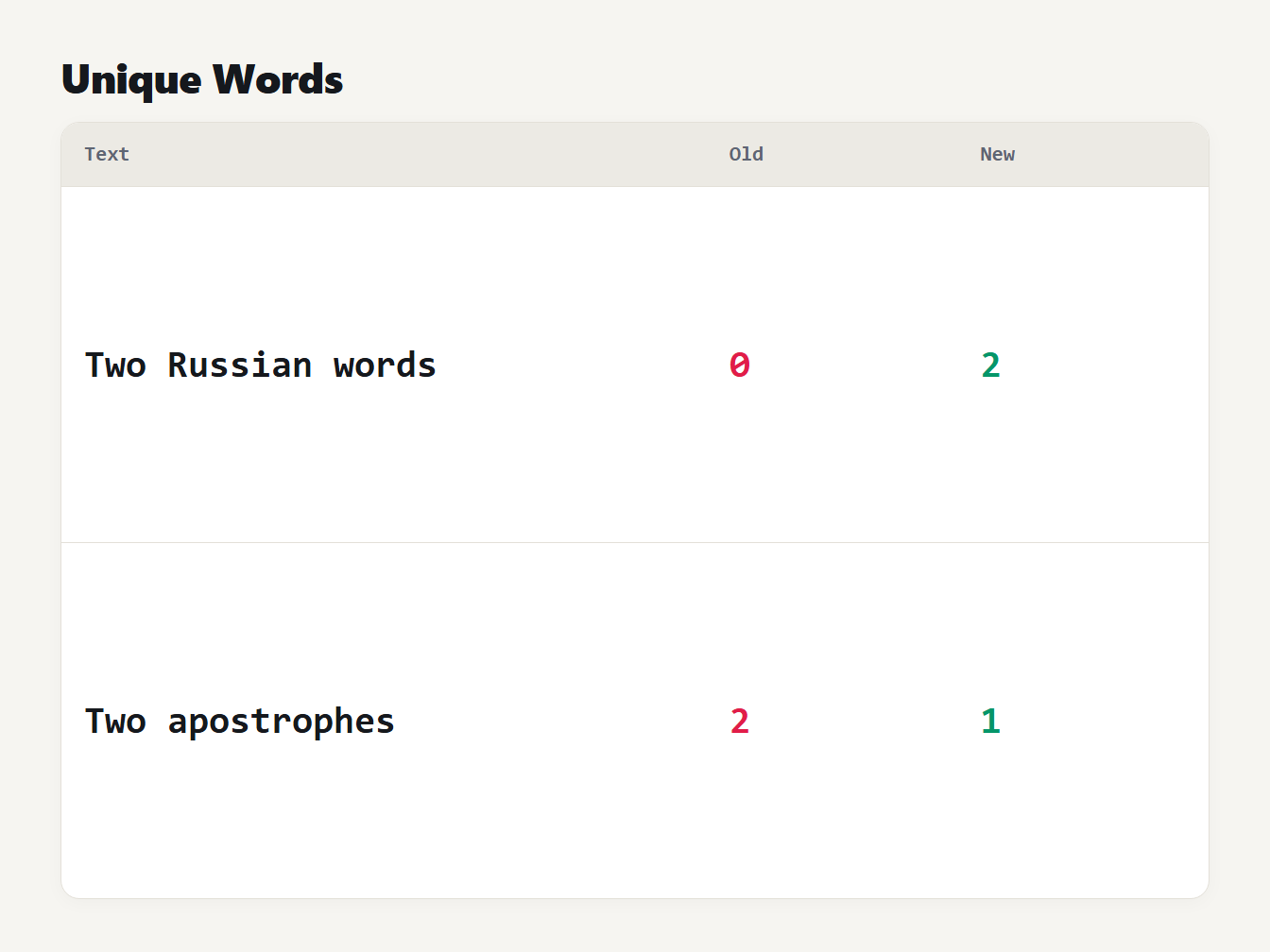
A table of two texts and their unique word counts. Two Russian words were counted as 0 and are now counted as 2. The same word written with a curly and a straight apostrophe was counted as 2 and is now counted as 1.
Tested on our own articles
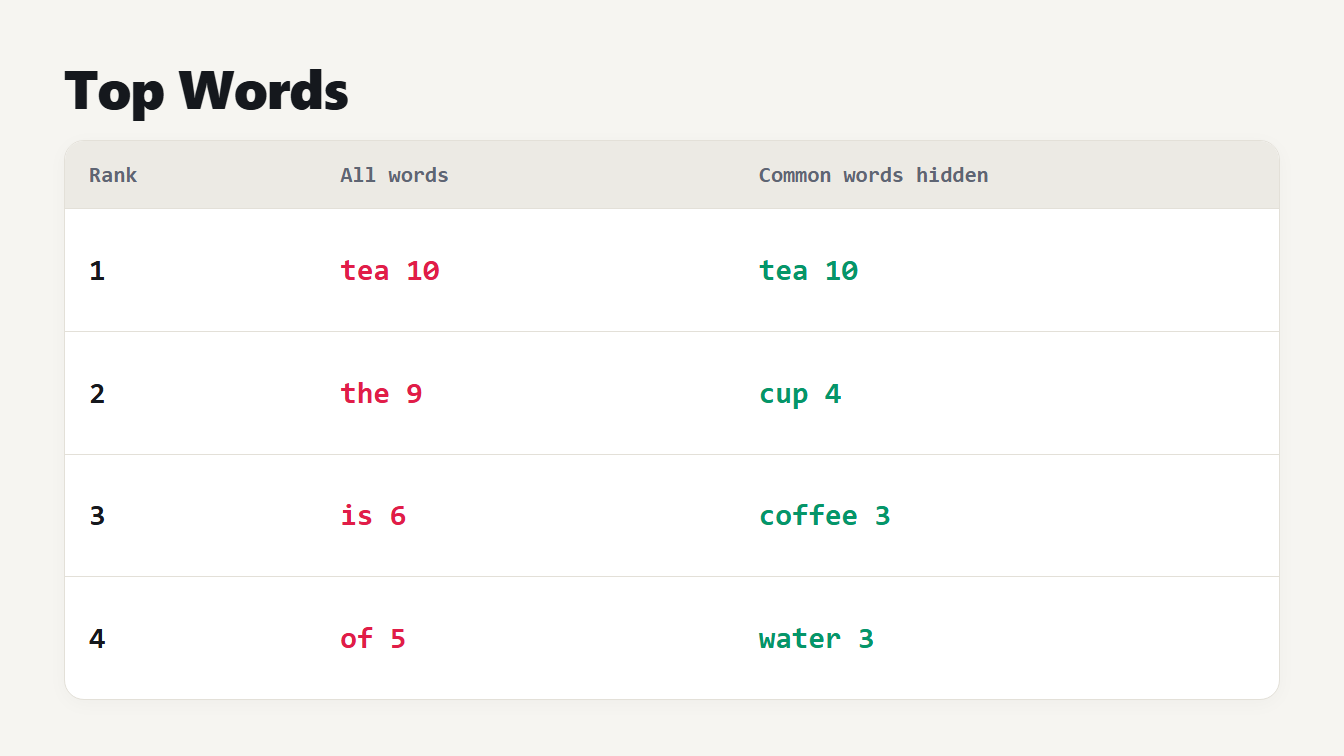
We took the 60 articles on this site, turned each into the text a reader sees, and counted it three ways. The space rule found 113,015 words. The Unicode rule found 115,040, which is 1.8 percent more, because it splits hyphenated words and web addresses. Our counter found 111,317, which is 1.5 percent fewer than the space rule. The difference comes from about 1,700 tokens with no letter or digit, such as {, +, = and *, in the code examples of the articles. Those, and text without spaces, are the only places where the two rules differ.
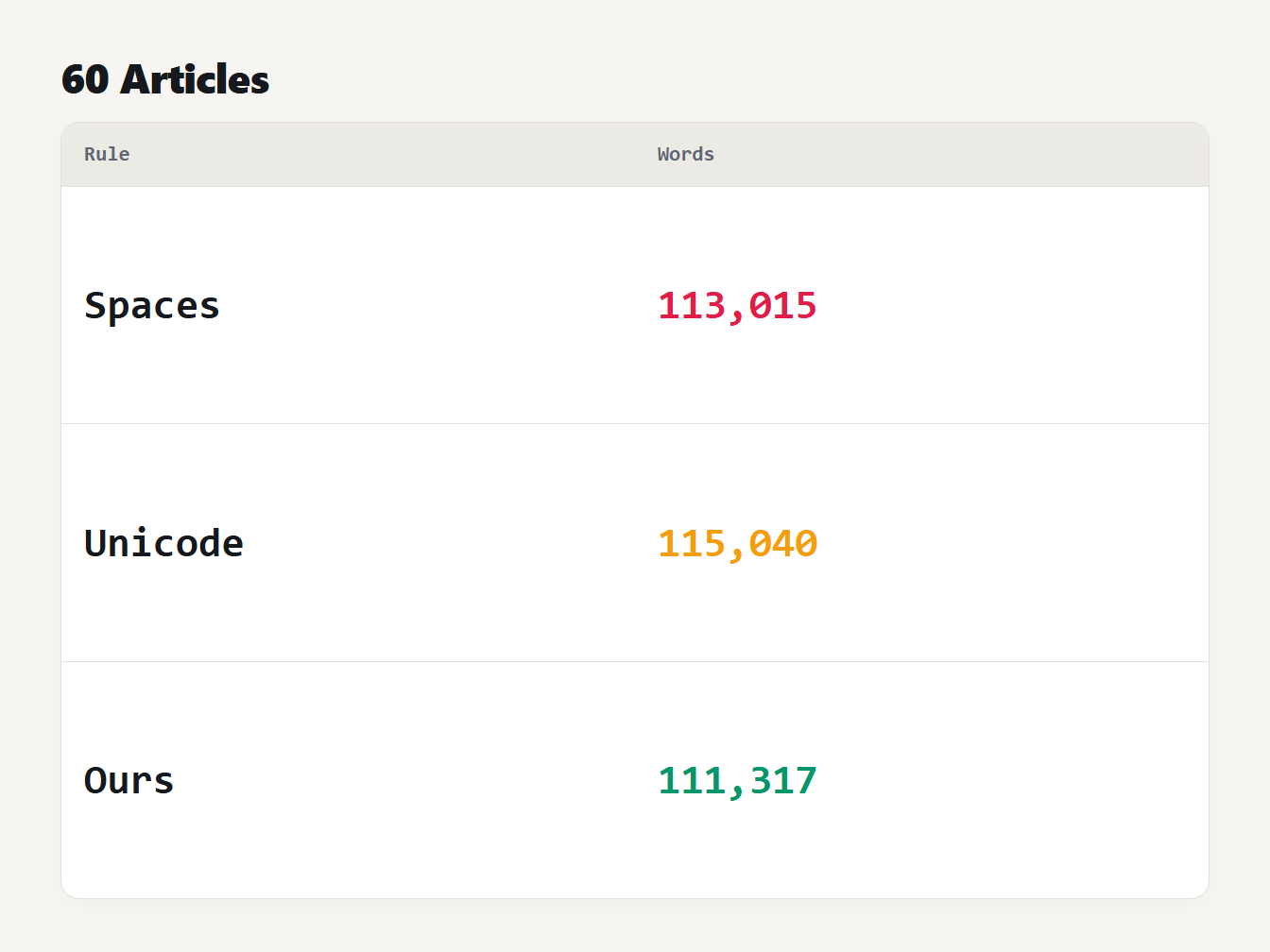
A table of the total word count of 60 articles under three rules. The space rule counted 113,015 words. The Unicode rule counted 115,040. The TheTextKit word counter counted 111,317.
Two limits apply. Our articles are English prose with some code, so a different kind of text will differ more. And we don't claim to match any particular word processor, whose rules we didn't test.
Which count should you use?
Use the rule of whoever sets the limit. An essay checked by a teacher's software should be measured in that software. A blog post with a target length can use any counter, since the difference is about 2 percent. Text in Chinese, Japanese or Thai needs a dictionary-based count, and even then the figure depends on the dictionary, so it can be safer to measure such text in characters. The Character Counter gives that count, and our guide to how to count characters explains it.
Before you send a piece of writing with a limit, run through four checks:
- Scope. Check whether the limit includes the title, headings, captions, references and quotations.
- Final text. Count the text after your last edit, not an early draft.
- One tool. Use the same counter each time, so the numbers are comparable.
- Margin. If you are near the limit, leave a few percent for differences between programs.
For page-length targets, our guide to how many words fit on a page gives typical figures.
Frequently asked questions
How do you count words in a text?
Paste the text into a word counter. By the usual rule, a word is a run of characters between spaces, tabs or line breaks. Our counter also skips a dash, bullet or emoji on its own, and cuts Chinese, Japanese and Thai text into words with a dictionary.
Is a hyphenated word one word or two?
One, by the space rule that most counters follow, so well-known and state-of-the-art each count once. A Unicode word-boundary rule would split them at the hyphens, which is why the same text can give different counts in different tools.
Are numbers and symbols counted as words?
A number such as 1,000 or 3.14 counts as one word, and so does a token like $5 or C++. A symbol on its own, such as a dash, an ampersand or an emoji, has no letter or digit and is not counted.
How do you count words in Chinese or Japanese?
Chinese and Japanese have no spaces between words, so counting spaces gives 1 for a whole sentence. The counter uses the browser's word dictionary to cut the text into words, so the count depends on that dictionary.
Why is my word count different in another program?
Programs make different choices about dashes, symbols, numbers and other scripts. If a limit must be met exactly, check the count in the program your reader will use.
Count your words now
Paste your text into the Word Counter and read the words, characters and unique words. Everything runs in your browser, so your text is never uploaded.