How to Count Sentences in a Text: Abbreviations, Quotes and Chinese Punctuation
Learn how to count sentences when full stops appear in Dr., e.g. and J. K. Rowling. Rules, a free counter and tests on 3,000 texts and 14 hard cases.
By TheTextKit TeamPublished
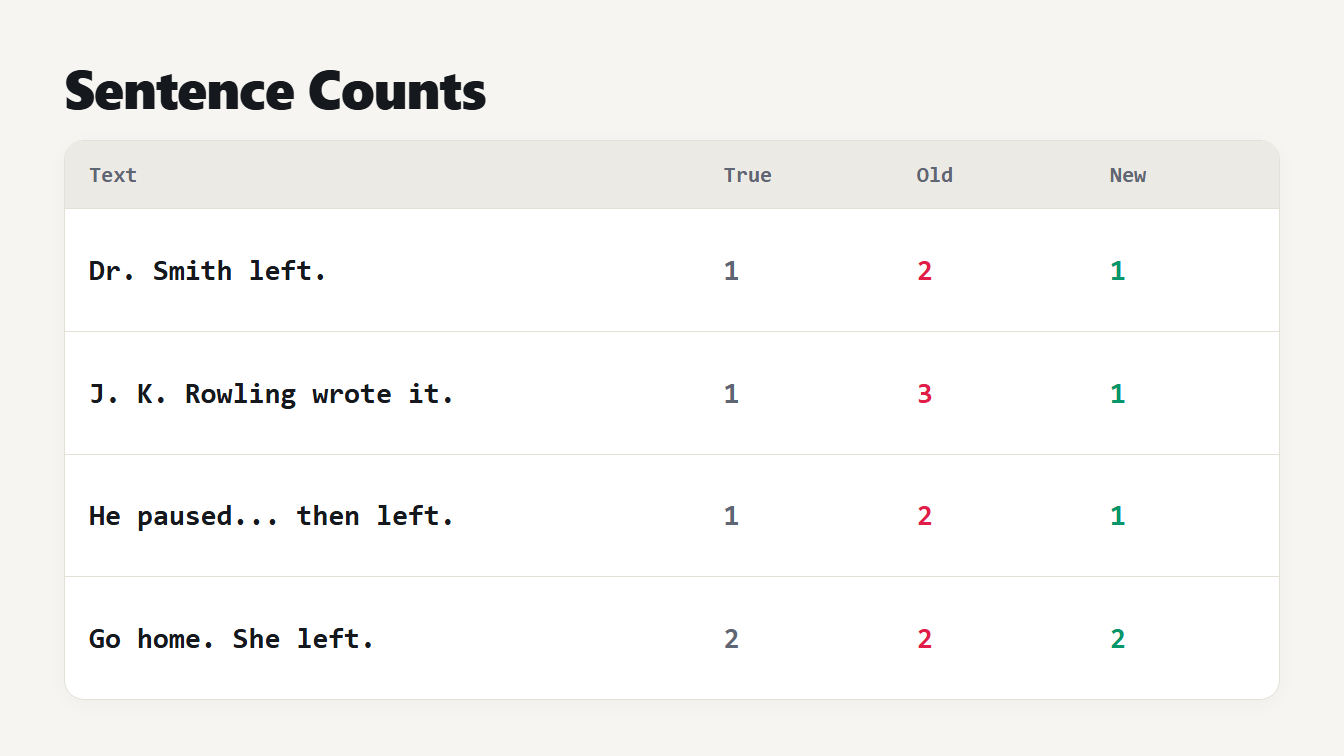
A table of four short texts with the true number of sentences and the counts from the old and the new counter. Dr. Smith left: 1, old 2, new 1. J. K. Rowling wrote it: 1, old 3, new 1. He paused... then left: 1, old 2, new 1. Go home. She left: 2, old 2, new 2.
To count sentences, count the full stops, question marks and exclamation marks that end a sentence, and skip the ones that only mark an abbreviation, an initial or a decimal point. The second half is the hard part. The text Dr. Smith met Mr. Jones at 9 a.m. on Monday. has five full stops and one sentence. Our old counter, which split at every stop followed by a space, said four. This guide shows how to count sentences correctly, how the rules work, and how a new counter did on 3,000 texts and 14 deliberately hard cases.
How to count sentences
- Open the Sentence & Paragraph Counter and paste your text.
- Read sentences, paragraphs, words per sentence and the word and character totals.
- Tick Count every line break as the end of a sentence if your text is a list with one item per line and no full stops.
- Look at the average words per sentence to find the paragraphs where sentences run long.
Why counting full stops fails
A full stop does three jobs. It ends sentences, it marks abbreviations (Dr., e.g., Inc.) and it is a decimal point or a dot in an address (3.14, example.com). Unicode's text segmentation report (UAX #29) says as much: plain text gives poor sentence-boundary cues because a period can end a sentence, mark an abbreviation or act as a decimal point. Its default rules handle some cases, such as a stop before a digit or before a lowercase letter, and the report admits they can't catch a case like Mr. Jones, which needs tailoring with a list of abbreviations.
Here is what three counters give for short texts whose true count we know:
| Text | True | Old counter | Unicode rules | New counter |
|---|---|---|---|---|
Dr. Smith met Mr. Jones at 9 a.m. on Monday. | 1 | 4 | 3 | 1 |
J. K. Rowling wrote the series. | 1 | 3 | 3 | 1 |
He said, "Go home." She left. | 2 | 1 | 2 | 2 |
He paused... then spoke. | 1 | 2 | 1 | 1 |
"Really?" he asked. | 1 | 1 | 2 | 1 |
| Two Chinese sentences ending in the ideographic full stop | 2 | 1 | 2 | 2 |
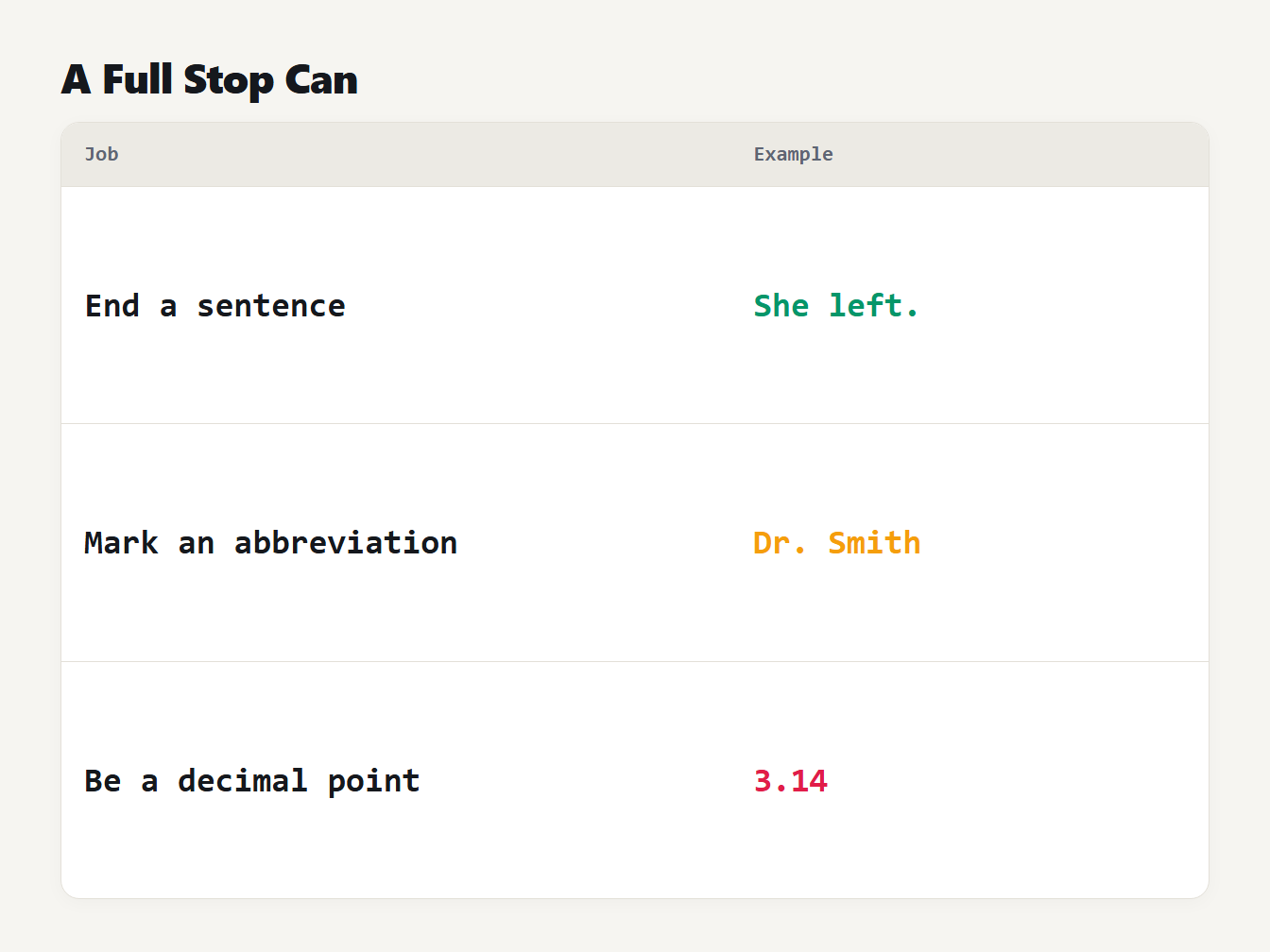
A table of three jobs of a full stop with an example of each. It ends a sentence, as in She left. It marks an abbreviation or an initial, as in Dr. Smith. It acts as a decimal point or a dot, as in 3.14 or example.com.
The old counter was wrong in both directions. It split at Dr. and at each initial, and it didn't split a Chinese sentence at all, because it only knew the Western stops. The Unicode rules in Intl.Segmenter, the version built into browsers, do better but split after a title and treat "Really?" he asked. as two sentences.
The rules our counter uses
The new counter reads your text from start to end and decides at each stop whether a sentence ends. A stop ends the sentence only if what follows looks like a new one. It doesn't end the sentence in these cases:
- After a title.
Dr.,Mr.,Mrs.,Ms.,Prof.,St.,Gen.and similar words. - After a Latin abbreviation.
e.g.,i.e.,cf.,vs.andviz. - After an initial.
J. K. Rowlingis one name, not three sentences. - Inside a number or address.
3.14,example.comand2.1.4have no space after the stop. - After a list marker.
1.at the start of a line is a number, not a sentence. - Before a lowercase letter.
approx. five kilosgoes on. - Before a reference number. In
See Fig. 3, the3belongs toFig.
A few words end a sentence only when a capital letter follows. These are etc., Inc., a.m. and p.m., so We bought apples, etc. Then we left. is two sentences and at 9 a.m. on Monday is part of one.
A closing quote or bracket right after the stop stays with its sentence. So He said, "Go home." She left. is two, and "Really?" he asked. is one, because a lowercase word follows the quote.
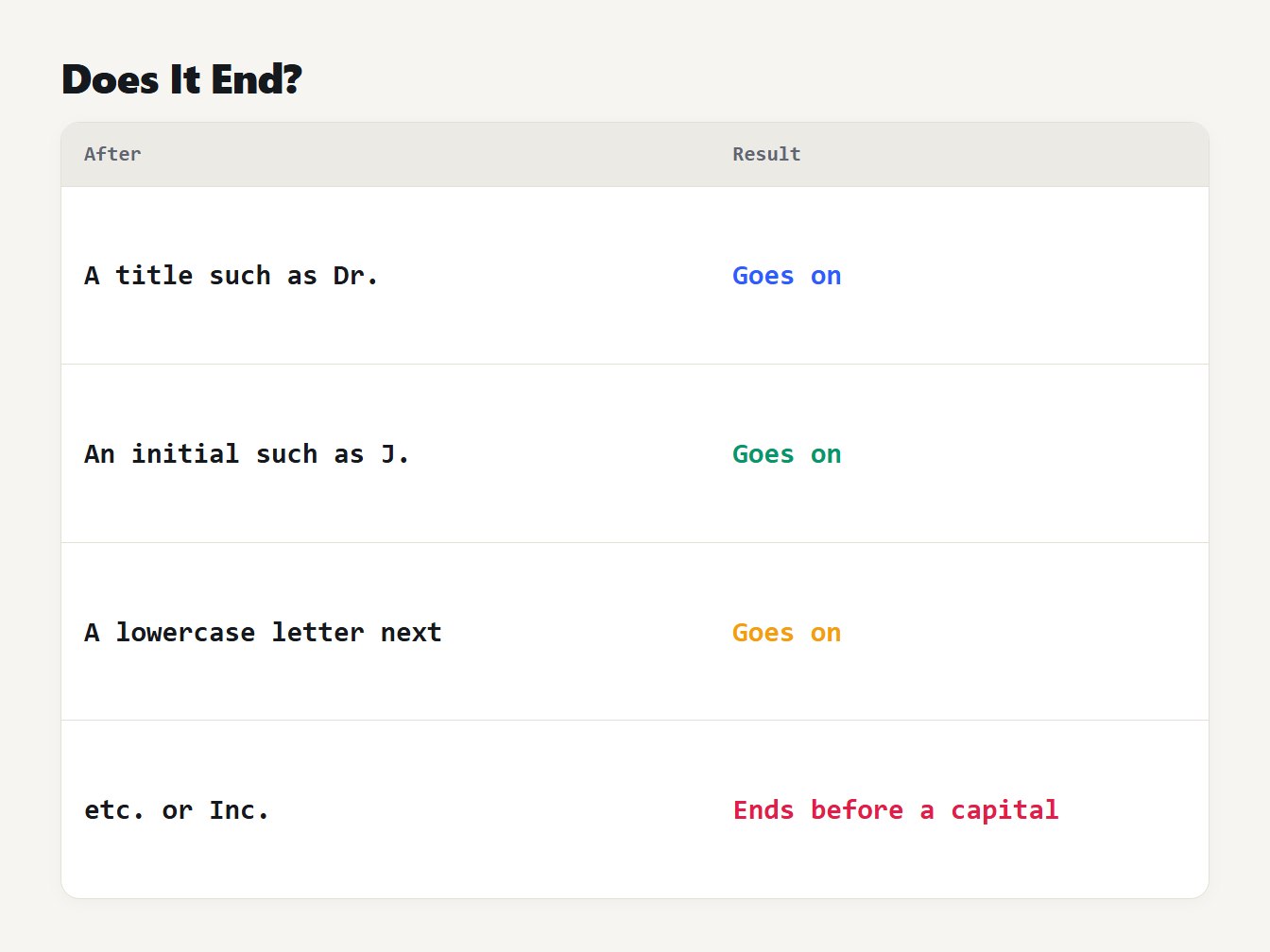
A table of four situations and what happens. After a title such as Dr., the sentence goes on. After an initial such as J., it goes on. Before a lowercase letter, it goes on. After etc. or Inc., it ends only before a capital letter.
Chinese and Japanese are easier. The ideographic full stop and the fullwidth question and exclamation marks end a sentence with no space needed after them. A blank line also ends a sentence that has no stop, so a heading counts as one.
How we tested it
We made a pool of 55 pieces of text with known sentence counts: plain sentences, titles, abbreviations, initials, numbers and addresses, quotes, ellipses, runs such as ?!, Chinese and Japanese, Spanish and Russian. We joined one to four pieces, with a space, two spaces or a line break between them, into 3,000 texts. Each text is counted correctly if the result equals the sum of its pieces.
| Counter | Texts counted correctly |
|---|---|
| Old counter | 1,046 of 3,000 |
Unicode rules (Intl.Segmenter) | 1,662 of 3,000 |
| New counter | 3,000 of 3,000 |
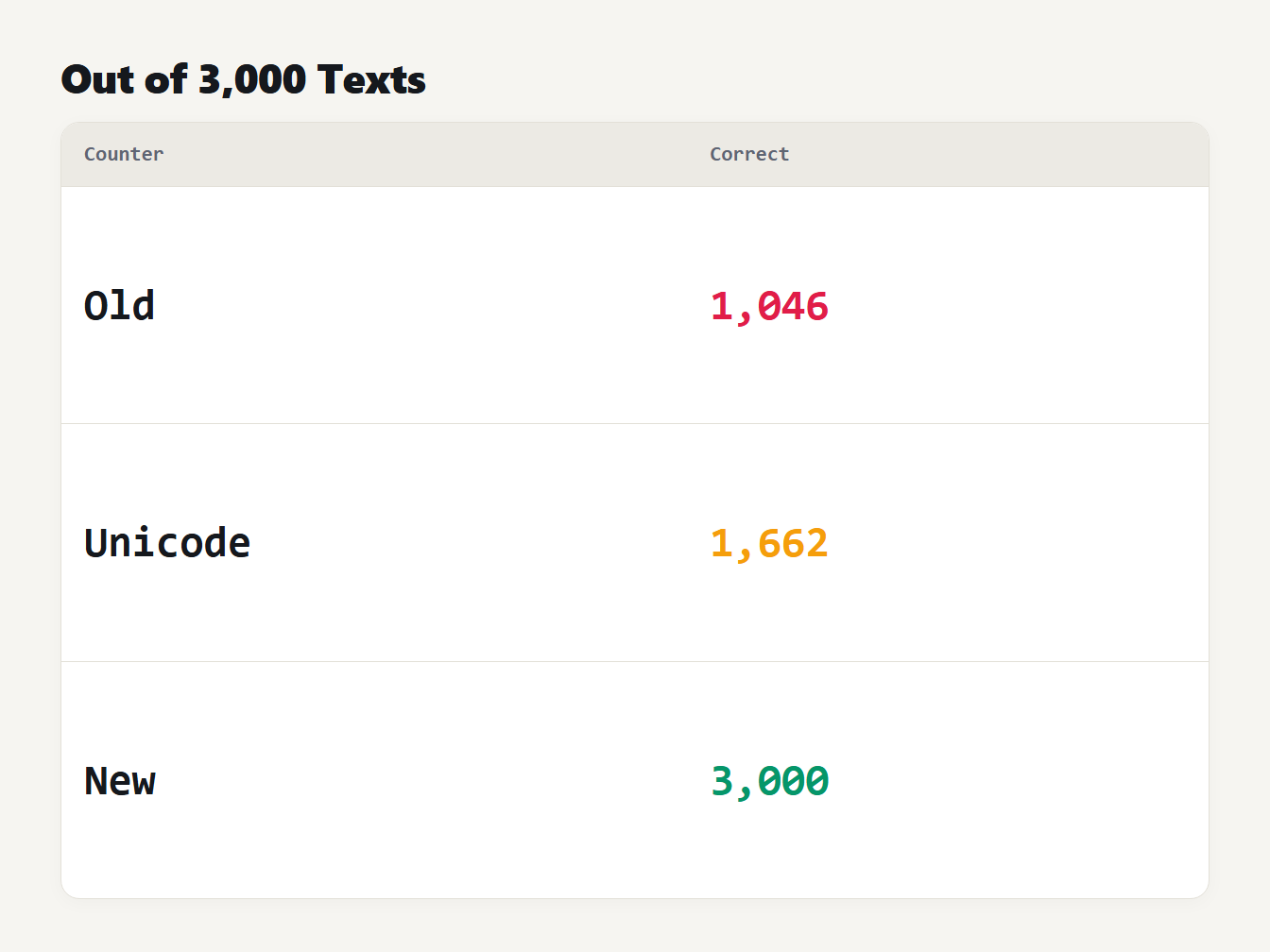
A table of how many of 3,000 test texts each counter counted correctly. The old counter got 1,046. The Unicode rules in the browser got 1,662. The new counter got 3,000.
That perfect score needs a caveat, and it is a big one. We wrote the pieces and the rules together, so the new counter was built to pass them. The figure shows that the rules are applied consistently, not that the counter is perfect. To be fairer, we wrote 14 harder cases, chosen to include the weak spots we expected. The old counter got 6 right, the Unicode rules 9, and the new counter 10.
Where it still goes wrong
A set of rules can't settle every case. These four of the 14 hard cases fail in our counter:
She joined the U.S. Army in 1990.is read as two sentences, because a capital letter followsU.S.I chose Plan B. Then I left.is read as one, becauseB.looks like an initial.Well... I suppose so.is read as two, because a capital letter follows the ellipsis.Jan. 5 was cold. Feb. 6 was warmer.is read as four, because the months aren't in the abbreviation list.
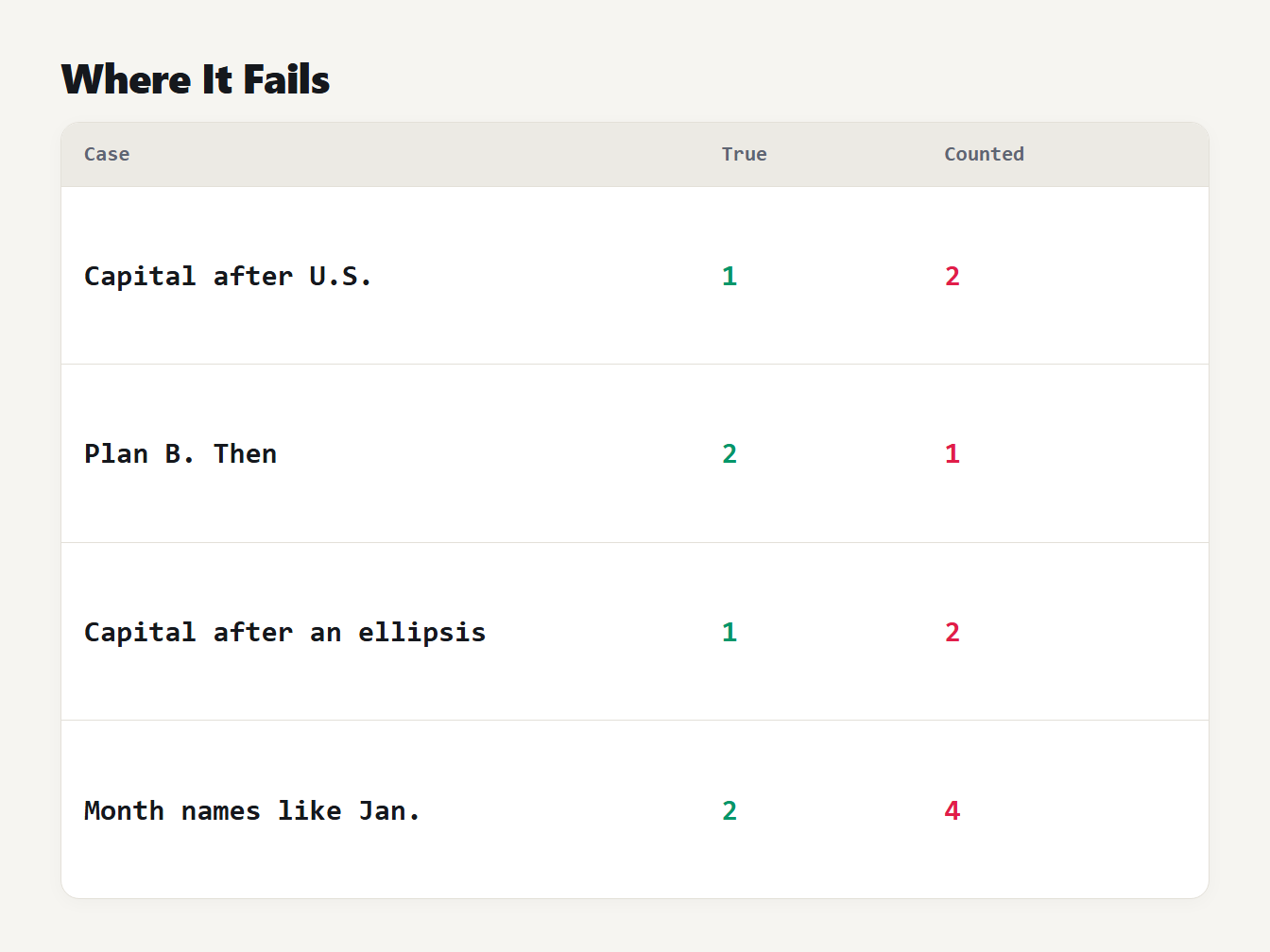
A table of four hard cases with the true sentence count and the new counter's count. A capital letter after U.S.: true 1, counted 2. A word like Plan B.: true 2, counted 1. A capital letter after an ellipsis: true 1, counted 2. Month names such as Jan.: true 2, counted 4.
If your text is full of such cases, check the count by eye, or turn the numbers into the figure you need with a small correction. The counter also treats a numbered list in the middle of a line as extra sentences, and it counts a list with one item per line as one sentence unless you tick the line-break box.
How to count sentences by hand
You can check any counter by hand, and the method is the same one the rules copy. Read the text and mark each place where one complete thought ends and the next begins. Ignore every full stop that sits inside a name, a title, an abbreviation or a number.
Then decide about the oddities: a heading is one sentence, a list item with a verb is one, and a quotation inside a sentence belongs to it. Count the marks. Doing this on a paragraph of your own text, then pasting the same paragraph into the counter, is a quick way to see whether the tool agrees with your reading and where your style produces edge cases.
Sentences and readability
The average words per sentence is a rough readability signal. Our word counter and the sentence count together give it, and the Readability Checker turns them into a grade. Our guide to the Flesch reading ease score explains the formula, which starts from the average sentence length. A sentence count that is too high, as the old counter's often was, makes text look easier than it is.
Frequently asked questions
How do you count sentences in a paragraph?
Count the full stops, question marks and exclamation marks that end a sentence, and ignore the ones that don't, such as those in Dr., e.g., 3.14 or an initial. A sentence counter applies those rules for you.
Does Dr. or e.g. end a sentence?
No. Titles such as Dr., Mr. and Prof., and words such as e.g., i.e. and vs., never end a sentence in our counter. After etc., Inc. and a.m., a sentence ends only if a capital letter follows.
How are Chinese and Japanese sentences counted?
The ideographic full stop and the fullwidth question and exclamation marks end a sentence, with no space needed after them. Text in those scripts is counted by those marks.
Does a heading count as a sentence?
Yes, if a blank line follows it. A blank line ends a sentence even without a full stop, so headings, captions and list items separated by blank lines are counted.
What is a good average sentence length?
There is no single right figure. Shorter sentences usually read more easily, and the average shows where yours run long. Compare it with other writing for the same readers.
Count your sentences now
Paste your text into the Sentence & Paragraph Counter, check the average, and look at the longest paragraphs first. Everything runs in your browser, so your text is never uploaded.