Morse Code Alphabet: Letters, Numbers, Timing and How It Works
The Morse code alphabet and numbers in one chart, plus the ITU timing rules, the PARIS speed standard and how to write SOS correctly.
By TheTextKit TeamPublished
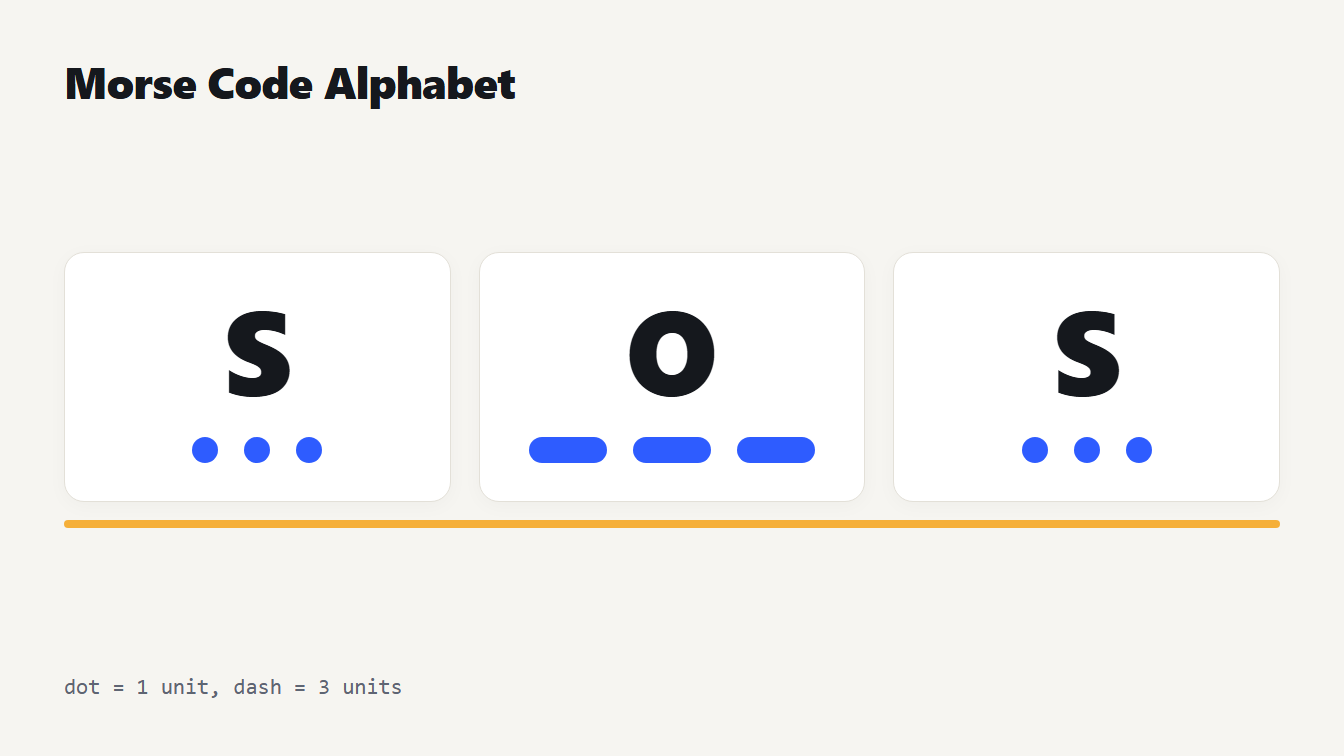
The letters S, O and S shown as dots and dashes: three dots, three dashes and three dots, with a dot lasting one time unit and a dash lasting three.
The Morse code alphabet gives every letter and digit a fixed pattern of dots and dashes: E is a single dot, T is a single dash, and every digit uses exactly five marks. A dash lasts three times as long as a dot, and the gaps between letters and words are timed too. The standard behind all of it is ITU-R M.1677-1, approved in October 2009. Below you get the full chart, the punctuation marks, the timing rules, the speed formula, the truth about SOS and a tested way to translate text.
The Morse code alphabet and numbers
These are the International Morse patterns for the 26 letters:
| Letter | Code | Letter | Code | Letter | Code |
|---|---|---|---|---|---|
| A | .- | J | .--- | S | ... |
| B | -... | K | -.- | T | - |
| C | -.-. | L | .-.. | U | ..- |
| D | -.. | M | -- | V | ...- |
| E | . | N | -. | W | .-- |
| F | ..-. | O | --- | X | -..- |
| G | --. | P | .--. | Y | -.-- |
| H | .... | Q | --.- | Z | --.. |
| I | .. | R | .-. |
The digits follow a pattern worth learning. The numbers 1 to 5 start with that many dots and fill the rest with dashes, and 6 to 9 start with that many dashes and fill the rest with dots:
| Digit | Code | Digit | Code |
|---|---|---|---|
| 1 | .---- | 6 | -.... |
| 2 | ..--- | 7 | --... |
| 3 | ...-- | 8 | ---.. |
| 4 | ....- | 9 | ----. |
| 5 | ..... | 0 | ----- |
The most common letters get the shortest codes: E is one dot and T is one dash.
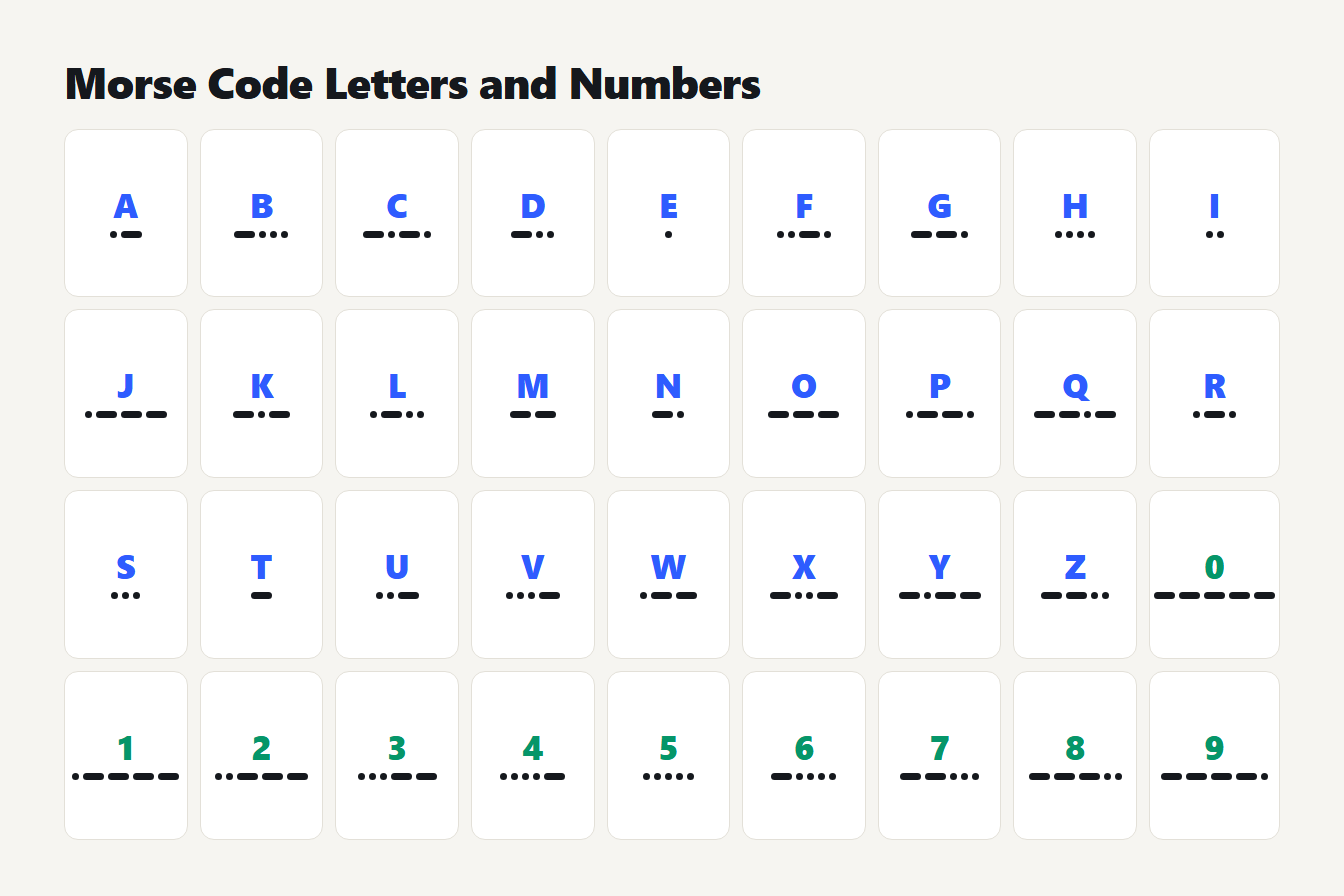
A grid of the 26 letters and 10 digits, each drawn as dots and short bars, with a dot as a small circle and a dash as a long bar.
Punctuation in Morse code
Punctuation has codes too. These 13 marks are in ITU-R M.1677-1, per the table on Wikipedia's Morse code page:
| Mark | Code | Mark | Code |
|---|---|---|---|
| Full stop . | .-.-.- | Colon : | ---... |
| Comma , | --..-- | Equals = | -...- |
| Question mark ? | ..--.. | Plus + | .-.-. |
| Apostrophe ' | .----. | Hyphen - | -....- |
| Slash / | -..-. | Quotation mark " | .-..-. |
| Left bracket ( | -.--. | At sign @ | .--.-. |
| Right bracket ) | -.--.- |
That same page marks the exclamation mark, ampersand, semicolon, underscore and dollar sign as nonstandard. People use them anyway, and our translator includes all five. A message with an exclamation mark will translate, but it may not decode on another reader's chart. Note that the ampersand's code, .-..., is also the code for the AS prosign, which means wait.
Prosigns
Operators also use procedural signals, which are sent as one unit with no gaps between their letters. The ones listed in Wikipedia's prosign table include:
| Prosign | Meaning | Code |
|---|---|---|
| K | General invitation to transmit | -.- |
| CT | Transmission start signal | -.-.- |
| RN | Next message follows | .-.-. |
| SN | Verified | ...-. |
| AS | Wait | .-... |
| SK | End of work | ...-.- |
| HH | Error | eight dots |
Morse code timing: dots, dashes and gaps
Morse is rhythm as much as symbols. Everything is measured in one basic time unit, and Wikipedia's description of the standard timing gives these lengths:
| Element | Length in units |
|---|---|
| Dot | 1 |
| Dash | 3 |
| Gap between marks inside a letter | 1 |
| Gap between letters | 3 |
| Gap between words | 7 |
Take the letters S, O, S. S is three dots with two one-unit gaps between them, so 5 units. O is three dashes with two gaps, so 11. Add two letter gaps of 3 each and the whole message is 5 + 3 + 11 + 3 + 5 = 27 units.
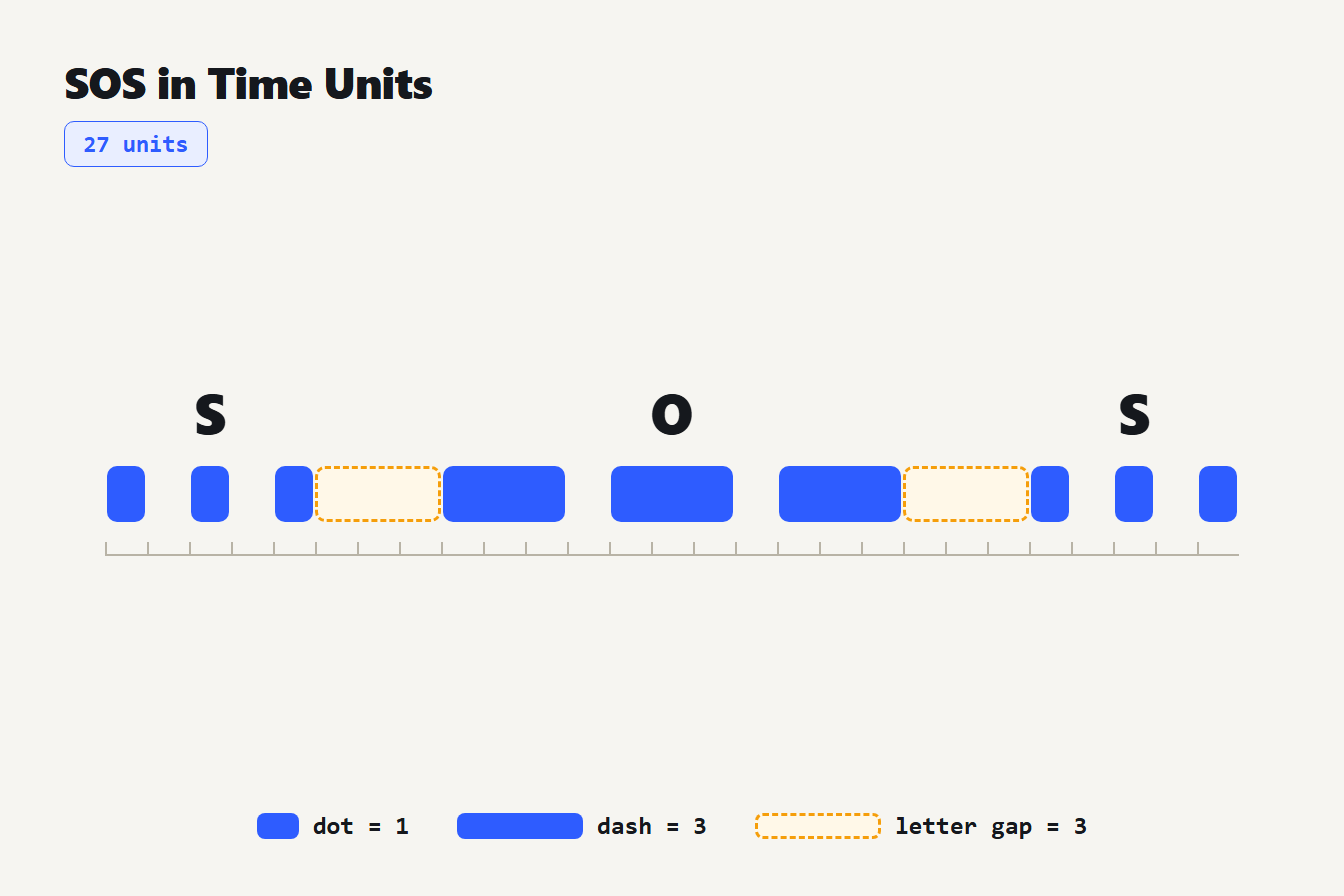
The letters S, O and S laid out on a timeline: three dots of 1 unit, a 3 unit letter gap, three dashes of 3 units, another 3 unit gap and three more dots, 27 units in total.
Morse code speed: words per minute
Because everything is built from one unit, speed is easy to define. The standard test word is PARIS, which comes to exactly 50 units including the gap after it. Wikipedia gives the conversion: the unit time in milliseconds is 1200 divided by the speed in words per minute.
| Speed | Unit | PARIS | SOS |
|---|---|---|---|
| 5 WPM | 240 ms | 12.0 s | 6.48 s |
| 10 WPM | 120 ms | 6.0 s | 3.24 s |
| 15 WPM | 80 ms | 4.0 s | 2.16 s |
| 20 WPM | 60 ms | 3.0 s | 1.62 s |
| 25 WPM | 48 ms | 2.4 s | 1.30 s |
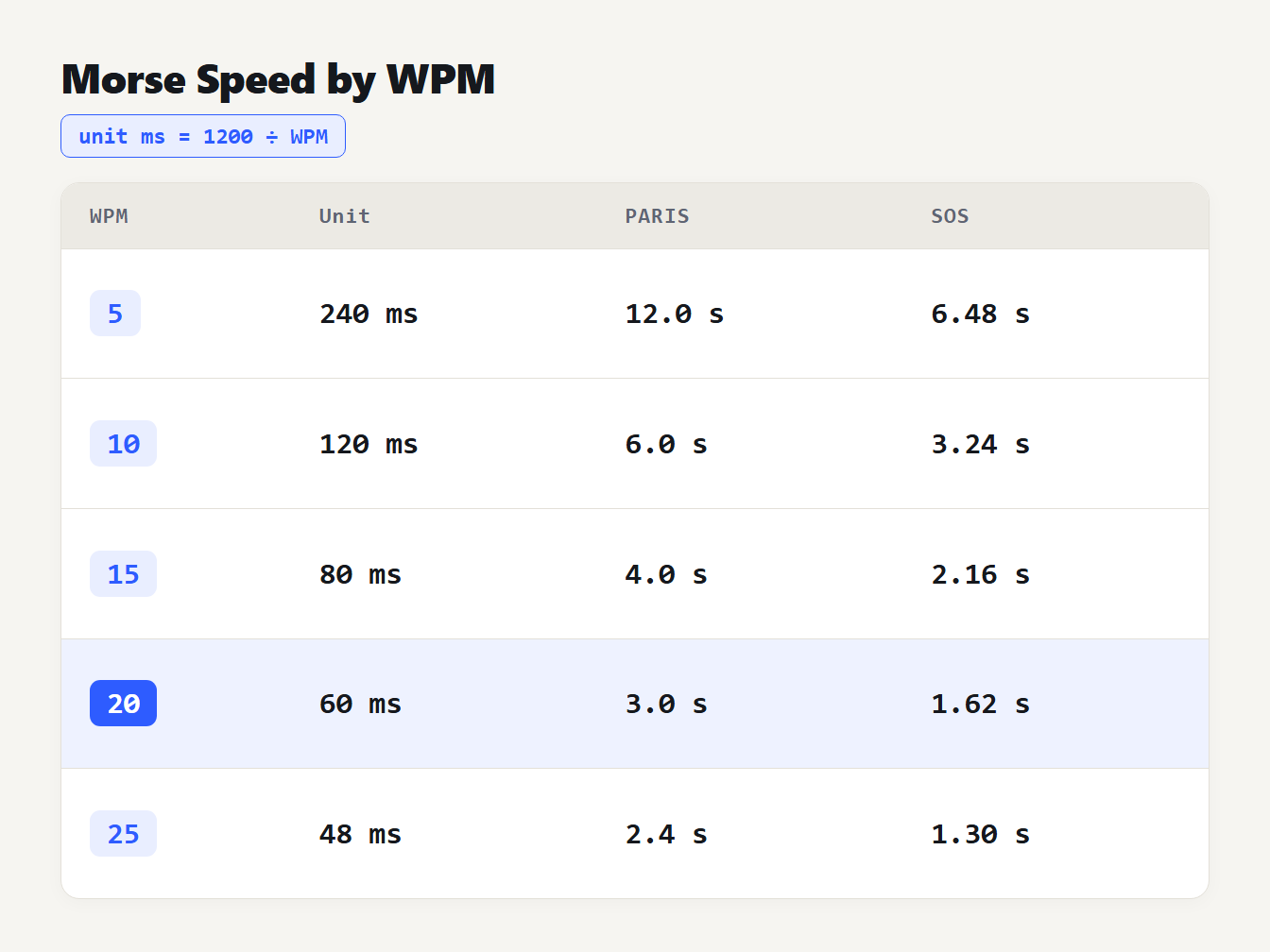
At 5 WPM a unit is 240 ms, PARIS takes 12.0 seconds and SOS takes 6.48. At 10 WPM: 120 ms, 6.0 s and 3.24 s. At 15: 80 ms, 4.0 s and 2.16 s. At 20: 60 ms, 3.0 s and 1.62 s. At 25: 48 ms, 2.4 s and 1.30 s.
SOS is a prosign, not three letters
Here is a detail that surprises people. SOS is not really the letters S, O and S. Wikipedia explains that it is sent as a single prosign, keyed without gaps between the characters, to mean the start of a distress message. Written out, the prosign is ...---..., while the three-letter spelling is ... --- ....
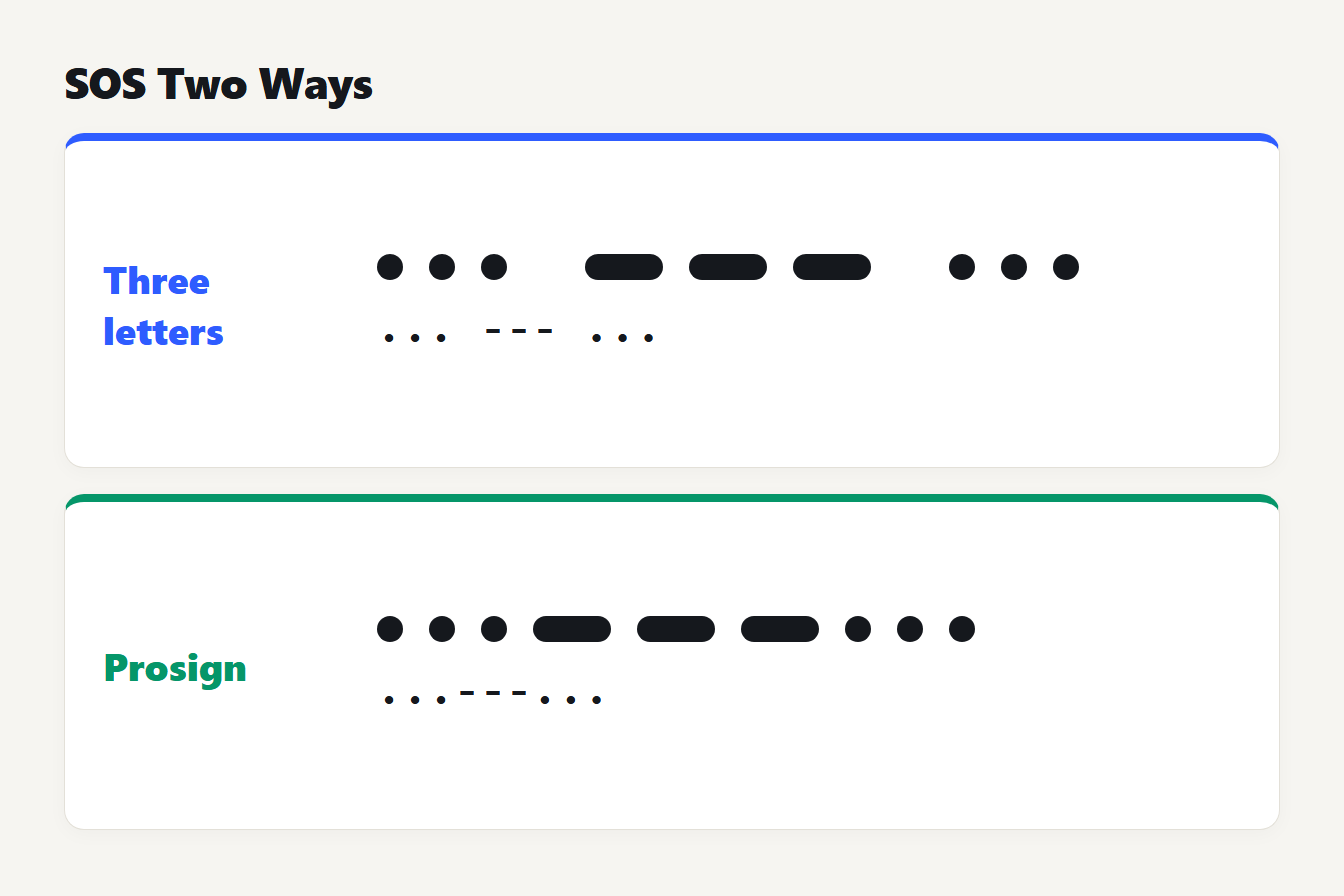
Spelled as three letters, SOS is written ... --- ... with a gap between letters. Sent as the prosign, it is written ...---... with no gaps between the characters.
The Morse Code Translator follows the letter-by-letter convention: type SOS and you get ... --- .... That is the right form for reading and writing about Morse. If you are keying a real signal, run the characters together.
The Morse code alphabet in plain text: spaces and slashes
Plain text needs two conventions that sound does not: a space between letters and a slash between words. So HI THERE becomes .... .. / - .... . .-. .. The translator reads a vertical bar or three or more spaces between words as well, and it ignores capitals, so sos and SOS give the same result.
The gaps carry real information. Two dots with a one-unit gap are the letter I, written ... The same two dots with a three-unit gap are two separate letters, E and E, written . .. The marks are identical and only the spacing differs.
Decode a message by hand
Try one yourself before you use the tool. Split the string at the slash into words, then at the spaces into letters, and look each pattern up in the chart:
.-- . -... / ... .. - .
The first word is .--, ., -..., which is W, E and B. The second is ..., .., -, ., which is S, I, T and E. The message is WEB SITE. You can check any message of your own by pasting it into the Morse Code Translator.
Using the Morse code translator
The tool translates in both directions and auto-detects which way you are going. We tested it against the standard rather than trusting our own copy:
- Letters, digits and ITU punctuation. All 36 letter and digit codes and all 13 ITU punctuation codes match the standard patterns.
- Round trips. Every one of its 54 supported characters survived text to Morse and back.
- Audio timing. We ran the tool's real playback scheduler against the unit rules. SOS plays for 1.62 seconds, 27 units at 60 ms, and PARIS PARIS for 5.58 seconds, 93 units, because there is no gap after the final word.
Two behaviors to know. Anything made only of dots, dashes and slashes is treated as Morse, so a lone . is read as the letter E rather than a full stop, and the direction buttons override the guess. And characters without a Morse pattern are skipped: café translates to -.-. .- ..-. with the é left out.
If you like seeing text in other encodings, our text to binary guide shows the same idea with bits, and the Text to Binary Translator converts any text in your browser.
Mistakes that garble Morse code
- Dropping the spaces. Without a gap between letters,
...---...could be SOS, or a dozen other strings. - Forgetting the word separator. Letters need a space and words need a slash, or the words run together.
- Counting the gaps wrong. A gap inside a letter is 1 unit, between letters 3 and between words 7. Sending all gaps the same length is the commonest beginner error.
- Expecting accents. Characters like é have no ITU code, so a translator has to skip or substitute them.
- Trusting nonstandard marks. An exclamation mark or dollar sign may not be understood by another reader.
Frequently asked questions
What is SOS in Morse code?
Three dots, three dashes and three dots: ... --- ... Sent as a real distress signal, SOS is a prosign keyed without gaps between the characters, written ...---... Typed into a translator, it is usually spelled letter by letter with spaces.
How long is a dash compared with a dot?
Three times as long. In International Morse a dot is one time unit and a dash is three. Gaps are one unit inside a letter, three between letters and seven between words.
What is the official Morse code standard?
The ITU publishes it as Recommendation ITU-R M.1677-1, International Morse code, approved on 3 October 2009 and still in force. It defines the letters, digits, punctuation and timing used worldwide.
Does Morse code have accented letters?
Almost none. Wikipedia notes that nonstandard punctuation, characters with diacritics and non-Latin letters are not part of ITU-R M.1677-1, except for the letter E with an ogonek. Our translator skips unsupported characters.
How fast is 20 words per minute in Morse code?
At 20 words per minute one time unit is 60 milliseconds, from the formula 1200 divided by the speed. The standard word PARIS is 50 units, so each word takes 3 seconds. A dot lasts 60 ms and a dash 180 ms.
Translate a message
Once you know the Morse code alphabet, the rest is rhythm and practice. Type your name into the Morse Code Translator, press play and listen at 20 words per minute. Then count the units in a short word yourself and compare with the table above. The ITU's own page for the standard is here: ITU-R M.1677-1, International Morse code. To spell a name aloud instead of keying it, try the NATO Phonetic Alphabet Converter.