NATO Phonetic Alphabet: Full Chart, Numbers and How to Spell Words
The NATO phonetic alphabet from Alfa to Zulu, with pronunciation, the number words Tree, Fower, Fife and Niner, how to spell names and codes, and its history.
By TheTextKit TeamPublished
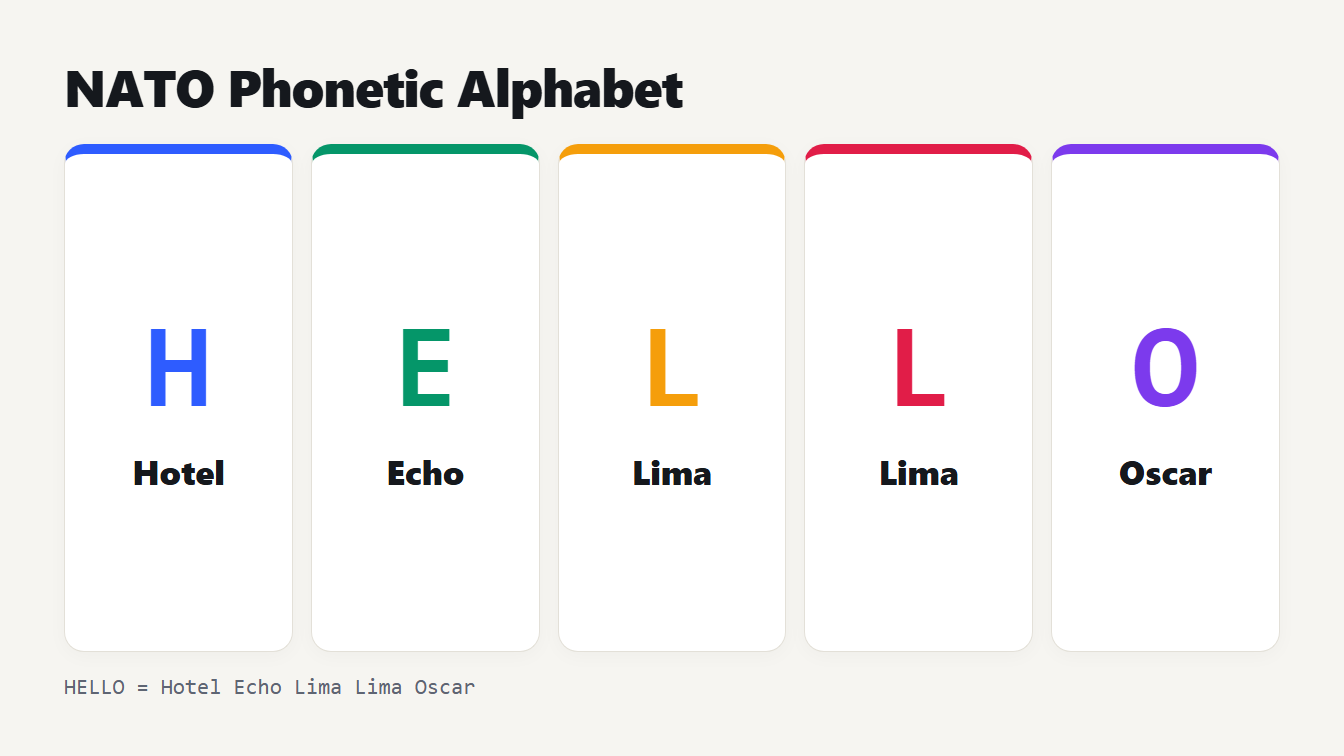
Five cards, one per letter of HELLO, each showing the letter and its code word: Hotel, Echo, Lima, Lima and Oscar.
The NATO phonetic alphabet gives each letter of the alphabet a code word so it can be understood over a bad phone line or radio. A is Alfa, B is Bravo, C is Charlie, and so on to Z, Zulu. It is formally the ICAO spelling alphabet, and numbers have their own words, such as Tree for 3 and Niner for 9. Below you get the full chart with pronunciation, the number words, a method for spelling anything, and the history behind the odd spellings.
The NATO phonetic alphabet chart
These are the 26 code words with the respelled pronunciation from Wikipedia's NATO phonetic alphabet article. Capital letters mark the stressed syllable.
| Letter | Code word | Say it | Letter | Code word | Say it |
|---|---|---|---|---|---|
| A | Alfa | AL FAH | N | November | NO VEM BER |
| B | Bravo | BRAH VOH | O | Oscar | OSS CAH |
| C | Charlie | CHAR LEE | P | Papa | PAH PAH |
| D | Delta | DELL TAH | Q | Quebec | KEH BECK |
| E | Echo | ECK OH | R | Romeo | ROW ME OH |
| F | Foxtrot | FOKS TROT | S | Sierra | SEE AIR RAH |
| G | Golf | GOLF | T | Tango | TANG GO |
| H | Hotel | HOH TELL | U | Uniform | YOU NEE FORM |
| I | India | IN DEE AH | V | Victor | VIK TAH |
| J | Juliett | JEW LEE ETT | W | Whiskey | WISS KEY |
| K | Kilo | KEY LOH | X | X-ray | ECKS RAY |
| L | Lima | LEE MAH | Y | Yankee | YANG KEY |
| M | Mike | MIKE | Z | Zulu | ZOO LOO |
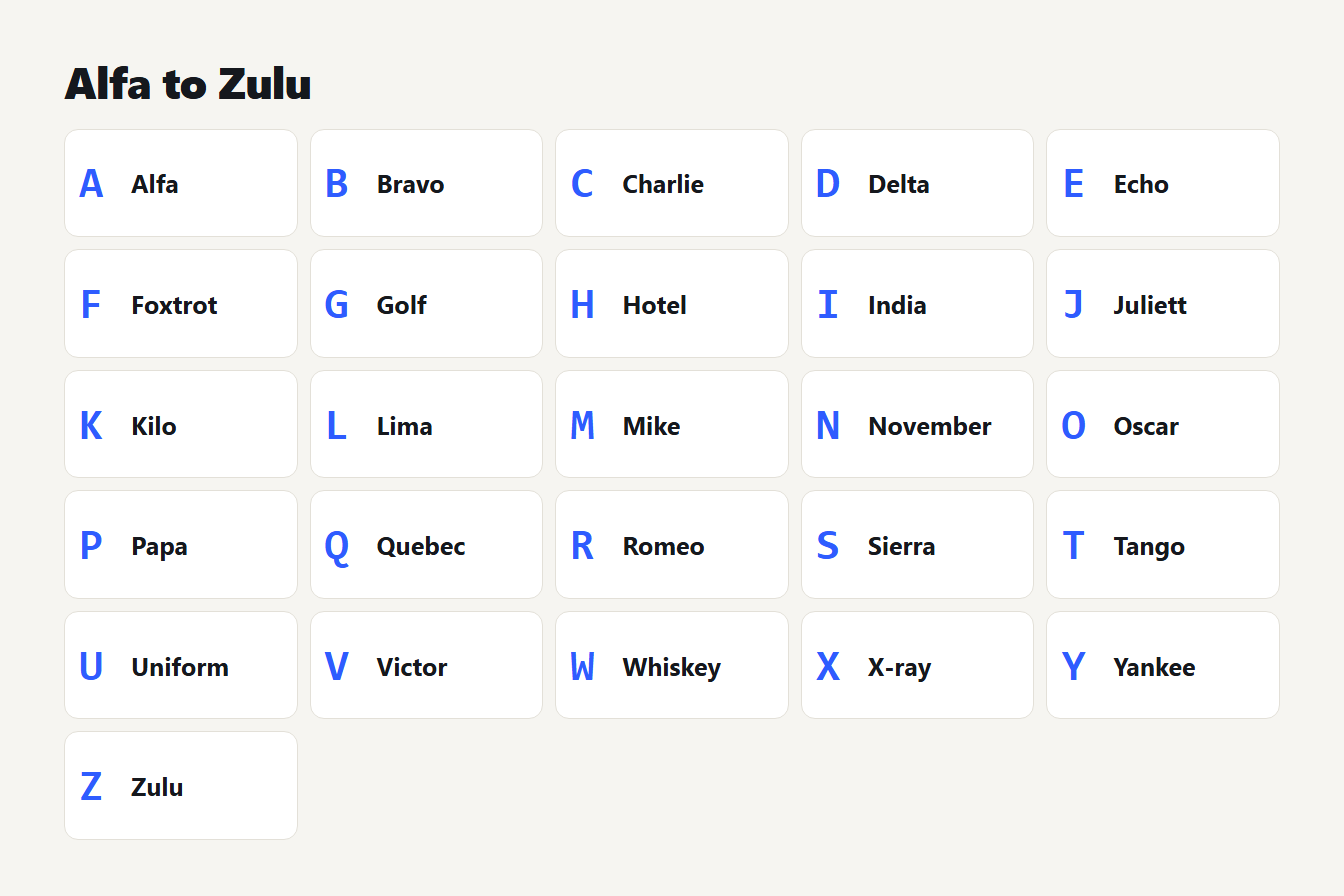
A grid of the 26 letters with their code words: Alfa, Bravo, Charlie, Delta, Echo, Foxtrot, Golf, Hotel, India, Juliett, Kilo, Lima, Mike, November, Oscar, Papa, Quebec, Romeo, Sierra, Tango, Uniform, Victor, Whiskey, X-ray, Yankee and Zulu.
Charlie has two accepted pronunciations, CHAR LEE and SHAR LEE. The sources do not agree on how to write the X word. NATO's own page hyphenates it as X-ray, while some lists write one word, Xray. Either is read as ECKS RAY, and our converter accepts both.
Numbers in the phonetic alphabet
Digits use modified English pronunciations so they are not misheard, according to the same Wikipedia article:
| Digit | Say it | Digit | Say it |
|---|---|---|---|
| 0 | Zero | 5 | FIFE |
| 1 | One | 6 | Six |
| 2 | Two | 7 | Seven |
| 3 | TREE | 8 | Eight |
| 4 | FOW-ER | 9 | NIN-ER |
Three, four, five and nine are the changed ones. Nine becomes Niner, and the extra syllable separates it from the German word nein. The same list adds Decimal for a decimal point, and Hundred and Thousand for round numbers. Maritime radio under the ITU and IMO has a separate set of number words, such as Nadazero and Unaone, which this chart does not use.
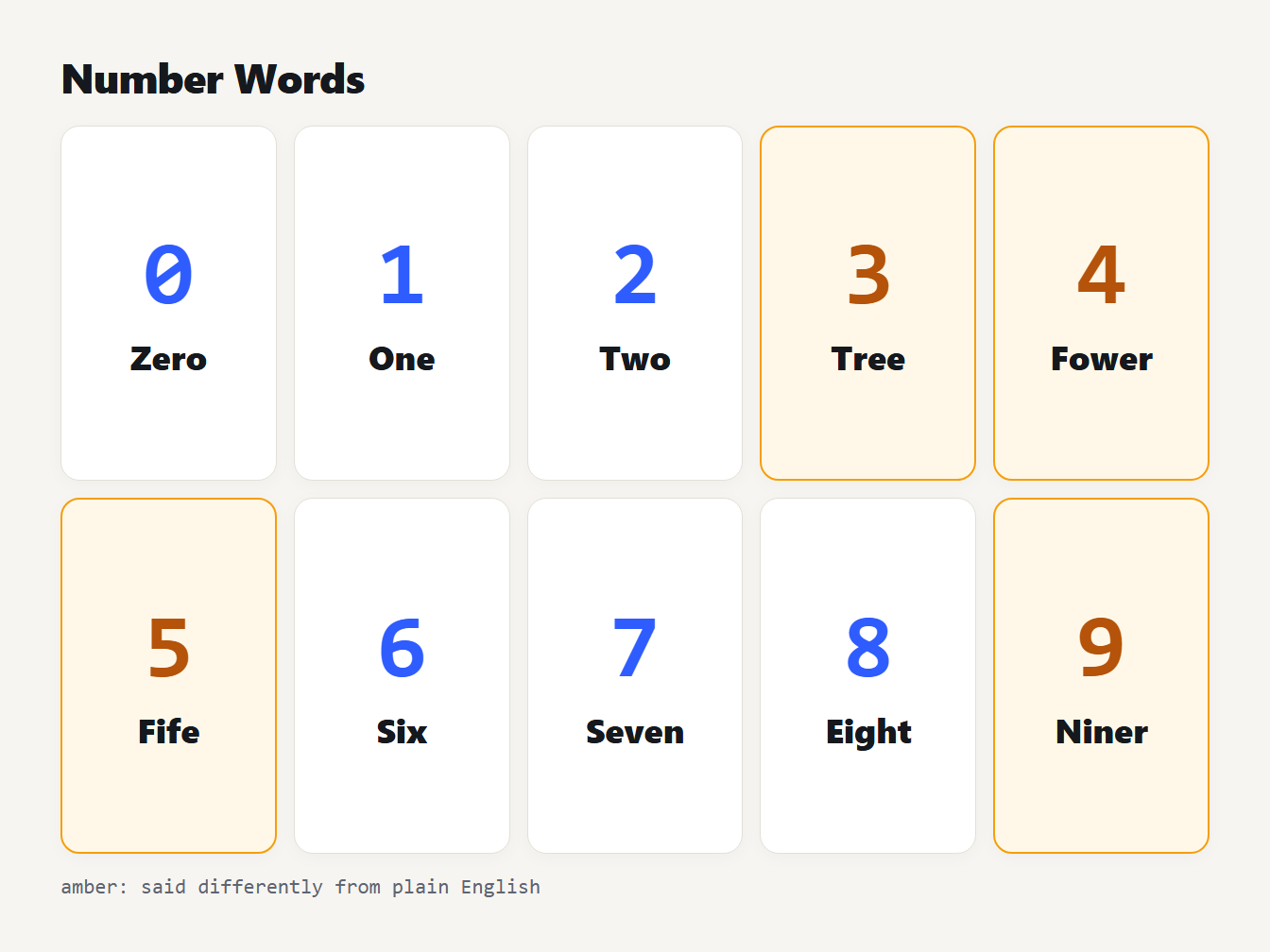
Ten tiles for the digits 0 to 9 with the radio words Zero, One, Two, Tree, Fower, Fife, Six, Seven, Eight and Niner. The four changed words are highlighted.
How to spell a word with the NATO alphabet
The method is the same for a name, a booking reference or a car registration:
- Say each character as its code word, in order.
- Pause briefly between words in the original text. In writing we use a slash.
- Say digits with the number words, so 9 is Niner.
- Skip punctuation, or name it plainly if it matters, such as dash.
We ran a few through the NATO Phonetic Alphabet Converter:
| Text | Spelled out |
|---|---|
| Hello | Hotel Echo Lima Lima Oscar |
| Hello 2026 | Hotel Echo Lima Lima Oscar / Two Zero Two Six |
| AB12 K9 | Alfa Bravo One Two / Kilo Niner |
| NATO 1956 | November Alfa Tango Oscar / One Niner Fife Six |
| Zoë | Zulu Oscar Echo |
The last row shows how accents are handled: the converter spells é as its base letter E, and characters with no code word, such as a hyphen, are kept as typed and listed.
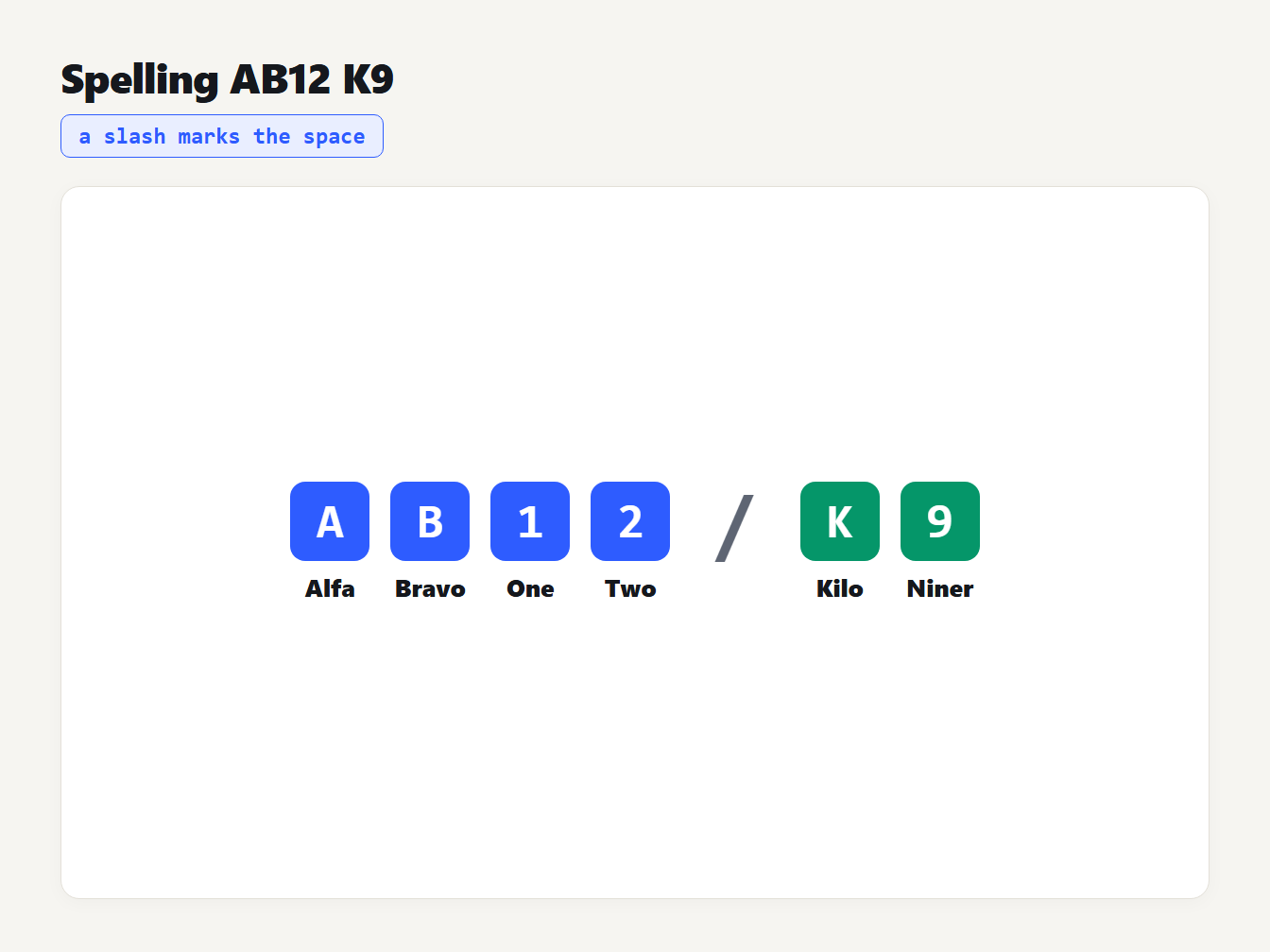
The reference AB12 K9 spelled as Alfa Bravo One Two, a slash for the space, then Kilo Niner.
Spelling plates, postcodes and codes
Real references mix letters, digits and the odd symbol, which is where mistakes happen. The converter produced these:
| Text | Spelled out |
|---|---|
| KX19 ABC | Kilo X-ray One Niner / Alfa Bravo Charlie |
| SW1A 1AA | Sierra Whiskey One Alfa / One Alfa Alfa |
| JB 007 | Juliett Bravo / Zero Zero Seven |
| Q4 2026 | Quebec Fower / Two Zero Two Six |
| 9F3T-Q8 | Niner Foxtrot Tree Tango - Quebec Eight |
The last row shows a symbol. The alphabet has no code word for a hyphen or a dot, so the converter keeps them as typed and lists them. When you say them aloud, name them in plain words, such as dash or dot, and say the digits as above. Letters that sound alike on a poor line, such as B, D, P and T, or M and N, are the ones worth spelling out first, even if you say the rest normally.
Why Alfa and Juliett are spelled that way
The two odd spellings are deliberate. Per Wikipedia, Alfa and Juliett are spelled to prevent mispronunciation by speakers of other languages. Alfa drops the ph of Alpha, and Juliett adds a second t. Everyday writing usually uses Alpha and Juliet, which is why our converter has a switch for them.
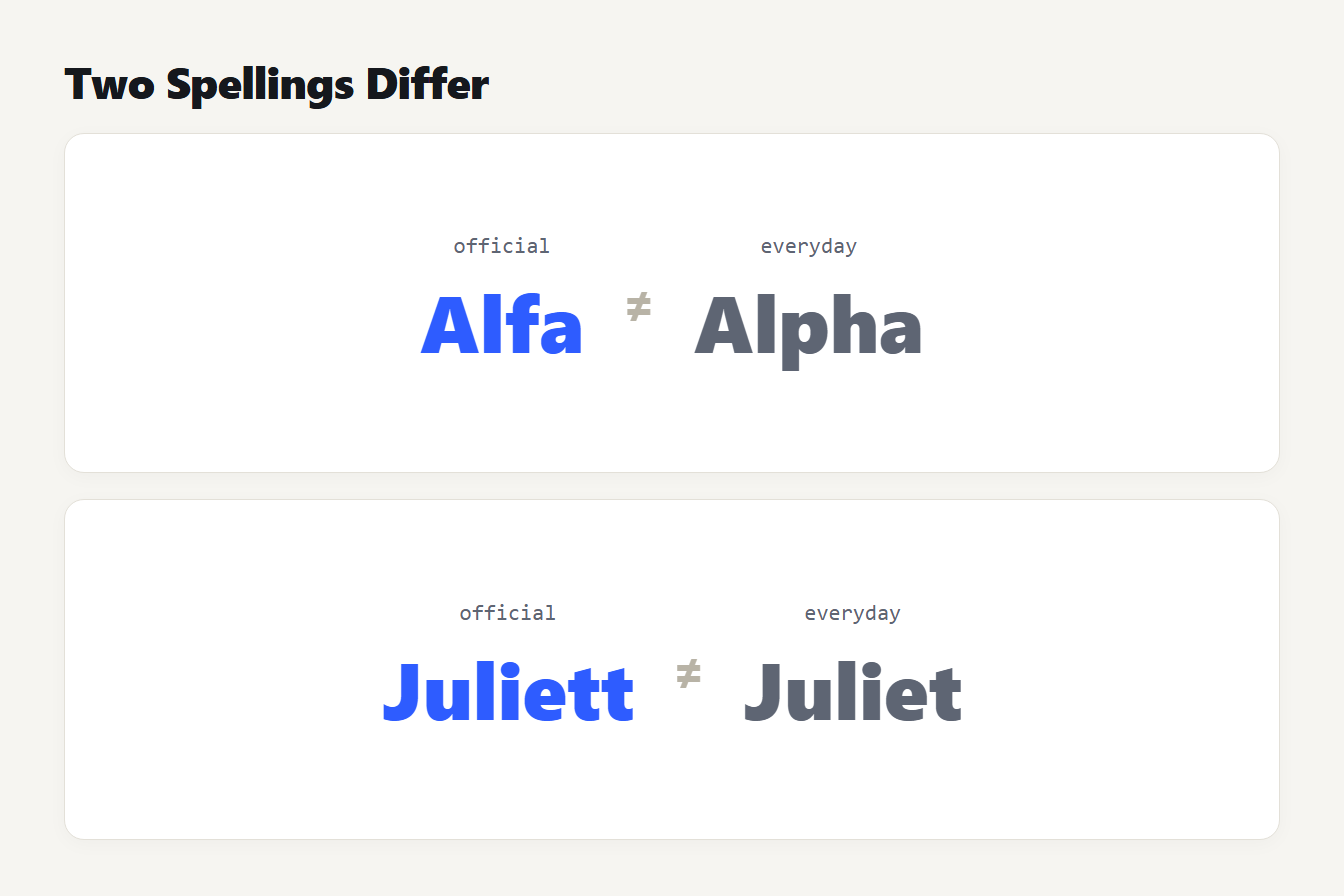
Two pairs. The official spelling Alfa sits next to the everyday Alpha, and the official Juliett sits next to the everyday Juliet.
A short history of the spelling alphabet
Earlier systems such as the Able Baker alphabet were used in World War II. Wikipedia says Jean-Paul Vinay, a linguistics professor at the Université de Montréal, worked with the ICAO between 1948 and 1949 to research a new one, and tests involved speakers from 31 nations. A 1951 version caused trouble: Delta was confused with Extra, and Nectar with Victor. The revised alphabet became official in 1956, with Nectar replaced by November. NATO's own page says NATO set up the alphabet that year after reviewing the 1951 version, and that it became known as the NATO phonetic alphabet.
Where it is used, and tips for clear spelling
Pilots, air traffic controllers, the military, emergency services and customer support teams use it for names, plates, tickets and codes. A few habits make it work:
- Use the official words. Inventing your own, such as A as in apple, defeats the purpose, because the listener cannot check it against a known list.
- Slow down on digits. Say Niner, not nine, if the listener knows the radio forms. Otherwise say the plain digit and be ready to repeat it.
- Read it back. Ask the other person to say the spelling back to you.
- Do not mix it up with Morse code. Morse is a signal made of dots and dashes. Our Morse code alphabet guide covers it, and the Morse Code Translator plays it.
It is also worth being clear about what the spelling alphabet is not. It is not a cipher, because anyone can read it. It is not a language, because it only names letters and digits. And the code words are not abbreviations: Alfa stands for the letter A and nothing more, so a pilot who says Bravo means the letter B, never the word.
Convert text with the NATO alphabet tool
The converter handles both directions. Type text to get code words, or paste code words to get text back. It accepts either spelling in any case, treats a slash or a new line as a space, and reports any word it does not recognise. You can switch to the plain digits Three, Four, Five and Nine, and copy the result. Everything runs in your browser. For other ways to write the same message, see the Text to Binary Translator.
Frequently asked questions
What is the NATO phonetic alphabet?
A list of 26 code words, one per letter, from Alfa to Zulu, made so letters are not confused over a poor phone or radio link. It is formally the ICAO spelling alphabet, and NATO adopted it in 1956.
How do you say numbers in the NATO phonetic alphabet?
Zero, One, Two, Tree, Fower, Fife, Six, Seven, Eight and Niner. Three, four, five and nine are said in modified ways so they are not misheard. Decimal, Hundred and Thousand are also used.
Why is it spelled Alfa and Juliett?
The unusual spellings are there to prevent mispronunciation by speakers of other languages. Alfa avoids the ph of Alpha, and Juliett has two t letters. Everyday text often uses Alpha and Juliet instead.
Is the NATO alphabet the same as the military alphabet?
Yes, in practice. People also call it the military alphabet, the ICAO alphabet or the radio alphabet. Older systems such as the Able Baker alphabet were used in World War II but are no longer standard.
How do I spell my name with the phonetic alphabet?
Say the code word for each letter in order, and pause between words. For Zoe, say Zulu Oscar Echo. Type the name into a converter to see the full spelling and copy it.
Practice with your own name
Spell your full name and a reference number aloud, then check yourself against the NATO Phonetic Alphabet Converter. Do it twice and you will remember the words you use most, which is all most people ever need. If you work with a team, agree on one spelling for Alfa, Juliett and X-ray so nobody has to guess.